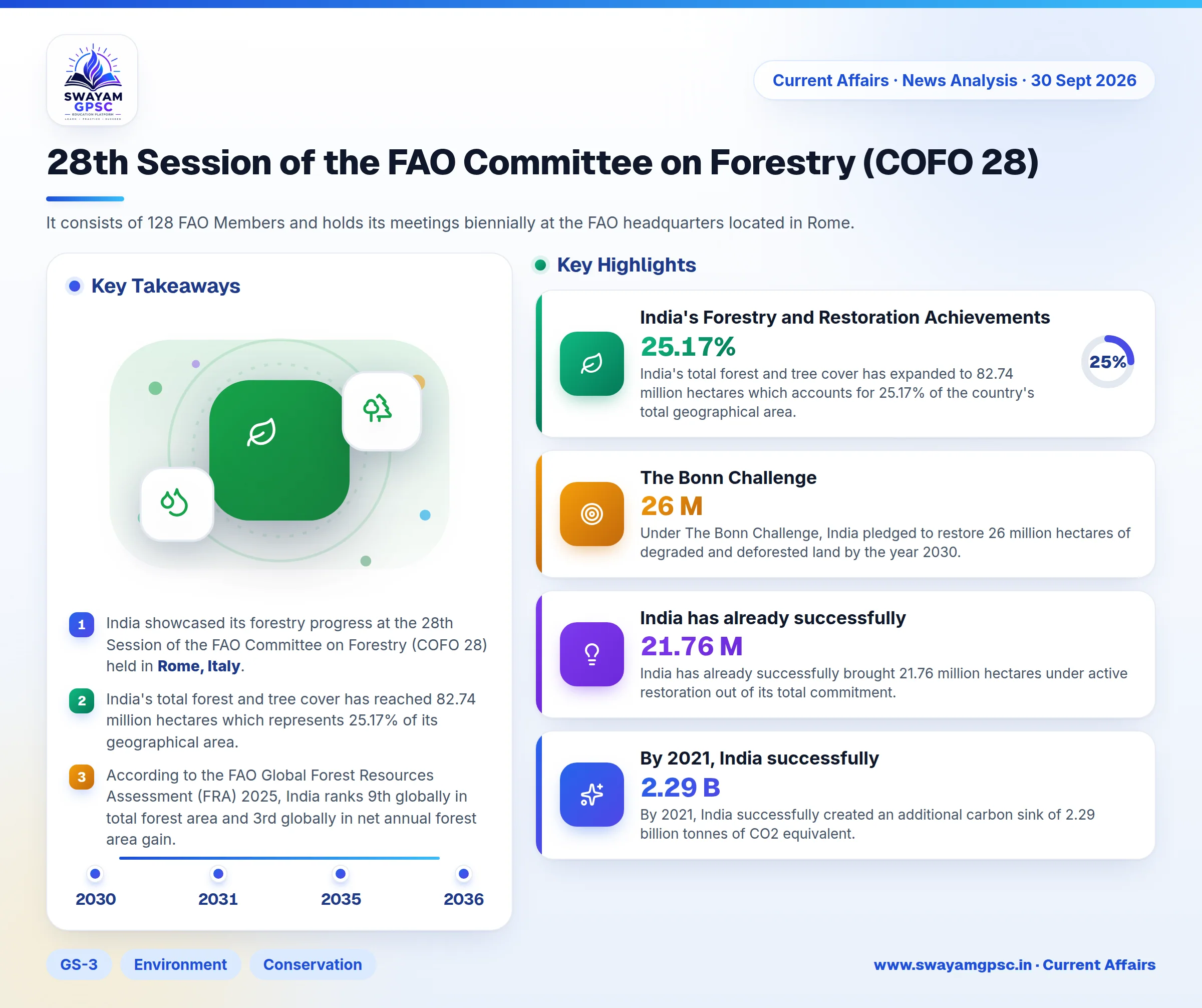
28th Session of the FAO Committee on Forestry (COFO 28)
#GS-3 #Environment #Conservation #Climate Change #Current Events #International
Key takeaways
- India showcased its forestry progress at the 28th Session of the FAO Committee on Forestry (COFO 28) held in Rome, Italy.
- India's total forest and tree cover has reached 82.74 million hectares which represents 25.17% of its geographical area.
- According to the FAO Global Forest Resources Assessment (FRA) 2025, India ranks 9th globally in total forest area and 3rd globally in net annual forest area gain.
- India has successfully restored 21.76 million hectares of degraded land out of its 26 million hectares target under The Bonn Challenge by 2030.
- India's upgraded Nationally Determined Contribution (2031 to 2035) aims to build a cumulative carbon sink of 3.5 to 4.0 billion tonnes by 2035.
Why in News
- India recently presented its major milestones in sustainable forest management, ecological restoration, and climate action during a global meeting.
- The country shared these achievements at the 28th Session of the FAO Committee on Forestry (COFO 28) held in Rome, Italy.
About Committee on Forestry
- The Committee on Forestry (COFO) serves as the highest-level global intergovernmental statutory body dedicated to forestry within the FAO.
- It consists of 128 FAO Members and holds its meetings biennially at the FAO headquarters located in Rome.
- The committee identifies emerging policy and technical issues, finds solutions, and advises the FAO and member nations on sustainable forest management.
- It plays a vital role in shaping the agendas for the UN Decade on Ecosystem Restoration (2021 to 2030) and the proposed UN Decade for Afforestation and Reforestation (2027 to 2036).
- The theme for the COFO 28 session was Forests for food, resilience and prosperity which helped India showcase its climate commitments, biodiversity finance, and landscape restoration.
- During the session, India highlighted Sustainable Forest Management (SFM) as an integrated system for restoring landscapes while balancing local community needs and national conditions.
India's Forestry and Restoration Achievements
- India's total forest and tree cover has expanded to 82.74 million hectares which accounts for 25.17% of the country's total geographical area.
- According to the FAO Global Forest Resources Assessment (FRA) 2025, India ranks 9th globally in total forest area and 3rd globally in net annual forest area gain.
- Under The Bonn Challenge, India pledged to restore 26 million hectares of degraded and deforested land by the year 2030.
- India has already successfully brought 21.76 million hectares under active restoration out of its total commitment.
- By 2021, India successfully created an additional carbon sink of 2.29 billion tonnes of CO2 equivalent.
- India ranked 5th among the top global carbon sinks by removing 150 Mt of CO2 per year through its forests during the years 2021 to 2025.
- India upgraded its Nationally Determined Contribution (2031 to 2035) target to achieve a cumulative sink of 3.5 to 4.0 billion tonnes by 2035 compared to the baseline year of 2005.
- The Aravalli Green Wall Project aims to restore 6.45 million hectares of degraded arid land across Gujarat, Rajasthan, Haryana, and Delhi to stop desertification.
- The MISHTI scheme, also known as the Mangrove Initiative for Shoreline Habitats and Tangible Incomes, is actively restoring coastal ecosystems to improve climate resilience and local incomes.
- India has expanded its network of internationally recognized Ramsar Sites to a total of 101 designated wetlands.
- The Ek Ped Maa Ke Naam campaign, also known as Plant4Mother, mobilized the public to plant more than 3.5 billion saplings across the country.