26th Shanghai Cooperation Organisation Summit in Bishkek
#GS-2 #Current Events #International #International Relations #Important International Institutions #Shanghai Cooperation Organisation #Regional Anti-Terrorist Structure #Bishkek Declaration #Strategic Autonomy #Connect Central Asia Policy #Prelims
Key takeaways
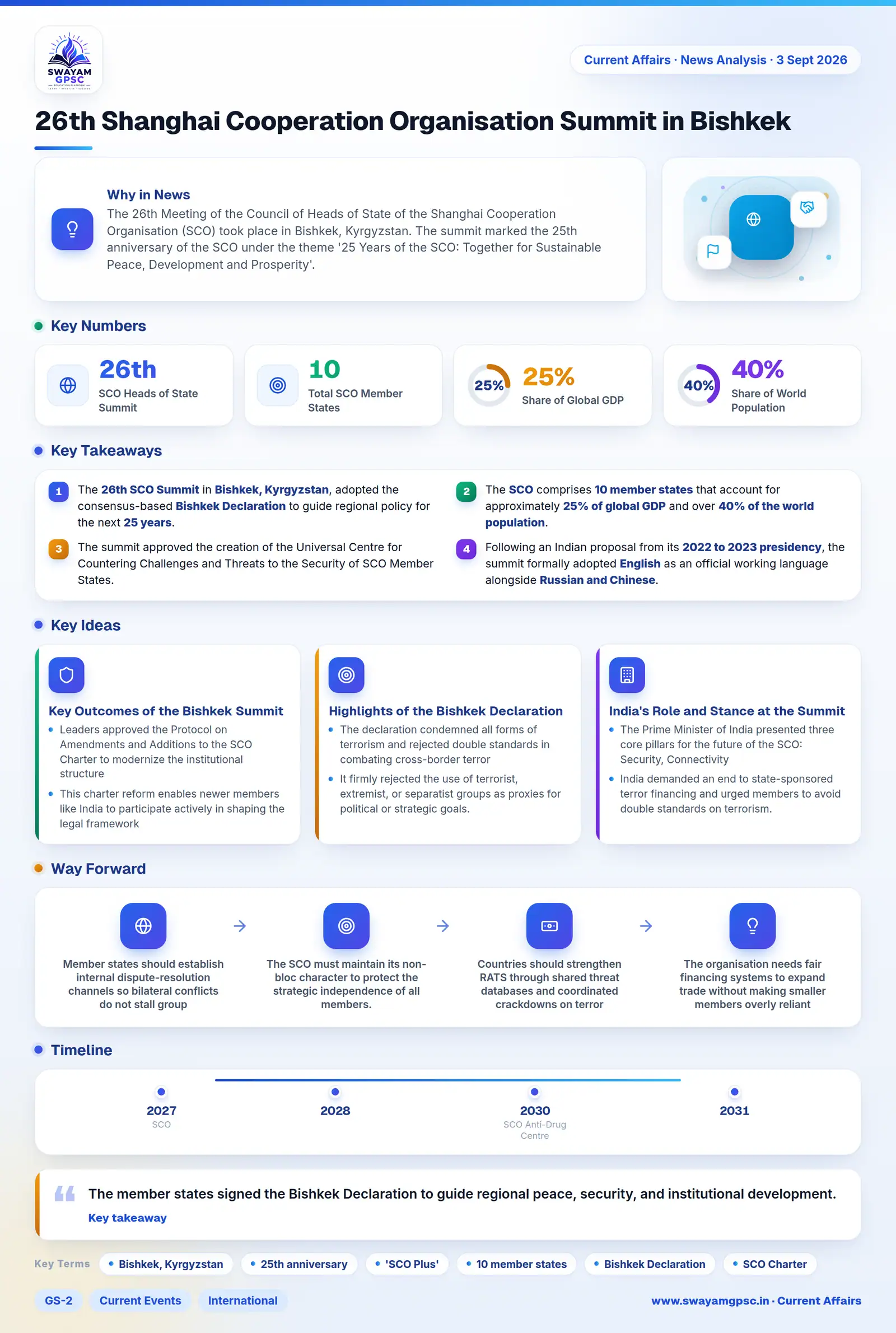
- The 26th SCO Summit in Bishkek, Kyrgyzstan, adopted the consensus-based Bishkek Declaration to guide regional policy for the next 25 years.
- The SCO comprises 10 member states that account for approximately 25% of global GDP and over 40% of the world population.
- The summit approved the creation of the Universal Centre for Countering Challenges and Threats to the Security of SCO Member States.
- Following an Indian proposal from its 2022 to 2023 presidency, the summit formally adopted English as an official working language alongside Russian and Chinese.
- The rotating chairmanship of the SCO for 2026 to 2027 passed to Pakistan, with Lahore named the SCO Tourism and Cultural Capital.
Why in News
- The 26th Meeting of the Council of Heads of State of the Shanghai Cooperation Organisation (SCO) took place in Bishkek, Kyrgyzstan.
- The summit marked the 25th anniversary of the SCO under the theme '25 Years of the SCO: Together for Sustainable Peace, Development and Prosperity'.
- Kyrgyzstan also hosted the inaugural 'SCO Plus' meeting alongside the main summit.
- Leaders of all 10 member states concluded the summit by signing the consensus-based Bishkek Declaration.
Key Outcomes of the Bishkek Summit
- The member states signed the Bishkek Declaration to guide regional peace, security, and institutional development.
- Leaders approved the Protocol on Amendments and Additions to the SCO Charter to modernize the institutional structure of the grouping.
- This charter reform enables newer members like India to participate actively in shaping the legal framework of the organisation.
- The summit approved regulations to create the Universal Centre for Countering Challenges and Threats to the Security of SCO Member States.
- Leaders established the Executive Committee of the SCO Anti-Drug Centre and adopted programmes to fight synthetic drugs until 2030.
- The grouping signed an action plan to develop logistics centers and ports across member countries from 2026 to 2030.
- Member countries created a framework for the SCO Green Technology Corridor to boost sustainable development.
- The summit endorsed a trilateral cooperation roadmap connecting the SCO, the Collective Security Treaty Organization (CSTO), and the Commonwealth of Independent States (CIS).
- The SCO Secretariat agreed to sign a Memorandum of Understanding with the African Union Commission to expand external ties.
- The leaders adopted a joint cooperation plan on international information security spanning 2026 to 2028.
- The summit approved a biodiversity conservation initiative and an action plan running from 2026 to 2031.
- The rotating presidency of the SCO for 2026 to 2027 passed to Pakistan, with the theme 'Turning Vision into Action: Connectivity, Innovation and Shared Prosperity'.
- The grouping designated Lahore as the SCO Tourism and Cultural Capital for the 2026 to 2027 cycle.
Highlights of the Bishkek Declaration
- The declaration condemned all forms of terrorism and rejected double standards in combating cross-border terror networks.
- It firmly rejected the use of terrorist, extremist, or separatist groups as proxies for political or strategic goals.
- Member states condemned unilateral military strikes on Iran as violations of international law and called for diplomatic solutions.
- The declaration reaffirmed that the SCO is not a military-political alliance directed against any outside nation.
- The leaders warned that disruptions at maritime chokepoints like the Strait of Hormuz threaten worldwide food and energy supplies.
- The declaration encouraged trade settlements in local currencies, alternative payment networks, and talks on an SCO Development Bank.
- It supported regional transport projects like the International North-South Transport Corridor (INSTC) while stressing respect for territorial integrity.
- The grouping institutionalized youth platforms including the SCO Young Scientists Forum and the SCO Start-up Forum.
India's Role and Stance at the Summit
- The Prime Minister of India presented three core pillars for the future of the SCO: Security, Connectivity, and Opportunity.
- India demanded an end to state-sponsored terror financing and urged members to avoid double standards on terrorism.
- India emphasized that military battles cannot solve international conflicts and that nations must choose dialogue and diplomacy instead.
- India reiterated that cross-border connectivity initiatives must strictly respect national sovereignty and territorial borders.
- This statement served as a principled objection to China's Belt and Road Initiative (BRI) and the China-Pakistan Economic Corridor (CPEC).
- The summit adopted India-led platforms including the SCO Young Scientists Forum and the SCO Young Authors Conference.
- Member states agreed to support India in hosting the first SCO Civilisation Dialogue Forum in 2026.
- Following India's proposal during its 2022 to 2023 presidency, the summit formally added English as an official working language alongside Russian and Chinese.
Understanding the SCO and the SCO Plus Format
- Leaders founded the SCO in 2001 in Shanghai, growing it out of the earlier Shanghai Five mechanism.
- The bloc covers 10 member states, representing around 25% of global GDP and more than 40% of the world population.
- The Heads of State Council serves as the supreme decision-making body, while the permanent Secretariat operates from Beijing, China.
- The Regional Anti-Terrorist Structure (RATS) operates from Tashkent, Uzbekistan, to counter terrorism, separatism, and extremism.
- The SCO Plus format brings non-member countries and international bodies together to discuss a multipolar global order.
Significance of the SCO for India
- The RATS network gives India valuable counter-terrorism intelligence and joint security cooperation across the region.
- The grouping supports India's Connect Central Asia Policy by opening diplomatic and commercial access to landlocked Central Asian nations.
- Central Asian states possess large reserves of uranium and fossil fuels that support India's long-term energy security needs.
- Active membership allows India to maintain strategic autonomy and multi-alignment while balancing its participation in the Quad.
Challenges
- Bilateral tensions between India and Pakistan as well as India and China slow down consensus-based decision-making.
- The growing closeness of China and Russia, alongside the entry of Iran and Belarus, creates perceptions of an anti-Western bloc.
- The RATS mechanism provides coordination and intelligence sharing but lacks binding powers to enforce collective counter-terror operations.
- China dominates trade and investment within the bloc, creating large trade deficits for smaller member economies.
- Rival connectivity projects and differing customs regulations create friction across Eurasian transit routes.
Way Forward
- Member states should establish internal dispute-resolution channels so bilateral conflicts do not stall group decisions.
- The SCO must maintain its non-bloc character to protect the strategic independence of all members.
- Countries should strengthen RATS through shared threat databases and coordinated crackdowns on terror financing networks.
- The organisation needs fair financing systems to expand trade without making smaller members overly reliant on a single economy.
- Members must develop interoperable transit corridors and harmonize border procedures while respecting national sovereignty.