25th SCO Council of Heads of Government Meeting
#GS-2 #Governance & Social Justice #Current Events #International Relations #SCO #Terrorism #International #Groupings & Agreements Involving India and/or Affecting India's Interests #India and its Neighbourhood
Key takeaways
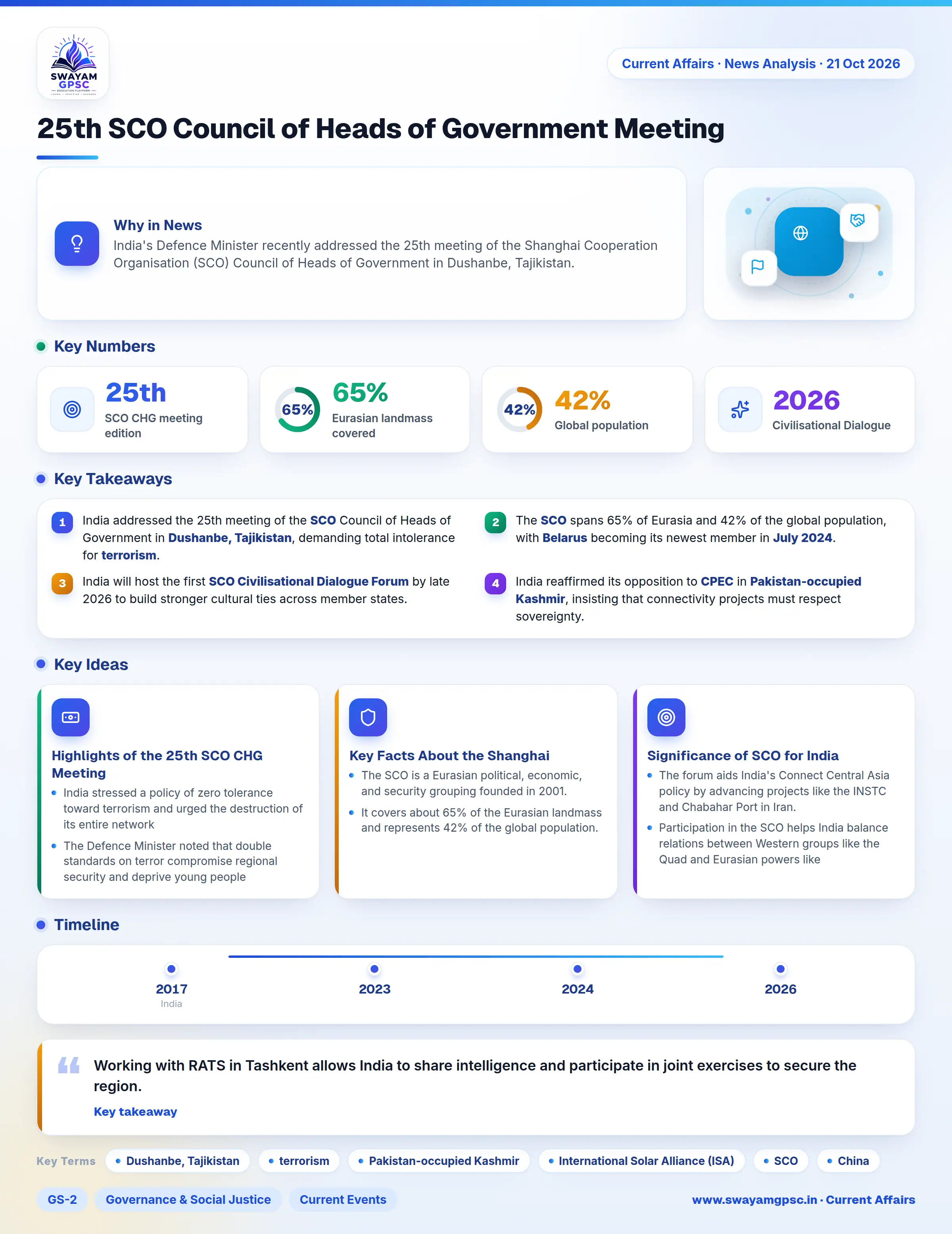
- India addressed the 25th meeting of the SCO Council of Heads of Government in Dushanbe, Tajikistan, demanding total intolerance for terrorism.
- The SCO spans 65% of Eurasia and 42% of the global population, with Belarus becoming its newest member in July 2024.
- India will host the first SCO Civilisational Dialogue Forum by late 2026 to build stronger cultural ties across member states.
- India reaffirmed its opposition to CPEC in Pakistan-occupied Kashmir, insisting that connectivity projects must respect sovereignty.
Why in News
- India's Defence Minister recently addressed the 25th meeting of the Shanghai Cooperation Organisation (SCO) Council of Heads of Government in Dushanbe, Tajikistan.
- During this summit, India urged all member nations to work together to dismantle terrorism and eliminate double standards in fighting it.
Highlights of the 25th SCO CHG Meeting
- India stressed a policy of zero tolerance toward terrorism and urged the destruction of its entire network, including terror financing and safe havens.
- The Defence Minister noted that double standards on terror compromise regional security and deprive young people of economic growth.
- India announced that it will host the first SCO Civilisational Dialogue Forum by the end of 2026 to deepen cultural ties.
- The country reaffirmed its support for the 2026-2030 Action Plan under the Programme for Multilateral Trade and Economic Cooperation (PMTEC).
- India emphasized that trade cooperation should build resilient supply chains and use modern technology to bridge economic gaps.
- Regarding regional connectivity, India asserted that all projects must respect national sovereignty and territorial integrity.
- This statement reflects India's ongoing opposition to China's Belt and Road Initiative (BRI) and the China-Pakistan Economic Corridor (CPEC) in Pakistan-occupied Kashmir.
- India encouraged member states to join climate platforms like the International Solar Alliance (ISA), CDRI, and the Global Biofuel Alliance.
Key Facts About the Shanghai Cooperation Organisation
- The SCO is a Eurasian political, economic, and security grouping founded in 2001.
- It covers about 65% of the Eurasian landmass and represents 42% of the global population.
- The original founding members from 2001 were China, Kazakhstan, Kyrgyzstan, Russia, Tajikistan, and Uzbekistan.
- The precursor group was called the Shanghai Five, which was created in 1996 to settle border issues.
- India and Pakistan became full members in 2017, Iran joined in 2023, and Belarus entered in July 2024.
- Nations like Afghanistan and Mongolia hold observer status, while countries like Turkey and Sri Lanka act as Dialogue Partners.
- The primary mandate of the organisation is combating the three evils of terrorism, separatism, and extremism.
- The grouping also encourages trade networks, energy transport corridors, and diplomatic alignment among member nations.
- The Heads of State Council serves as the highest decision-making body and meets once every year.
- The main administrative body of the grouping is the SCO Secretariat, which operates from Beijing, China.
- The Council of Heads of Government is the second-highest decision-making body, focusing on trade, economic affairs, and budget approvals.
- The Regional Anti-Terrorist Structure (RATS) is a permanent counter-terrorism body based in Tashkent, Uzbekistan.
- RATS handles daily intelligence sharing, maintains databases on terror groups, and supports security capacity building.
Significance of SCO for India
- Working with RATS in Tashkent allows India to share intelligence and participate in joint exercises to secure the region.
- The forum aids India's Connect Central Asia policy by advancing projects like the INSTC and Chabahar Port in Iran.
- Participation in the SCO helps India balance relations between Western groups like the Quad and Eurasian powers like Russia and China.
- However, issues like India-China-Pakistan rivalries and economic differences continue to limit the organisation's overall effectiveness.