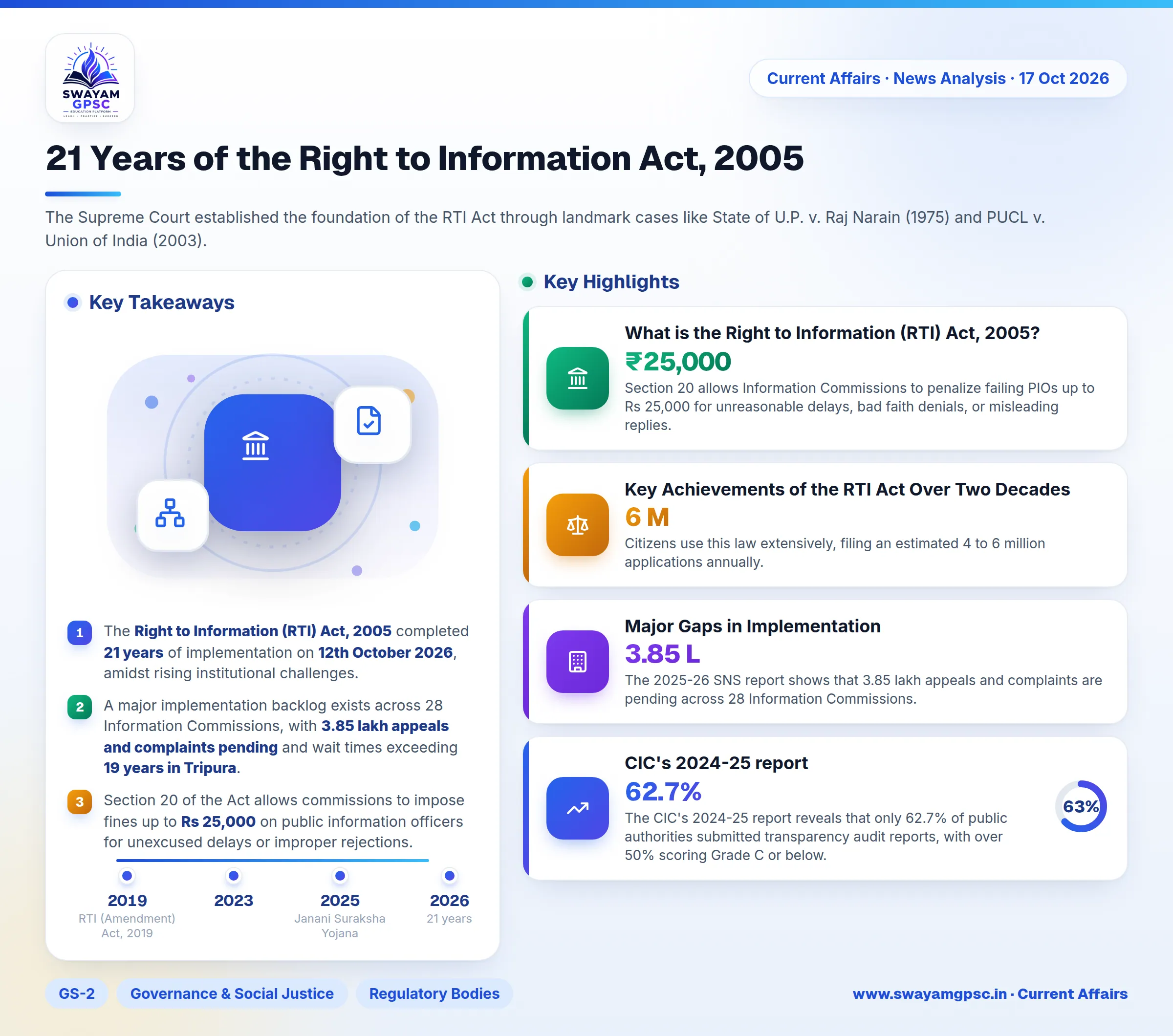
21 Years of the Right to Information Act, 2005
#GS-2 #Governance & Social Justice #Regulatory Bodies #E-Governance #Good Governance #Current Events #National #Gujarat #Right to Information #Quasi Judicial Bodies
Key takeaways
- The Right to Information (RTI) Act, 2005 completed 21 years of implementation on 12th October 2026, amidst rising institutional challenges.
- A major implementation backlog exists across 28 Information Commissions, with 3.85 lakh appeals and complaints pending and wait times exceeding 19 years in Tripura.
- Section 20 of the Act allows commissions to impose fines up to Rs 25,000 on public information officers for unexcused delays or improper rejections.
- Citizens file an estimated 4 to 6 million RTI applications annually, using the law to expose high-profile scams and secure basic social welfare delivery.
- Between July 2025 and June 2026, nine commissions returned over 37,700 cases on procedural technicalities, with up to 95% never refiled.
Why in News
- The Right to Information (RTI) Act, 2005 completed 21 years of implementation on 12th October 2026.
- A report by Satark Nagrik Sangathan (SNS) highlights severe implementation gaps and an institutional crisis weakening citizens' Right to Know.
Summary
- The RTI Act, 2005 strengthens transparency, accountability, and citizen empowerment, allowing people to inspect government operations and expose corruption.
- Growing pendency, unfilled institutional posts, and recent legislative amendments require stronger Information Commissions, proactive disclosures, whistleblower protections, and a balance between privacy and transparency.
What is the Right to Information (RTI) Act, 2005?
- The Supreme Court established the foundation of the RTI Act through landmark cases like *State of U.P. v. Raj Narain (1975)* and *PUCL v. Union of India (2003)*.
- The apex court ruled that the Right to Know forms an integral part of the Fundamental Right to Freedom of Speech and Expression under Article 19(1)(a).
- Grassroots civil society campaigns, led by the Mazdoor Kisan Shakti Sangathan (MKSS), eventually replaced the ineffective Freedom of Information Act, 2002.
- Enacted in 2005, the RTI Act shifts Indian governance from official secrecy to structural transparency, empowering citizens to demand accountability from officials.
- The law gives citizens a statutory right to request information held by public authorities, including government-owned, controlled, or substantially financed bodies.
- It sets up a multi-tier grievance redressal mechanism with Public Information Officers (PIOs) at the base, departmental Appellate Authorities next, and independent State and Central Information Commissions (SICs and CIC) as final authorities.
- Section 4 mandates that every public authority must proactively publish 16 specific categories of information on their websites to reduce the need for formal applications.
- Section 8 details specific grounds where public bodies can legally deny information requests, such as national security or sovereignty.
- Section 20 allows Information Commissions to penalize failing PIOs up to Rs 25,000 for unreasonable delays, bad faith denials, or misleading replies.
- The original 2005 law gave the Chief Information Commissioner and Information Commissioners a fixed 5-year tenure or up to age 65, matching the terms of the Chief Election Commissioner.
- The RTI (Amendment) Act, 2019 gave the Central Government powers to set their terms of office, salaries, allowances, and service conditions.
Key Achievements of the RTI Act Over Two Decades
- Citizens use this law extensively, filing an estimated 4 to 6 million applications annually.
- The Act exposed major scandals like the Adarsh Housing Scam and 2G spectrum allocation, while providing data that led the Supreme Court to strike down the Electoral Bonds scheme.
- It increased high-level transparency by bringing the Office of the Chief Justice of India (CJI) under public scrutiny.
- Marginalized groups used the law to claim basic rights under schemes like the Public Distribution System (PDS), Janani Suraksha Yojana (JSY), and the Viksit Bharat-Guarantee for Rozgar and Ajeevika Mission (Gramin) Act, 2025 (VB-G RAM G).
- Public applications exposed Below Poverty Line (BPL) ration-card fraud in Bilaspur (Chhattisgarh) and released delayed maternity incentives in Bikaner (Rajasthan).
- In *CBSE v. Aditya Bandopadhyay (2011)*, the Supreme Court ruled that evaluated answer scripts qualify as information and records under the Act.
- This ruling allowed students and exam candidates to inspect their marked answer sheets in major competitive exams.
Major Gaps in Implementation
- The 2025-26 SNS report shows that 3.85 lakh appeals and complaints are pending across 28 Information Commissions.
- Appeals face long delays, with estimated waiting times reaching 19 years and eight months in Tripura, 19 years and two months in Madhya Pradesh, and 18 years in Chhattisgarh.
- The CIC's 2024-25 report reveals that only 62.7% of public authorities submitted transparency audit reports, with over 50% scoring Grade C or below.
- Commissions reject many cases over minor procedural errors, returning over 37,700 cases between July 2025 and June 2026 without passing orders.
- Up to 95% of these returned cases are never refiled, which hurts poor applicants disproportionately.
- The RTI (Amendment) Act, 2019 reduced the operational independence of Information Commissioners by giving salary and tenure decisions to the Central Government.
- The Digital Personal Data Protection (DPDP) Act, 2023 amended Section 8(1)(j) to create a blanket exemption for personal data, removing the public interest exception that exposed corrupt officials.
- Commissions face chronic staffing vacancies, leaving bodies in states like Jharkhand and Himachal Pradesh non-functional for extended periods.
- Over 108 RTI activists have been killed because the government has not implemented the Whistle Blowers Protection Act, 2014.
Measures Needed to Strengthen the RTI Act
- Governments should connect online RTI portals with Digital Public Infrastructure (DPI) platforms like DigiLocker for identity checks and real-time tracking.
- States must switch from static files to interactive open-data portals like Rajasthan's Jan Soochna Portal to handle voluntary disclosures.
- Deploying AI-assisted chatbots can help citizens draft applications, while blockchain records can prevent public records from being altered.
- State governments must follow the Supreme Court guidelines from *Kishan Chand Jain v. Union of India (2023)* to regularly monitor proactive disclosures.
- Authorities should adhere to *CBSE v. Aditya Bandopadhyay (2011)* by publishing routine data so formal RTI requests become rare.
- India must align its practices with global standards like the Universal Declaration of Human Rights (UDHR) and the International Covenant on Civil and Political Rights (ICCPR).
- Lawmakers must review the DPDP Act, 2023 to restore the public interest test so privacy rules do not hide official misconduct.
- Public bodies should conduct yearly third-party transparency audits and display the results on updated websites.
- Governments must set fixed timelines for filling commission vacancies and enforce a 90-day limit for deciding second appeals.
- Commissions should stop returning appeals over technical errors and review cases if basic information is provided.
- The government must issue rules for the Whistle Blowers Protection Act, 2014 to ensure physical security for field activists.
- States should adopt successful models like Maharashtra's searchable RTI databases and Gujarat's RTI on Wheels mobile awareness initiative.
Conclusion
- The RTI Act, 2005 strengthens citizen rights and supports democratic governance, directly matching the goals of SDG 16 (Peace, Justice and Strong Institutions).
- Filling vacancies, resolving backlogs, and protecting activists are essential steps to keep public information accessible to every citizen.