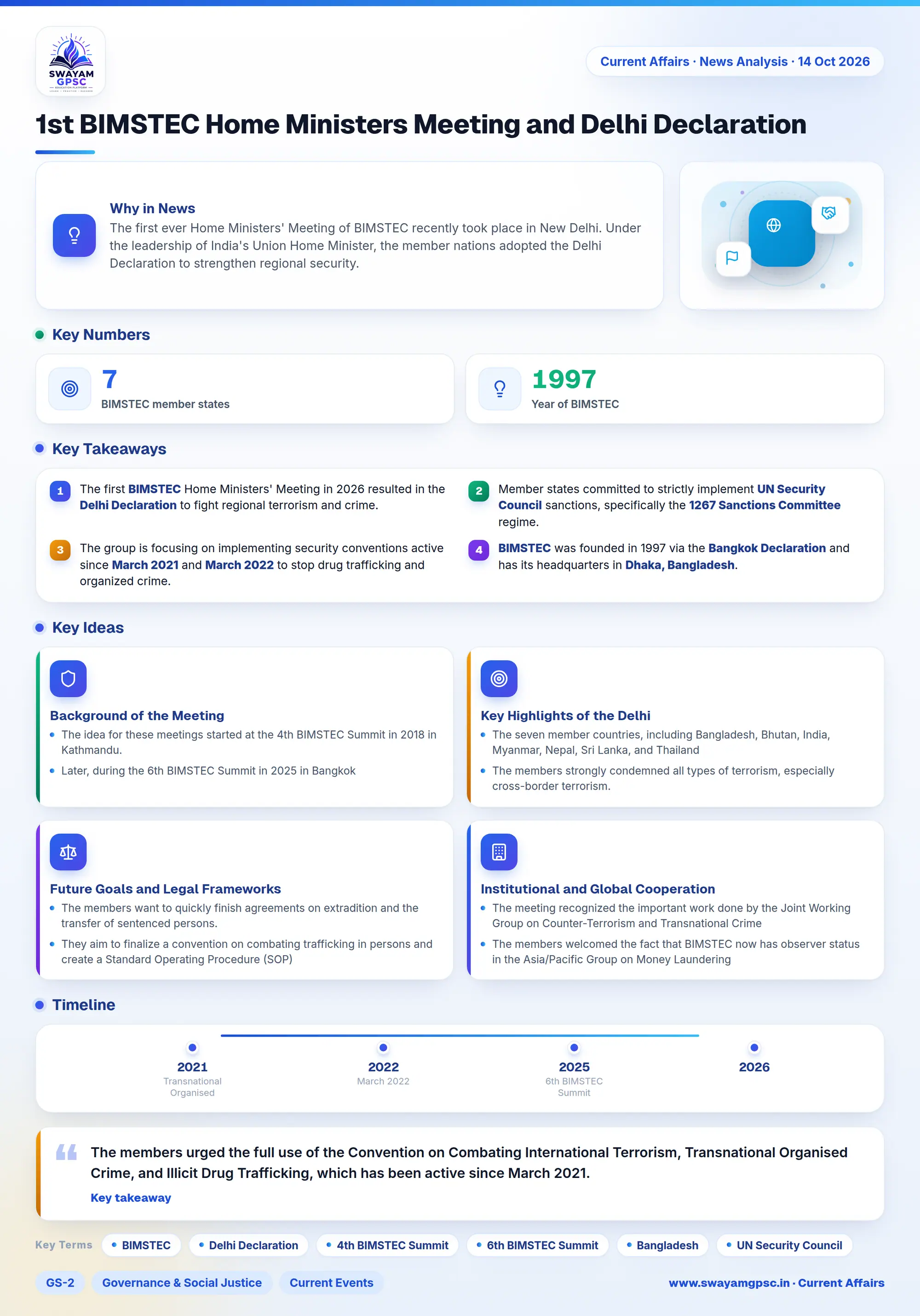
1st BIMSTEC Home Ministers Meeting and Delhi Declaration
#GS-2 #Governance & Social Justice #Current Events #National #International #Regional Groupings #Groupings & Agreements Involving India and/or Affecting India's Interests
Key takeaways
- The first BIMSTEC Home Ministers' Meeting in 2026 resulted in the Delhi Declaration to fight regional terrorism and crime.
- Member states committed to strictly implement UN Security Council sanctions, specifically the 1267 Sanctions Committee regime.
- The group is focusing on implementing security conventions active since March 2021 and March 2022 to stop drug trafficking and organized crime.
- BIMSTEC was founded in 1997 via the Bangkok Declaration and has its headquarters in Dhaka, Bangladesh.
Why in News
- The first ever Home Ministers' Meeting of BIMSTEC recently took place in New Delhi.
- Under the leadership of India's Union Home Minister, the member nations adopted the Delhi Declaration to strengthen regional security.
Background of the Meeting
- The idea for these meetings started at the 4th BIMSTEC Summit in 2018 in Kathmandu. The goal was to add a Home Ministers' level of cooperation to the existing National Security Advisors' system.
- Later, during the 6th BIMSTEC Summit in 2025 in Bangkok, the members officially welcomed the start of the Home Ministers' Meeting mechanism.
- Finally, India hosted the inaugural meeting in 2026 to provide a clear strategic direction for law enforcement and security in the region.
Key Highlights of the Delhi Declaration
- The seven member countries, including Bangladesh, Bhutan, India, Myanmar, Nepal, Sri Lanka, and Thailand, agreed to work together based on sovereign equality and non-interference.
- The members strongly condemned all types of terrorism, especially cross-border terrorism.
- They agreed to strictly follow UN Security Council sanctions, with a specific focus on the 1267 Sanctions Committee.
- The declaration highlighted the need to fight radicalisation, money laundering, and terror financing.
- The ministers agreed to stop terrorists from using new technologies and cyberspace for their activities.
- There was a strong call for coordinated action against human trafficking, online scams, and cyber slavery, using an approach that focuses on helping the victims.
- The members urged the full use of the Convention on Combating International Terrorism, Transnational Organised Crime, and Illicit Drug Trafficking, which has been active since March 2021.
- They also emphasized the Convention on Mutual Legal Assistance in Criminal Matters signed in March 2022.
Future Goals and Legal Frameworks
- The members want to quickly finish agreements on extradition and the transfer of sentenced persons.
- They aim to finalize a convention on combating trafficking in persons and create a Standard Operating Procedure (SOP) for rescuing and reintegrating victims.
- The group plans to develop the BIMSTEC Drug Offences Monitoring Desk (BDOMD) to track drug crimes.
- They intend to create better regional systems for sharing information and publishing annual reports on drugs.
- The declaration encourages better training and capacity building to fight transnational crimes.
Institutional and Global Cooperation
- The meeting recognized the important work done by the Joint Working Group on Counter-Terrorism and Transnational Crime (JWG-CTTC).
- The members welcomed the fact that BIMSTEC now has observer status in the Asia/Pacific Group on Money Laundering (APG).
- The declaration encourages strong partnerships with global bodies like UNODC, INTERPOL, and FATF.
- The ministers agreed to hold these Home Ministers' Meetings regularly to keep the momentum going.
Prelims in Focus: BIMSTEC
- The Bay of Bengal Initiative for Multi-Sectoral Technical and Economic Cooperation (BIMSTEC) was created on 6th June 1997 through the Bangkok Declaration.
- It acts as a vital link connecting the regions of South Asia and Southeast Asia.
- The official Secretariat of the organization is located in Dhaka, Bangladesh.