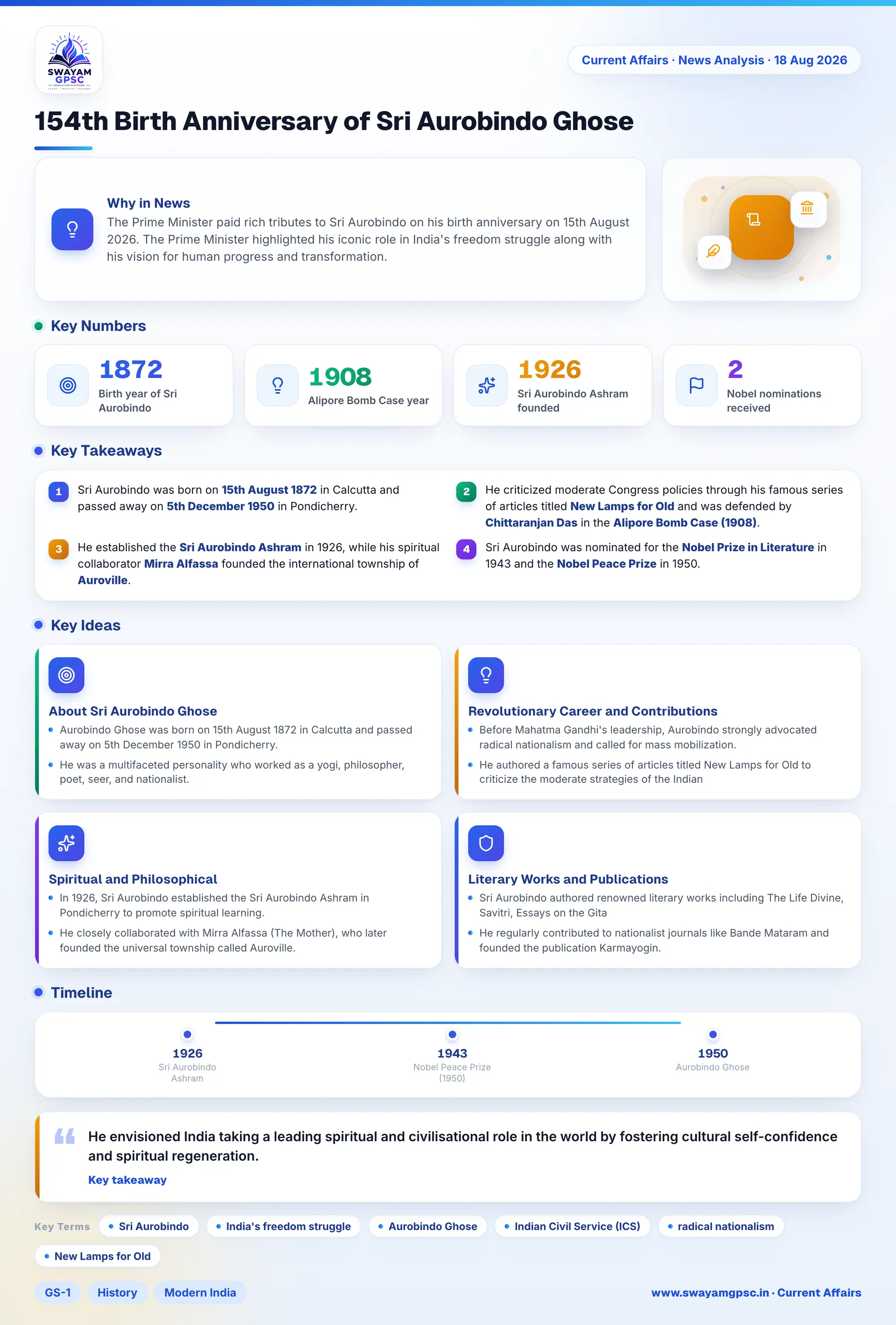
154th Birth Anniversary of Sri Aurobindo Ghose
#GS-1 #History #Modern India #Freedom Struggle #Culture #Literature #GS-2 #Current Events #National
Key takeaways
- Sri Aurobindo was born on 15th August 1872 in Calcutta and passed away on 5th December 1950 in Pondicherry.
- He criticized moderate Congress policies through his famous series of articles titled New Lamps for Old and was defended by Chittaranjan Das in the Alipore Bomb Case (1908).
- He established the Sri Aurobindo Ashram in 1926, while his spiritual collaborator Mirra Alfassa founded the international township of Auroville.
- Sri Aurobindo was nominated for the Nobel Prize in Literature in 1943 and the Nobel Peace Prize in 1950.
Why in News
- The Prime Minister paid rich tributes to Sri Aurobindo on his birth anniversary on 15th August 2026.
- The Prime Minister highlighted his iconic role in India's freedom struggle along with his vision for human progress and transformation.
About Sri Aurobindo Ghose
- Aurobindo Ghose was born on 15th August 1872 in Calcutta and passed away on 5th December 1950 in Pondicherry.
- He was a multifaceted personality who worked as a yogi, philosopher, poet, seer, and nationalist.
- He successfully cleared the Indian Civil Service (ICS) examination but chose not to join after missing the mandatory horse-riding test.
Revolutionary Career and Contributions
- Before Mahatma Gandhi's leadership, Aurobindo strongly advocated radical nationalism and called for mass mobilization.
- He authored a famous series of articles titled New Lamps for Old to criticize the moderate strategies of the Indian National Congress.
- Authorities arrested him during the Alipore Bomb Case (1908), where prominent lawyer Chittaranjan Das successfully defended him.
Spiritual and Philosophical Contributions
- In 1926, Sri Aurobindo established the Sri Aurobindo Ashram in Pondicherry to promote spiritual learning.
- He closely collaborated with Mirra Alfassa (The Mother), who later founded the universal township called Auroville.
Literary Works and Publications
- Sri Aurobindo authored renowned literary works including The Life Divine, Savitri, Essays on the Gita, The Synthesis of Yoga, and Defense of Indian Culture.
- He regularly contributed to nationalist journals like Bande Mataram and founded the publication Karmayogin.
- He maintained active links with revolutionary groups such as Jugantar and Anushilan Samiti.
Nominations and Vision
- Recognizing his intellectual and global impact, experts nominated him for the Nobel Prize in Literature (1943) and the Nobel Peace Prize (1950).
- He envisioned India taking a leading spiritual and civilisational role in the world by fostering cultural self-confidence and spiritual regeneration.