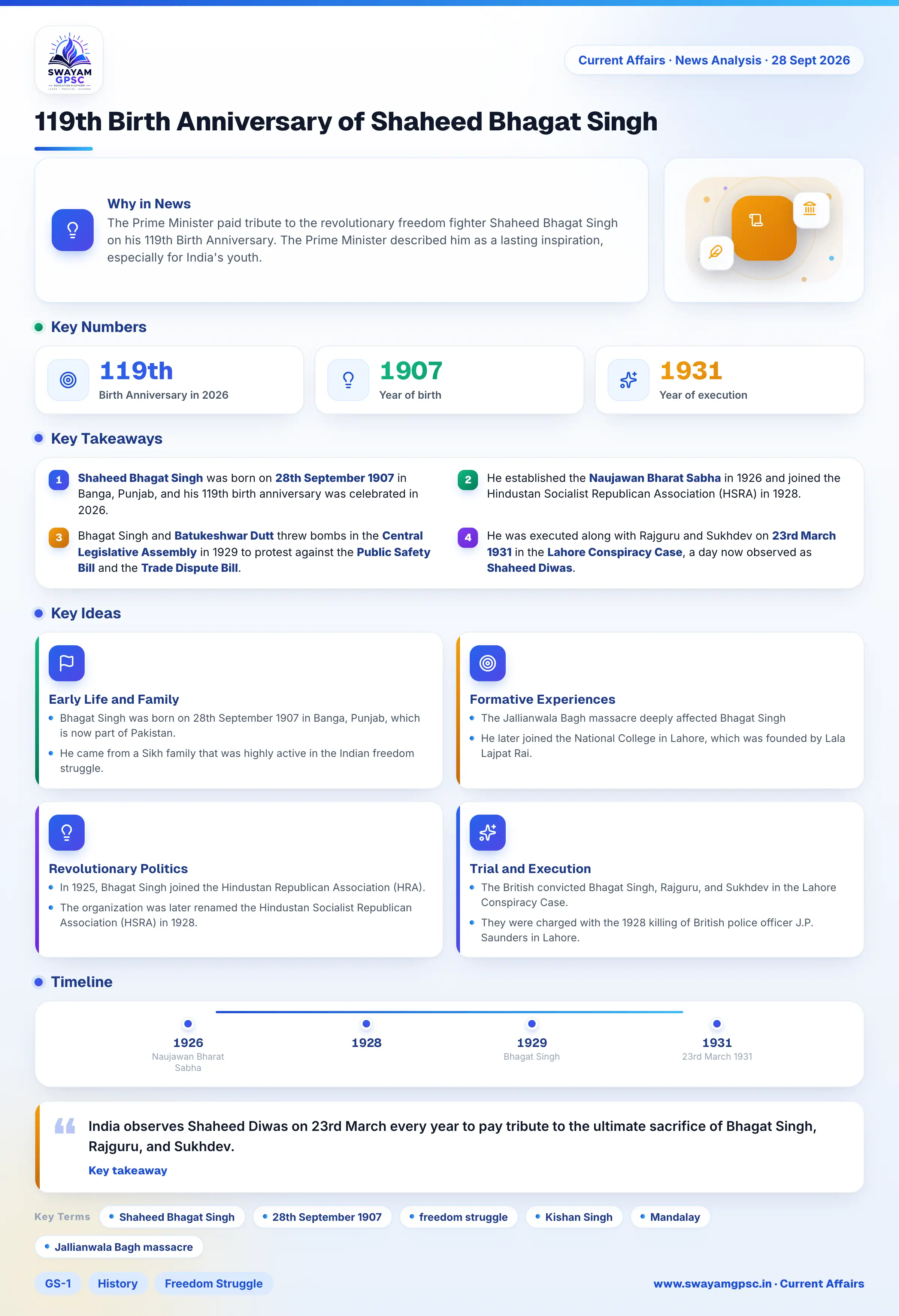
119th Birth Anniversary of Shaheed Bhagat Singh
#GS-1 #History #Freedom Struggle #Indian National Movement #Important Personalities
Key takeaways
- Shaheed Bhagat Singh was born on 28th September 1907 in Banga, Punjab, and his 119th birth anniversary was celebrated in 2026.
- He established the Naujawan Bharat Sabha in 1926 and joined the Hindustan Socialist Republican Association (HSRA) in 1928.
- Bhagat Singh and Batukeshwar Dutt threw bombs in the Central Legislative Assembly in 1929 to protest against the Public Safety Bill and the Trade Dispute Bill.
- He was executed along with Rajguru and Sukhdev on 23rd March 1931 in the Lahore Conspiracy Case, a day now observed as Shaheed Diwas.
Why in News
- The Prime Minister paid tribute to the revolutionary freedom fighter Shaheed Bhagat Singh on his 119th Birth Anniversary.
- The Prime Minister described him as a lasting inspiration, especially for India's youth.
Early Life and Family
- Bhagat Singh was born on 28th September 1907 in Banga, Punjab, which is now part of Pakistan.
- He came from a Sikh family that was highly active in the Indian freedom struggle.
- His father, Kishan Singh, and his uncle, Ajit Singh, were both notable revolutionaries.
- The British deported his uncle to Mandalay, and he later worked with the San Francisco-based Ghadar Party.
Formative Experiences
- The Jallianwala Bagh massacre deeply affected Bhagat Singh, and he visited the site shortly after the tragedy occurred.
- He later joined the National College in Lahore, which was founded by Lala Lajpat Rai.
- At this college, he was exposed to Swadeshi and revolutionary ideas.
Revolutionary Politics
- In 1925, Bhagat Singh joined the Hindustan Republican Association (HRA).
- The organization was later renamed the Hindustan Socialist Republican Association (HSRA) in 1928.
- In 1926, he founded the Naujawan Bharat Sabha to mobilize the youth of the country for the freedom movement.
- In 1929, Bhagat Singh and Batukeshwar Dutt threw low-intensity bombs inside the Central Legislative Assembly.
- This assembly protest was aimed against the Public Safety Bill and the Trade Dispute Bill.
Trial and Execution
- The British convicted Bhagat Singh, Rajguru, and Sukhdev in the Lahore Conspiracy Case.
- They were charged with the 1928 killing of British police officer J.P. Saunders in Lahore.
- This assassination was planned to avenge the death of leader Lala Lajpat Rai.
- All three revolutionaries were hanged on 23rd March 1931 inside the Lahore Central Jail.
Ideology and Writings
- Bhagat Singh was a committed atheist and a socialist.
- He was deeply influenced by revolutionary thinkers like Marx, Lenin, Trotsky, and Bakunin.
- His famous essay "Why I Am an Atheist" reflects his strong belief in rationalism, equality, and social justice.
- During the 1920s, he wrote articles for various Urdu and Punjabi newspapers in Amritsar.
- He also contributed to 'Kirti', the journal of the Kirti Kisan Party, and wrote briefly for the Delhi-based Veer Arjun newspaper.
- He used several pen names for his writings, including Balwant, Ranjit, and Vidhrohi.
Legacy
- The nation honors Bhagat Singh with the title of Shahid-e-Azam.
- He popularized the famous slogan 'Inquilab Zindabad', which became a major rallying cry during the freedom struggle.
- India observes Shaheed Diwas on 23rd March every year to pay tribute to the ultimate sacrifice of Bhagat Singh, Rajguru, and Sukhdev.