114th International Labour Conference
#GS-3 #Economy #Growth #Employment #GS-2 #Governance & Social Justice #Poverty #Industrial Policy #Human Resource
Key takeaways
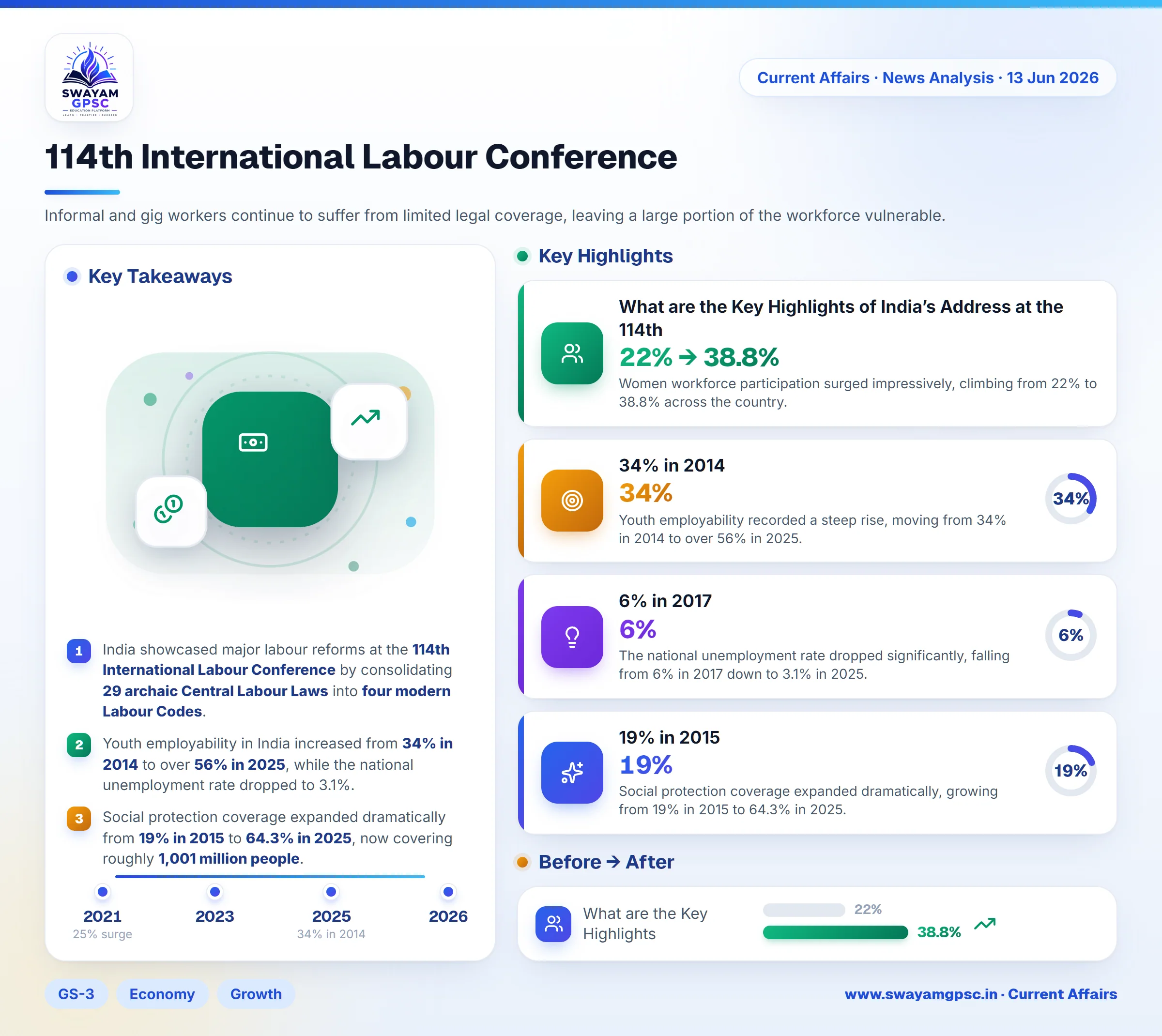
- India showcased major labour reforms at the 114th International Labour Conference by consolidating 29 archaic Central Labour Laws into four modern Labour Codes.
- Youth employability in India increased from 34% in 2014 to over 56% in 2025, while the national unemployment rate dropped to 3.1%.
- Social protection coverage expanded dramatically from 19% in 2015 to 64.3% in 2025, now covering roughly 1,001 million people.
- Despite these reforms, millions of gig workers and informal labourers remain vulnerable due to weak enforcement, wage stagnation, and lack of formal employee recognition.
Why in News
- The Union Minister of State for Labour and Employment led the Indian delegation at the 114th International Labour Conference in Geneva.
- India showcased its major labour reforms, expanding social protection initiatives, and Digital Public Infrastructure during the global event.
- Experts point out that the enactment of the four Labour Codes still faces serious challenges regarding weak implementation and enforcement.
- Informal and gig workers continue to suffer from limited legal coverage, leaving a large portion of the workforce vulnerable.
Summary
- India highlighted its progressive labour reforms, broader social security coverage, and Digital Public Infrastructure at the 114th International Labour Conference.
- The government pointed to improved employment indicators and wider social security benefits delivered through the e-Shram Portal and new labour laws.
- Despite these milestones, critics warn that poor enforcement of labour codes leaves gig and informal workers exposed to wage stagnation and weak welfare mechanisms.
- Workers still face limited collective bargaining rights, requiring stronger administrative actions to ensure genuine labour welfare.
What are the Key Highlights of India’s Address at the 114th ILC?
- India consolidated 29 archaic Central Labour Laws into four modern Labour Codes to simplify compliance and strengthen overall worker welfare.
- These reforms draw inspiration from the guiding principle of Antyodaya, which focuses on uplifting the most vulnerable segments of society.
- Youth employability recorded a steep rise, moving from 34% in 2014 to over 56% in 2025.
- The national unemployment rate dropped significantly, falling from 6% in 2017 down to 3.1% in 2025.
- Women workforce participation surged impressively, climbing from 22% to 38.8% across the country.
- Social protection coverage expanded dramatically, growing from 19% in 2015 to 64.3% in 2025.
- According to ILO estimates, this expanded social safety net now protects around 1,001 million people across the nation.
- The National Career Service Portal and the e-Shram Portal were presented to the world as scalable digital public goods.
- During bilateral talks with Rwanda and Sri Lanka, India offered technical help to build similar digital platforms for workforce management.
- India emphasized international labour mobility by aligning domestic skilling programs with global job markets through an ongoing study with the ILO.
- The government also launched the Pradhan Mantri Viksit Bharat Rozgar Yojana to stimulate rapid employment generation nationwide.
International Labour Conference (ILC)
- The International Labour Conference serves as the supreme decision-making body of the International Labour Organization, which is a specialized agency of the United Nations.
- Often called the international parliament of labour, this assembly meets every year in June in Geneva, Switzerland.
- The conference sets global labour standards, discusses major workplace challenges, and shapes the overarching policies of the ILO.
- Unlike most international bodies, the ILC follows a unique tripartite structure where different groups hold independent voting powers.
- Every member state sends two government delegates, one employer delegate, and one worker delegate to the conference.
- This arrangement lets employers and workers vote independently from their governments, protecting industry and labour interests directly.
New Labour Codes
- The Code on Wages, 2019 ensures universal minimum wages and timely wage payments for workers across organized and unorganized sectors.
- The Industrial Relations Code, 2020 streamlines dispute resolution, updates trade union rules, and modifies conditions for layoffs and factory closures.
- The Code on Social Security, 2020 expands the administrative reach of the Employees' State Insurance Corporation and the Employees' Provident Fund Organisation.
- This social security code marks the first legal step in India to bring gig workers and platform workers into formal social security nets.
- The Occupational Safety, Health and Working Conditions Code, 2020 regulates workplace health and safety while specifically addressing inter-state migrant and contract workers.
Why is the Indian Workforce Still Vulnerable Despite the New Labour Reforms?
- The Code on Social Security, 2020 mentions gig workers but refuses to classify them as standard employees.
- Because they lack a formal employer-employee bond, gig workers remain excluded from the Industrial Relations Code, 2020 and the OSH Code, 2020.
- This exclusion denies delivery personnel and ride-hailing drivers basic minimum wage guarantees and legal workplace safety rights.
- Algorithmic management systems dictate daily tasks, ratings, and financial penalties for logistics workers without any avenue for human review.
- Platform aggregators frequently alter piece-rate wage structures overnight, reducing per-delivery payouts to cut their own operational costs.
- The Industrial Relations Code, 2020 raised the employee threshold for factory closures and layoffs without government permission from 100 workers to 300 workers.
- This higher threshold creates a flexible hire and fire system that strips job security from millions of workers in micro and small enterprises.
- The OSH Code, 2020 establishes a broad 48-hour work week while leaving daily shift limits and rest intervals dangerously ambiguous.
- This regulatory loophole allows companies to force grueling 12-hour shifts under a compressed four-day work week without paying proper overtime.
- New rules make it harder for unions to gain recognition by demanding support from 51% of workers on the muster roll.
- Workers must also serve a strict 60-day notice period before striking and face total strike bans during conciliation talks.
- The OSH Code, 2020 applies only to establishments with 10 or more workers, leaving micro-enterprises outside safety inspection mandates.
- While the e-Shram portal registers millions of unorganized workers, converting this digital data into actual welfare benefits remains inconsistent across states.
- Inflation has caused severe real wage erosion because base wages are rarely revised despite a 25% surge in the Consumer Price Index for Industrial Workers between 2021 and 2026.
- Inter-state migrant workers face severe urban cost-of-living crises as rent and black-market essential prices outpace nominal wage gains.
What Measures are Needed to Strengthen Labour Welfare?
- India must move past the binary of traditional employees versus independent contractors by learning from the EU Platform Work Directive.
- Creating a legal category for dependent contractors will ensure minimum base pay protection despite fluctuating piece rates.
- India should replicate key features of the Rajasthan Platform-Based Gig Workers Act, 2023 across the country.
- This includes setting up dedicated welfare boards with worker representation and collecting welfare cesses on digital transactions.
- Inspector-centric enforcement should be replaced with digital wage monitoring and electronic employment records.
- The massive e-Shram database must be actively linked with schemes like the One Nation One Ration Card, Ayushman Bharat, and PM-SYM.
- This digital convergence will instantly trigger financial relief and healthcare access for migrant workers during economic shocks.
- The domestic Indian Labour Conference must be revived regularly to foster genuine dialogue between the state, employers, and trade unions.
Conclusion
- India’s new labour codes are crucial steps toward boosting economic competitiveness and market flexibility.
- However, long-term success depends on extending true social security, fair wages, and dignified conditions to informal workers.
- Achieving the national vision of Viksit Bharat 2047 requires balancing market flexibility with robust worker welfare protections.