10 Years of UPI: Transforming Digital Payments in India and Beyond
#GS-3 #Economy #Banking #Infrastructure #Current Events #National #International
Key takeaways
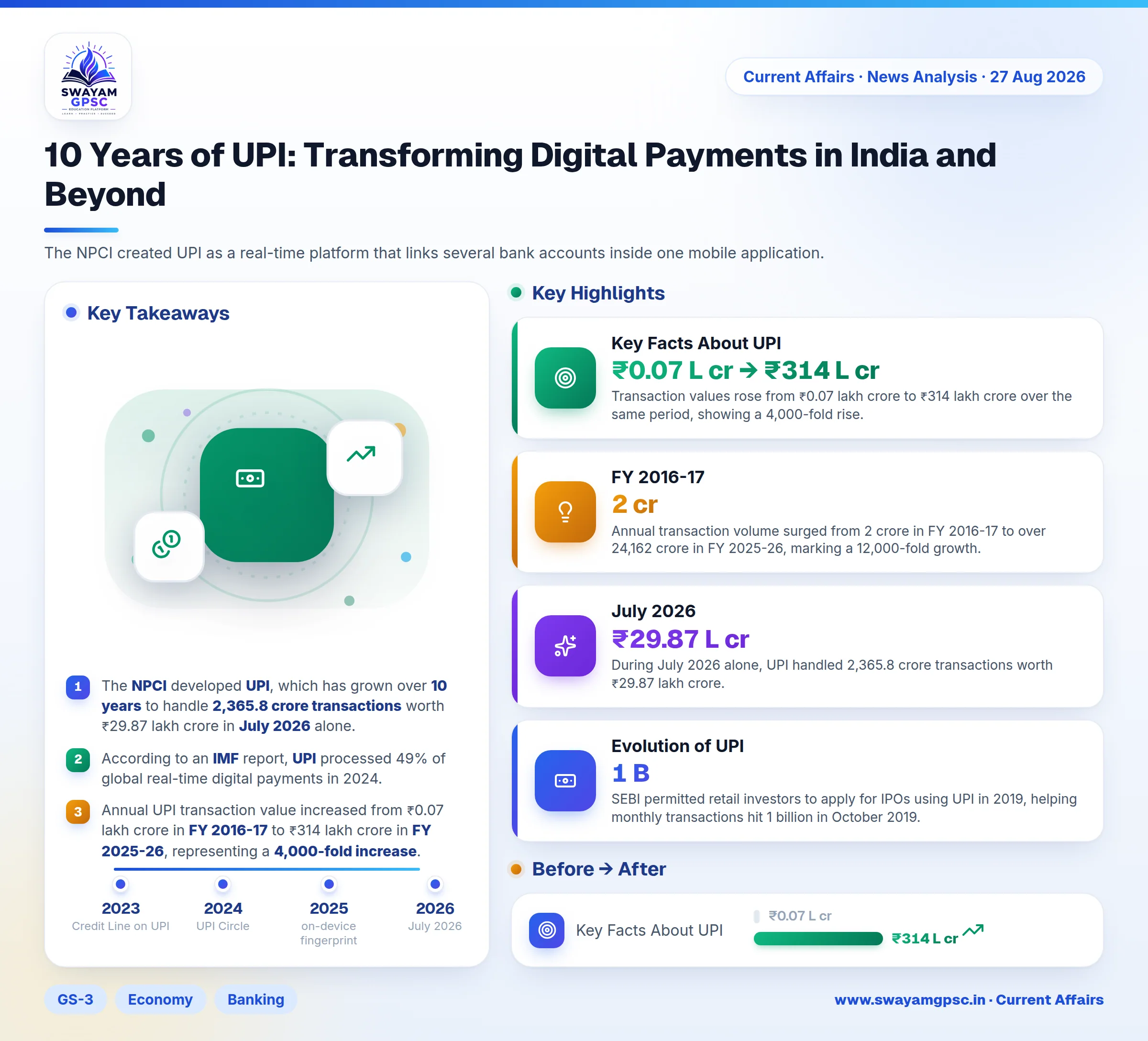
- The NPCI developed UPI, which has grown over 10 years to handle 2,365.8 crore transactions worth ₹29.87 lakh crore in July 2026 alone.
- According to an IMF report, UPI processed 49% of global real-time digital payments in 2024.
- Annual UPI transaction value increased from ₹0.07 lakh crore in FY 2016-17 to ₹314 lakh crore in FY 2025-26, representing a 4,000-fold increase.
- The UPI global network now spans 11 foreign countries, including recent links with Cambodia, Greece, and the Maldives.
Why in News
- The National Payments Corporation of India (NPCI) developed the Unified Payments Interface (UPI), which has now completed 10 years of operations.
- UPI serves as a core pillar of India's Digital Public Infrastructure (DPI) by offering instant, safe, and connected payment services.
- Today, 11 foreign countries run UPI services, showing India's leadership in global financial technology.
Key Facts About UPI
- The NPCI created UPI as a real-time platform that links several bank accounts inside one mobile application.
- The platform combines money transfers, banking facilities, and store payments for round-the-clock operations.
- Security is maintained through two-factor authentication alongside end-to-end data encryption.
- Annual transaction volume surged from 2 crore in FY 2016-17 to over 24,162 crore in FY 2025-26, marking a 12,000-fold growth.
- Transaction values rose from ₹0.07 lakh crore to ₹314 lakh crore over the same period, showing a 4,000-fold rise.
- By July 2026, 741 live banks had joined the UPI network to expand banking access.
- During July 2026 alone, UPI handled 2,365.8 crore transactions worth ₹29.87 lakh crore.
- This rapid expansion reshaped Indian finance by making payments fast, easy, and universally accessible.
Evolution of UPI
- Officials started UPI on a pilot basis in April 2016 with 21 banks, before launching it publicly in August 2016.
- The government introduced the BHIM app in December 2016 to allow direct bank account transfers.
- Merchants adopted dynamic QR codes in 2017 to automate payment details and avoid typing mistakes.
- UPI 2.0 arrived in 2018 with features like inbox invoices, signed QR codes, recurring mandates, and overdraft links.
- SEBI permitted retail investors to apply for IPOs using UPI in 2019, helping monthly transactions hit 1 billion in October 2019.
- Between 2020 and 2022, the system added UPI AutoPay, UPI 123PAY for feature phones, UPI Lite for small payments, credit card links, and cross-border expansion to Bhutan.
- In 2023, the platform introduced Credit Line on UPI, helping UPI process 70% of all Indian digital transactions during FY 2023-24.
- Authorities launched UPI Circle in 2024, while raising transaction limits for tax payments to ₹5 lakh, UPI 123PAY to ₹10,000, and UPI Lite to ₹5,000.
- Biometric features like on-device fingerprint unlock and Aadhaar-based Face Authentication joined the system in 2025 to simplify onboarding.
UPI's Global Footprint
- According to an IMF report from June 2025, UPI handled 49% of all global real-time payment transactions in 2024.
- The network now operates in 11 foreign nations, including Bhutan, Nepal, Singapore, UAE, France, Sri Lanka, Mauritius, Qatar, Cambodia, Greece, and Maldives.
- NPCI International Payments Limited (NIPL) partnered with ACLEDA Bank Plc in June 2026 to enable UPI acceptance across Cambodia.
- Cross-border money transfers between India and Greece went live in June 2026 through Eurobank.
- India linked UPI with the Maldives instant payment system named Favara on 30th July 2026 to boost regional payments.
Conclusion
- UPI has modernized India's payment system by making money transfers instant, safe, connected, and accessible to everyone.
- The growth of UPI from a local pilot into international infrastructure proves the success of India's Digital Public Infrastructure model.