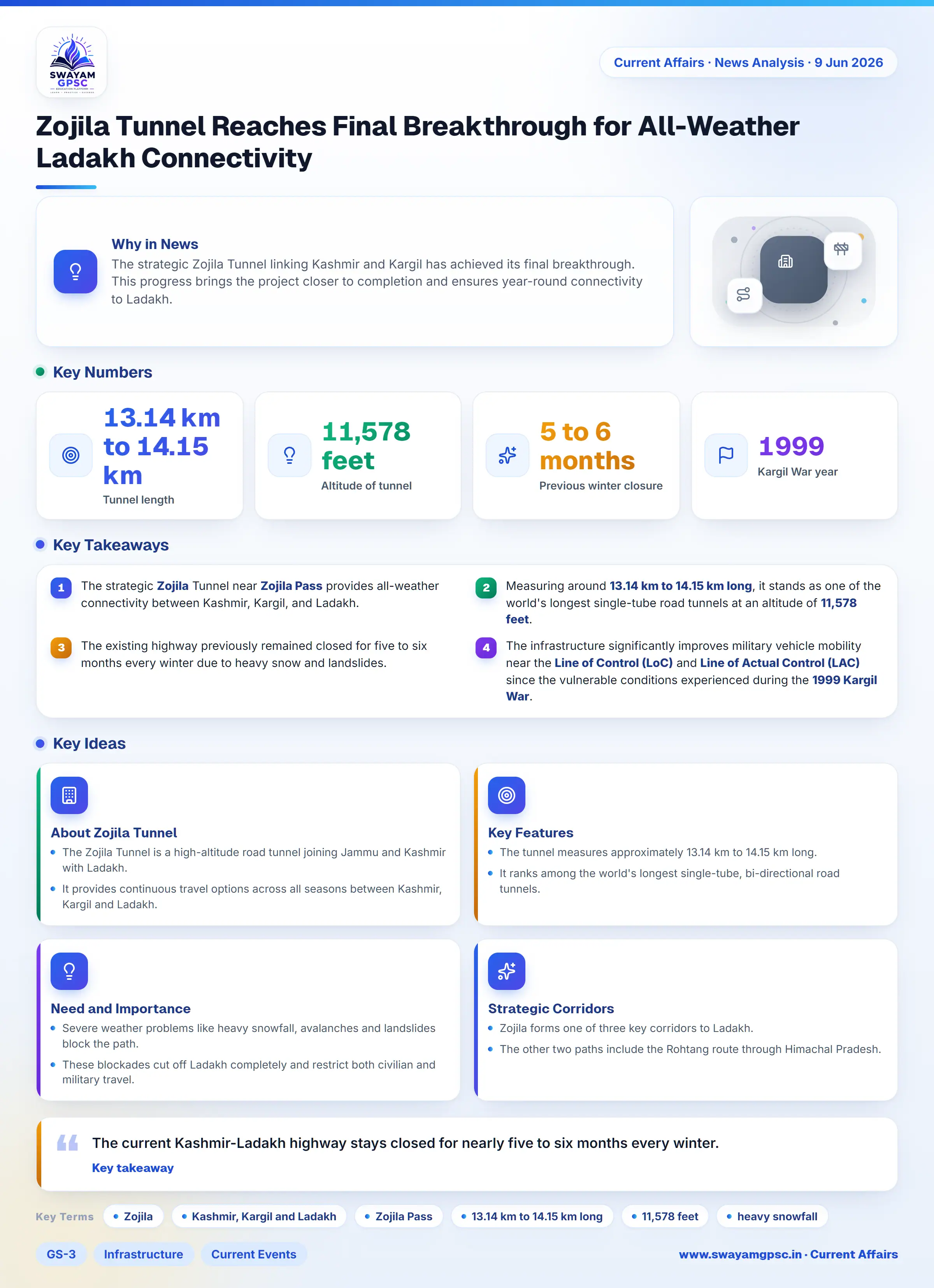
Zojila Tunnel Reaches Final Breakthrough for All-Weather Ladakh Connectivity
#GS-3 #Infrastructure #Current Events #National #Economy #Geography
Key takeaways
- The strategic Zojila Tunnel near Zojila Pass provides all-weather connectivity between Kashmir, Kargil, and Ladakh.
- Measuring around 13.14 km to 14.15 km long, it stands as one of the world's longest single-tube road tunnels at an altitude of 11,578 feet.
- The existing highway previously remained closed for five to six months every winter due to heavy snow and landslides.
- The infrastructure significantly improves military vehicle mobility near the Line of Control (LoC) and Line of Actual Control (LAC) since the vulnerable conditions experienced during the 1999 Kargil War.
Why in News
- The strategic Zojila Tunnel linking Kashmir and Kargil has achieved its final breakthrough.
- This progress brings the project closer to completion and ensures year-round connectivity to Ladakh.
About Zojila Tunnel
- The Zojila Tunnel is a high-altitude road tunnel joining Jammu and Kashmir with Ladakh.
- It provides continuous travel options across all seasons between Kashmir, Kargil and Ladakh.
- Engineers built it near Zojila Pass, which links the Kashmir Valley directly to Drass, Kargil and Ladakh.
Key Features
- The tunnel measures approximately 13.14 km to 14.15 km long.
- It ranks among the world's longest single-tube, bi-directional road tunnels.
- Workers constructed the structure at an impressive altitude of about 11,578 feet.
Need and Importance
- The current Kashmir-Ladakh highway stays closed for nearly five to six months every winter.
- Severe weather problems like heavy snowfall, avalanches and landslides block the path.
- These blockades cut off Ladakh completely and restrict both civilian and military travel.
Strategic Corridors
- Zojila forms one of three key corridors to Ladakh.
- The other two paths include the Rohtang route through Himachal Pradesh.
- The Shinku La tunnel route also connects Himachal with Ladakh's Zanskar Valley.
Military Mobility
- The new tunnel speeds up the movement of military vehicles and supplies to forward border zones.
- This improvement proves vital during emergencies along the Line of Control (LoC) and Line of Actual Control (LAC).
- During the 1999 Kargil War, Pakistani shelling made the old highway vulnerable.
- That vulnerability caused severe difficulties when transporting troops and war materials.