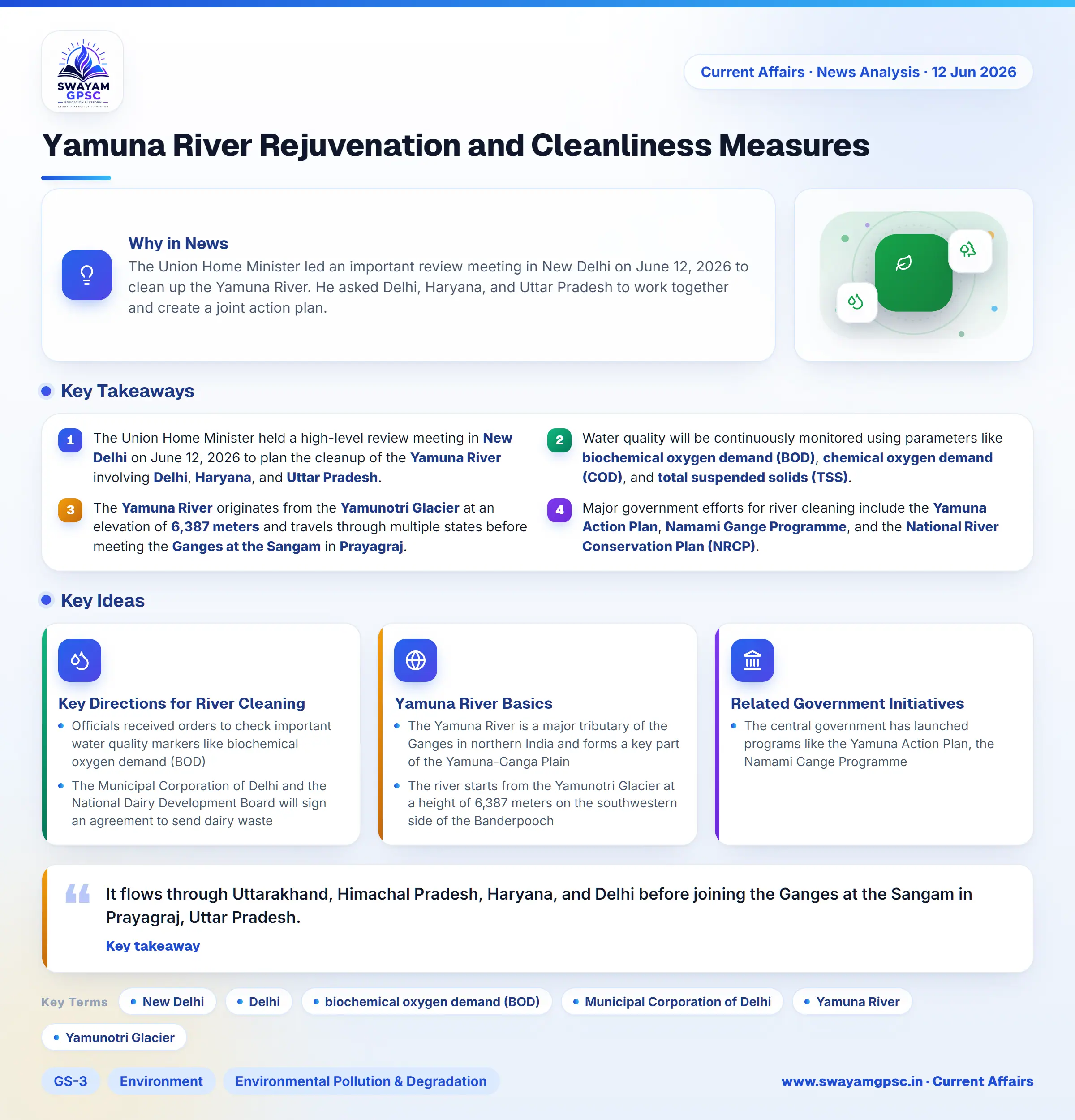
Yamuna River Rejuvenation and Cleanliness Measures
#GS-3 #Environment #Environmental Pollution & Degradation #Rapid Fire CA #Quick Facts For Prelims
Key takeaways
- The Union Home Minister held a high-level review meeting in New Delhi on June 12, 2026 to plan the cleanup of the Yamuna River involving Delhi, Haryana, and Uttar Pradesh.
- Water quality will be continuously monitored using parameters like biochemical oxygen demand (BOD), chemical oxygen demand (COD), and total suspended solids (TSS).
- The Yamuna River originates from the Yamunotri Glacier at an elevation of 6,387 meters and travels through multiple states before meeting the Ganges at the Sangam in Prayagraj.
- Major government efforts for river cleaning include the Yamuna Action Plan, Namami Gange Programme, and the National River Conservation Plan (NRCP).
Why in News
- The Union Home Minister led an important review meeting in New Delhi on June 12, 2026 to clean up the Yamuna River.
- He asked Delhi, Haryana, and Uttar Pradesh to work together and create a joint action plan.
Key Directions for River Cleaning
- Officials received orders to check important water quality markers like biochemical oxygen demand (BOD), chemical oxygen demand (COD), and total suspended solids (TSS) on a regular basis.
- The Municipal Corporation of Delhi and the National Dairy Development Board will sign an agreement to send dairy waste to biogas and manure plants rather than dumping it into the river.
Yamuna River Basics
- The Yamuna River is a major tributary of the Ganges in northern India and forms a key part of the Yamuna-Ganga Plain, which is one of the biggest alluvial plains globally.
- The river starts from the Yamunotri Glacier at a height of 6,387 meters on the southwestern side of the Banderpooch crests in the lower Himalayan ranges.
- It flows through Uttarakhand, Himachal Pradesh, Haryana, and Delhi before joining the Ganges at the Sangam in Prayagraj, Uttar Pradesh.
- Major dams on this river include the Lakhwar-Vyasi Dam in Uttarakhand and the Tajewala Barrage Dam in Haryana.
- Important tributaries feeding into the river include the Chambal, Sindh, Betwa, and Ken.
Related Government Initiatives
- The central government has launched programs like the Yamuna Action Plan, the Namami Gange Programme, and the National River Conservation Plan (NRCP) to clean up water bodies.