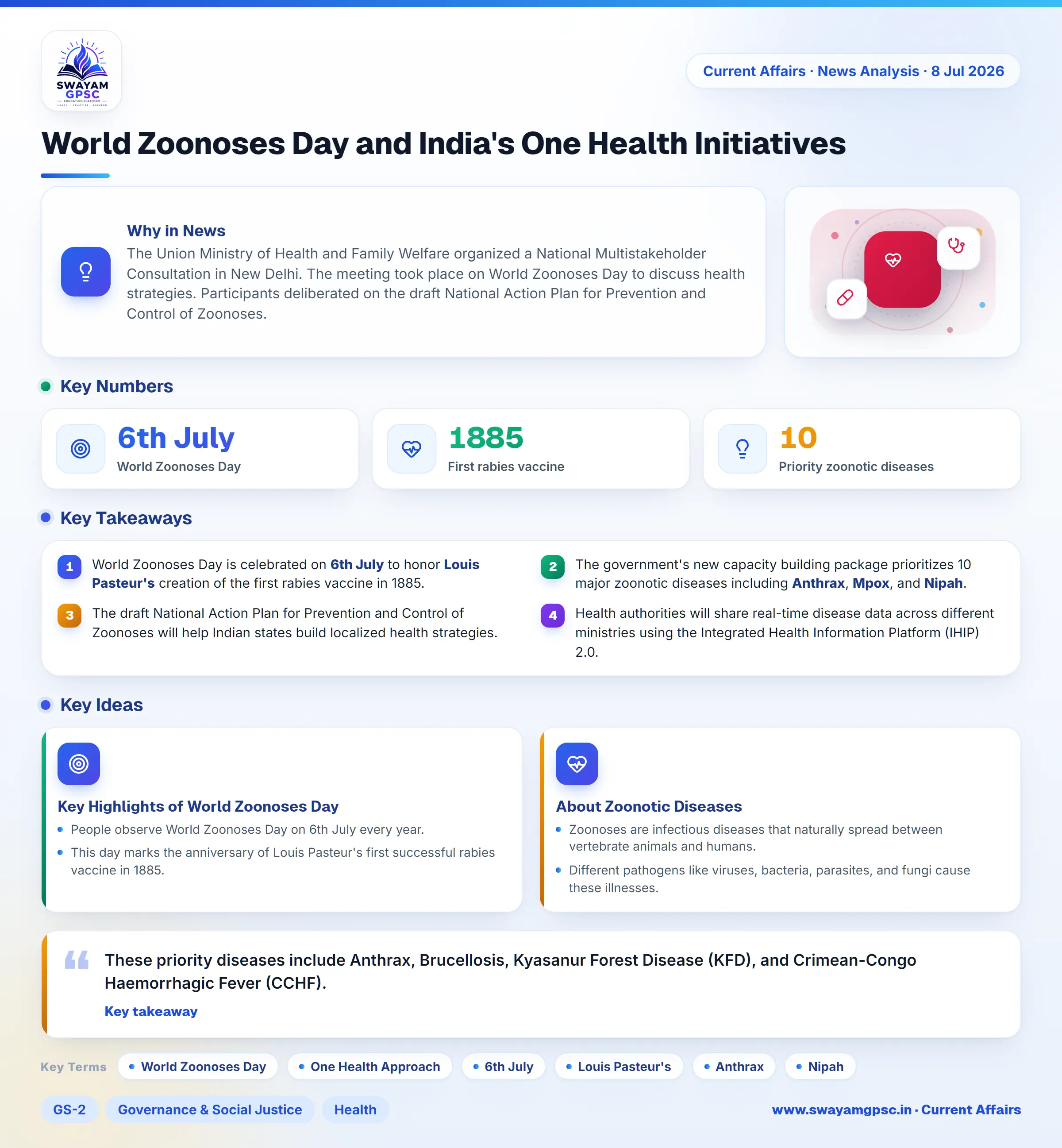
World Zoonoses Day and India's One Health Initiatives
#GS-2 #Governance & Social Justice #Health #Current Events #National
Key takeaways
- World Zoonoses Day is celebrated on 6th July to honor Louis Pasteur's creation of the first rabies vaccine in 1885.
- The government's new capacity building package prioritizes 10 major zoonotic diseases including Anthrax, Mpox, and Nipah.
- The draft National Action Plan for Prevention and Control of Zoonoses will help Indian states build localized health strategies.
- Health authorities will share real-time disease data across different ministries using the Integrated Health Information Platform (IHIP) 2.0.
Why in News
- The Union Ministry of Health and Family Welfare organized a National Multistakeholder Consultation in New Delhi.
- The meeting took place on World Zoonoses Day to discuss health strategies.
- Participants deliberated on the draft National Action Plan for Prevention and Control of Zoonoses.
- This draft plan builds on the One Health Approach to connect human, animal, and environmental health.
Key Highlights of World Zoonoses Day
- People observe World Zoonoses Day on 6th July every year.
- This day marks the anniversary of Louis Pasteur's first successful rabies vaccine in 1885.
- The official theme for the year 2026 is One World, One Health: Prevent Zoonoses.
- The new national plan will guide States and Union Territories to design their own customized local plans.
- The government launched two technical tools under the National One Health Programme for Prevention and Control of Zoonoses.
- The first tool is a Learning Resource Package that targets 10 priority zoonotic diseases.
- These priority diseases include Anthrax, Brucellosis, Kyasanur Forest Disease (KFD), and Crimean-Congo Haemorrhagic Fever (CCHF).
- Other targeted diseases are Nipah, Mpox, Rabies, Leptospirosis, Scrub Typhus, and Zika.
- The second tool consists of E-Learning Modules to train doctors, veterinarians, and public health workers.
- Experts highlighted the need to share real-time health data across sectors using the Integrated Health Information Platform (IHIP) 2.0.
- The National Centre for Disease Control (NCDC) will lead these disease surveillance efforts and handle risk communication.
About Zoonotic Diseases
- Zoonoses are infectious diseases that naturally spread between vertebrate animals and humans.
- Different pathogens like viruses, bacteria, parasites, and fungi cause these illnesses.
- Direct contact with an infected animal's saliva, blood, urine, or feces can transmit the disease.
- Indirect contact with surfaces or areas where infected animals live can also spread the infection.
- Vector-borne transmission happens when bugs like ticks, mosquitoes, or fleas bite a person.
- Foodborne transmission occurs when people consume contaminated meat, unpasteurized milk, or dirty water.