Scheme to Boost Sintered Rare Earth Permanent Magnet Manufacturing
#GS-3 #Economy #Infrastructure #Science & Technology #Energy #GS-2 #Governance & Social Justice #Current Events #National #Critical Minerals #Rare Earth Elements
Key takeaways
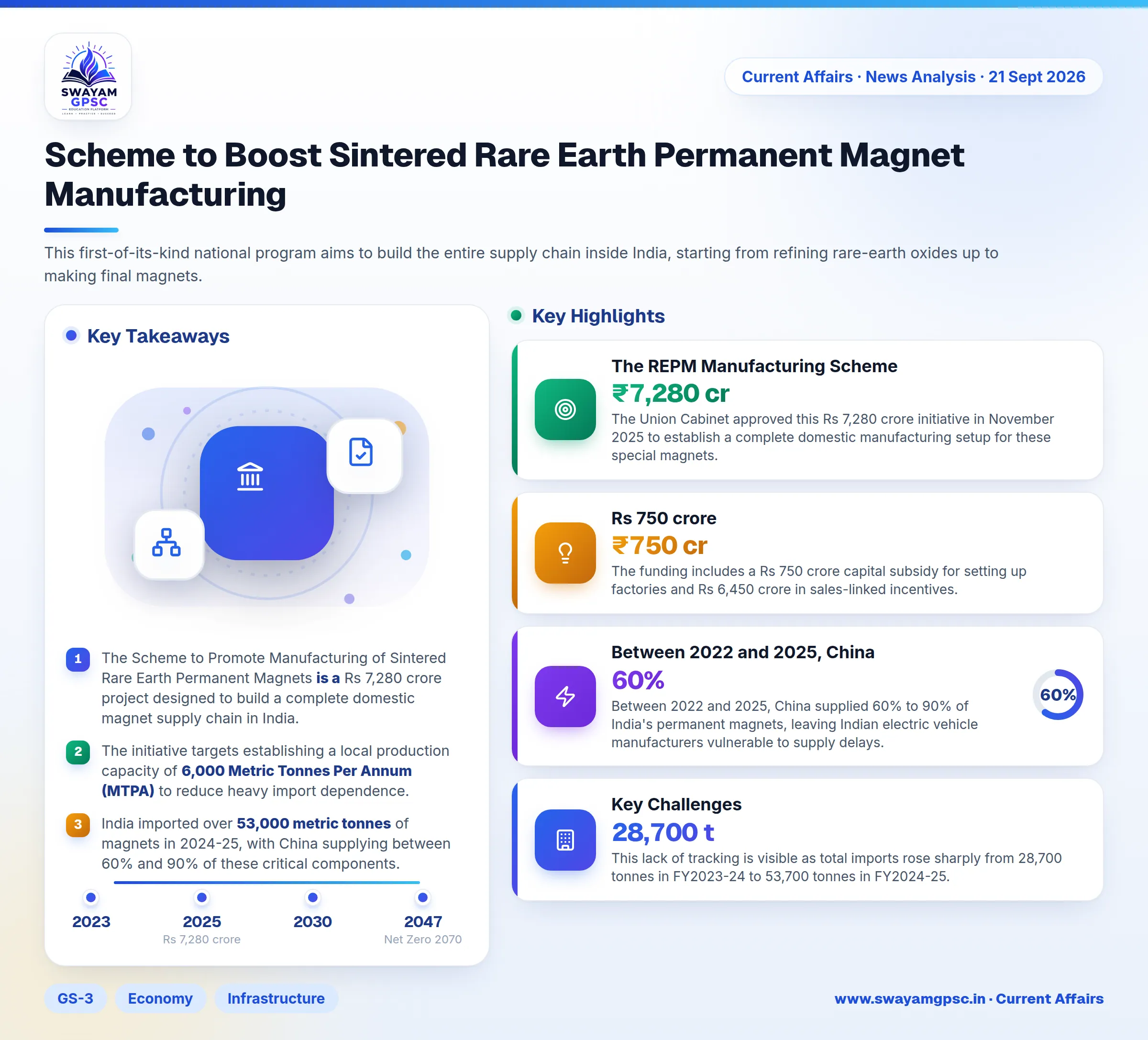
- The Scheme to Promote Manufacturing of Sintered Rare Earth Permanent Magnets is a Rs 7,280 crore project designed to build a complete domestic magnet supply chain in India.
- The initiative targets establishing a local production capacity of 6,000 Metric Tonnes Per Annum (MTPA) to reduce heavy import dependence.
- India imported over 53,000 metric tonnes of magnets in 2024-25, with China supplying between 60% and 90% of these critical components.
- Although India holds 13.15 million tonnes of monazite, its deposits lack heavy rare earth elements like Dysprosium and Terbium needed for high-temperature electric vehicle motors.
Why in News
- The government introduced the Scheme to Promote Manufacturing of Sintered Rare Earth Permanent Magnets to build a strong local magnet industry.
- This program aims to establish a self-reliant domestic ecosystem and reduce India's heavy import dependence on China.
- However, researchers point out a major visibility problem in tracking India's actual technical skills and dependencies across the entire rare earth supply chain.
The REPM Manufacturing Scheme
- The Union Cabinet approved this Rs 7,280 crore initiative in November 2025 to establish a complete domestic manufacturing setup for these special magnets.
- This first-of-its-kind national program aims to build the entire supply chain inside India, starting from refining rare-earth oxides up to making final magnets.
- The government aims to establish a domestic production capacity of 6,000 Metric Tonnes Per Annum (MTPA).
- This total capacity will be divided among five selected companies with each producing 1,200 MTPA through a global bidding process.
- The funding includes a Rs 750 crore capital subsidy for setting up factories and Rs 6,450 crore in sales-linked incentives.
- The program will run for 7 years, which includes two years for building the factories and five years for distributing the financial incentives.
- India needs this scheme because local demand for these magnets will likely double by the year 2030.
- Currently, India depends heavily on foreign supplies and imported more than 53,000 metric tonnes of magnets in 2024-25 alone.
- Between 2022 and 2025, China supplied 60% to 90% of India's permanent magnets, leaving Indian electric vehicle manufacturers vulnerable to supply delays.
- Building a local magnet industry is vital for clean mobility and helps India reach its Net Zero 2070 and Viksit Bharat 2047 goals.
Understanding Rare Earth Permanent Magnets
- These high-performance magnets use rare-earth elements like Samarium (Sm), Neodymium (Nd), Praseodymium (Pr), Dysprosium (Dy), and Cerium (Ce).
- These magnets are far stronger, more durable, and more compact than traditional ferrite or AlNiCo magnets.
- Sintered magnets are made by crushing alloys into a fine powder, pressing them into shapes, and heating them to create dense, powerful structures.
- Sintered Neodymium-Iron-Boron (NdFeB) and Samarium-Cobalt (SmCo) magnets are the strongest commercial permanent magnets available today.
- These magnets are crucial for electric vehicle traction motors, steering, and brakes because they improve vehicle power and increase battery range.
India's Policy Initiatives
- The Mines and Minerals (Development and Regulation) Amendment Act, 2023 removed rare earths from the atomic minerals list to allow private sector mining.
- The government launched the National Critical Minerals Mission (NCMM) in January 2025 to secure critical mineral supplies through mining, recycling, and foreign acquisitions.
- The Union Budget 2026-27 announced dedicated rare earth corridors in Odisha, Kerala, Andhra Pradesh, and Tamil Nadu to connect mining with manufacturing.
- India is building international partnerships with nations like Australia, Argentina, Zambia, and Mozambique to secure mineral supplies.
- The state-owned company Khanij Bidesh India Limited (KABIL) is actively acquiring overseas mining assets, including lithium exploration blocks in Argentina.
Key Challenges
- India faces a major visibility gap because many magnets enter the country hidden inside imported electric vehicle motors and wind turbines.
- This lack of tracking is visible as total imports rose sharply from 28,700 tonnes in FY2023-24 to 53,700 tonnes in FY2024-25.
- Critical mineral auctions suffer from poor participation because of weak geological data, meaning only 48% of blocks auctioned from 2020 to 2023 were successfully sold.
- India has a large monazite resource base of 13.15 million tonnes containing 7.23 million tonnes of rare earth oxides across eight states.
- The country's monazite deposits contain mostly light rare earth elements but lack heavy rare earth elements like Dysprosium and Terbium, which are necessary for high-temperature vehicle magnets.
- Monazite is found alongside radioactive Thorium, which is restricted for India's nuclear program and subjects extraction to strict atomic energy rules.
- India lacks a circular economy for these materials because it does not have specific recycling targets for rare earth magnets, treating them as general electronic waste.
Way Forward
- The government must update the monitoring framework of the National Critical Mineral Mission to map domestic capabilities at every single stage of production.
- India needs to use mineral diplomacy to secure long-term supply contracts for heavy rare earths like Dysprosium and process these materials domestically.
- The state should create a clear, licensed path for private companies to process monazite while safely returning radioactive thorium to government agencies.
- Developing urban mining protocols will help recover used NdFeB magnets from old electric vehicles, providing a steady supply of recycled rare earths without new mining.