India's Fintech Ecosystem and Digital Finance Revolution
#GS-3 #Economy #Banking #Infrastructure #Science & Technology #ICT #Artificial Intelligence #Current Events #National
Key takeaways
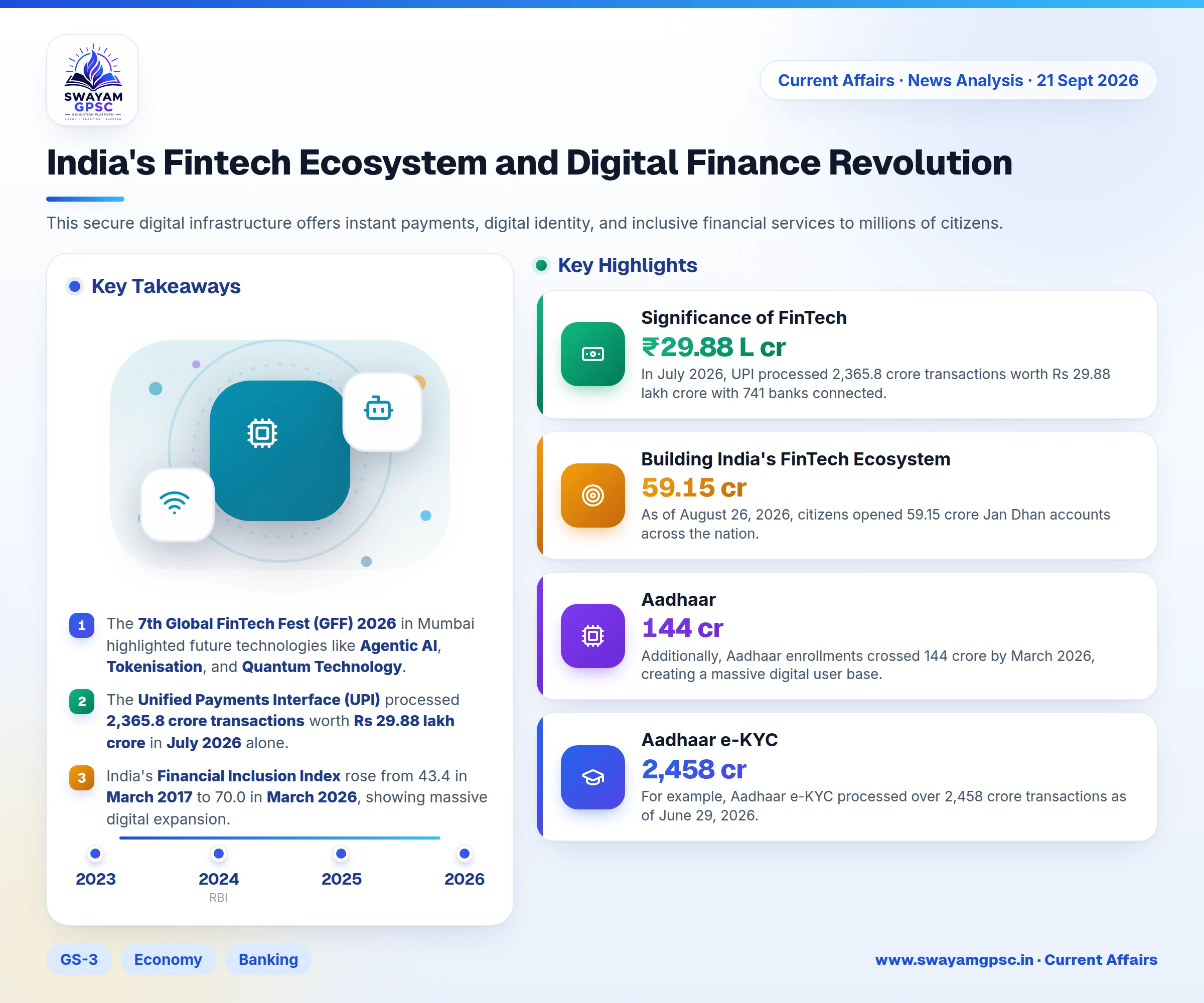
- The 7th Global FinTech Fest (GFF) 2026 in Mumbai highlighted future technologies like Agentic AI, Tokenisation, and Quantum Technology.
- The Unified Payments Interface (UPI) processed 2,365.8 crore transactions worth Rs 29.88 lakh crore in July 2026 alone.
- India's Financial Inclusion Index rose from 43.4 in March 2017 to 70.0 in March 2026, showing massive digital expansion.
- The JAM Trinity has scaled up to 59.15 crore Jan Dhan accounts and over 144 crore Aadhaar enrollments as of 2026.
- Cumulative Direct Benefit Transfer (DBT) transfers reached Rs 53.26 lakh crore by September 2026, ensuring leak-proof welfare delivery.
Why in News
- Mumbai recently hosted the 7th edition of the Global FinTech Fest (GFF) 2026 to showcase digital finance growth.
- This festival highlighted India's massive progress in financial technology and digital payment systems.
- India transformed its financial landscape using Digital Public Infrastructure (DPI) like Aadhaar and UPI.
- This secure digital infrastructure offers instant payments, digital identity, and inclusive financial services to millions of citizens.
Global Fintech Fest (GFF) Key Facts
- The Global FinTech Fest (GFF) acts as a global platform for fintech innovation, collaboration, and discussion.
- It showcases India's achievements in digital finance and its success with Digital Public Infrastructure (DPI).
- The festival started in 2020 and has quickly grown into one of the leading global fintech gatherings.
- It connects global innovators, policymakers, and financial industry leaders in one collaborative space.
- The Payments Council of India (PCI), National Payments Corporation of India (NPCI), and Fintech Convergence Council (FCC) organize this event.
- Major institutions like the RBI, MeitY, SEBI, and NITI Aayog actively support the festival.
- The theme for GFF 2026 focuses on three transformative technologies: Agentic AI, Tokenisation, and Quantum systems.
- Agentic AI allows systems to make real-time decisions, automate processes, prevent fraud, and offer personalized services.
- Tokenisation enables programmable digital assets, fractional ownership, and much faster transaction settlements.
- Quantum Technology strengthens financial security through quantum-safe security systems and advanced computing.
What is FinTech
- Financial Technology (FinTech) refers to technology-driven innovations that improve the delivery, speed, and accessibility of financial services.
- It includes new business models, applications, and products that influence how financial markets and institutions operate.
Key Enabling Technologies
- Application Programming Interfaces (APIs) allow different software applications to communicate and share data smoothly.
- Cloud Computing provides scalable and flexible digital infrastructure over the internet to reduce operational costs.
- Biometric Technology uses unique physical traits like fingerprints and facial recognition for secure user authentication.
- Distributed Ledger Technology (DLT) records transaction data across multiple secure locations simultaneously to boost transparency.
- Big Data Analytics helps financial institutions study massive amounts of data to make better business decisions.
- Artificial Intelligence (AI) and Machine Learning (ML) enable computers to learn from data patterns and automate complex tasks.
Significance of FinTech
- FinTech makes financial services much faster, cheaper, and highly efficient for the common citizen.
- The Unified Payments Interface (UPI) is recognized by the International Monetary Fund (IMF) as the largest real-time payment system globally.
- In July 2026, UPI processed 2,365.8 crore transactions worth Rs 29.88 lakh crore with 741 banks connected.
- The monthly transaction volume on the UPI platform has grown nearly 12,000 times since FY 2016-17.
- FinTech promotes financial inclusion by overcoming information gaps and reducing high transaction costs for users.
- India's Financial Inclusion Index rose from 43.4 in March 2017 to 70.0 in March 2026.
- FinTech platforms expand credit access through alternative lending models, reducing dependency on traditional banks.
- This diversification of credit sources increases competition, resilience, and overall stability in the financial ecosystem.
Building India's FinTech Ecosystem
- The Jan Dhan-Aadhaar-Mobile (JAM) Trinity serves as the foundation for digital financial inclusion in India.
- Jan Dhan accounts provide banking access, Aadhaar offers secure digital identity, and mobile connectivity links users to services.
- As of August 26, 2026, citizens opened 59.15 crore Jan Dhan accounts across the nation.
- Additionally, Aadhaar enrollments crossed 144 crore by March 2026, creating a massive digital user base.
- UPI forms the backbone of digital payments, offering instant, low-cost, and highly interoperable transactions.
- Digital identity systems have reduced barriers in financial onboarding through quick paperless customer verification.
- For example, Aadhaar e-KYC processed over 2,458 crore transactions as of June 29, 2026.
- DigiLocker has over 73.53 crore registered users and has issued 936.03 crore documents as of 2026.
- The Direct Benefit Transfer (DBT) system transfers government benefits directly into bank accounts, reducing leakages.
- Cumulative transfers under DBT reached Rs 53.26 lakh crore as of September 2026, showing massive scale.
- The Open Network for Digital Commerce (ONDC) creates an open digital marketplace that goes beyond standard payments.
- By June 2026, ONDC expanded to over 20 crore buyers and 5 lakh sellers across 1,000 cities.
- The ONDC Financial Services category allows fintech firms to deliver digital financial products to a wider audience.
Regulatory Ecosystem in India
- The RBI introduced the Framework for Self-Regulatory Organisation(s) in the FinTech Sector (SRO-FT) 2024 to promote ethical practices.
- The RBI Master Directions on Digital Payment Security Controls (2021) establish minimum security standards for digital banking channels.
- The NPCI uses advanced AI and ML fraud monitoring systems to secure UPI transactions in real time.
- The Digital Personal Data Protection Act, 2023 and the Digital Personal Data Protection Rules, 2025 protect user privacy.
- The RBI Regulatory Sandbox framework, launched in August 2019, lets companies test innovative products safely.
- To fight fraudulent lending, the RBI uses tools like the Digital Lending Apps (DLA) directory to protect consumers.
- Citizens can report digital financial fraud through the National Cybercrime Reporting Portal or by calling the helpline 1930.
- The government launched the SACHET portal to help citizens report illegal deposit-taking and financial scams easily.
Conclusion
- India's fintech journey shows how combining Digital Public Infrastructure (DPI), innovation, and trust can democratize finance.
- The next phase of growth will depend on balancing technological advancements with safety, inclusion, and responsible regulation.