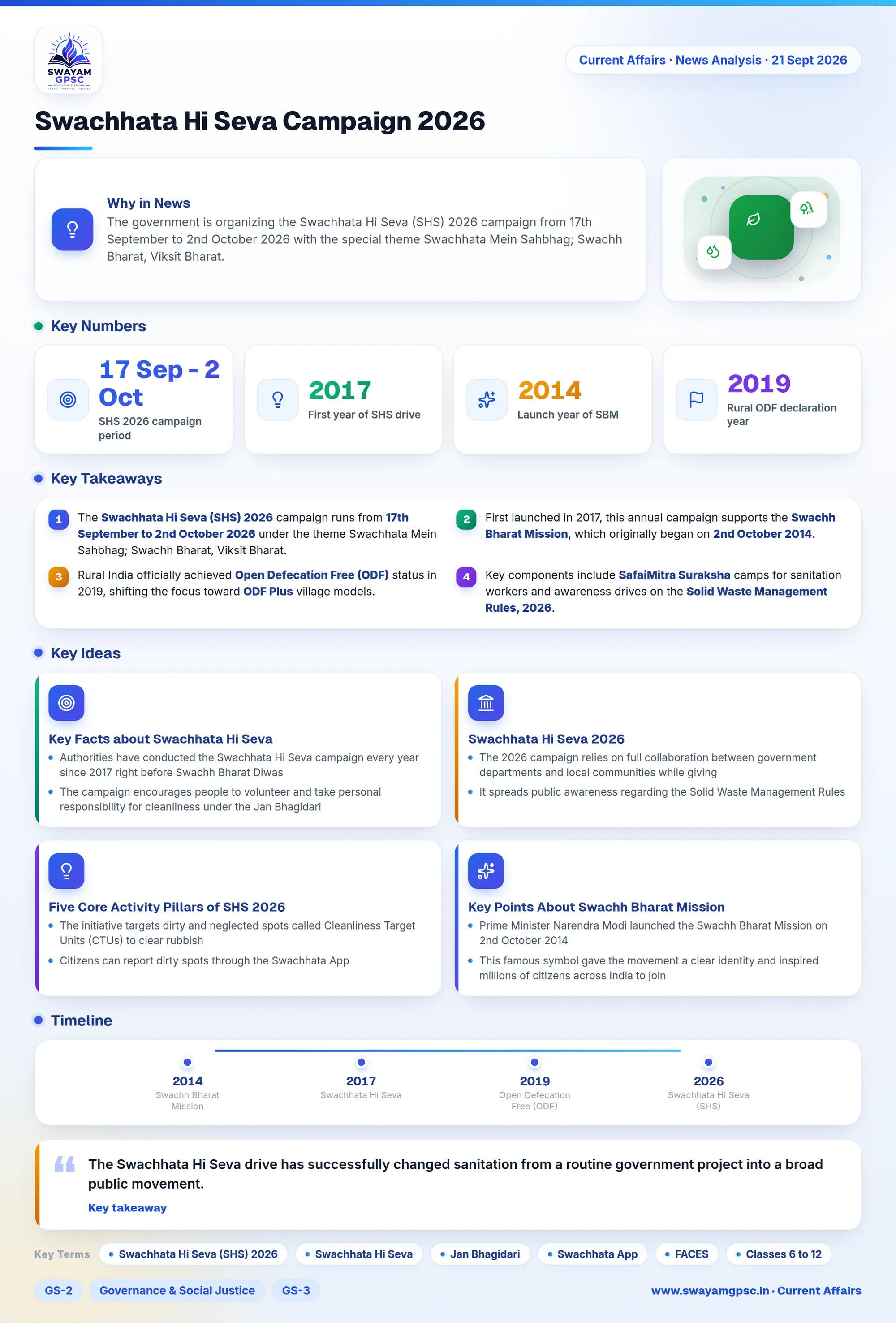
Swachhata Hi Seva Campaign 2026
#GS-2 #Governance & Social Justice #GS-3 #Environment #Sustainable Development #Current Events #National
Key takeaways
- The Swachhata Hi Seva (SHS) 2026 campaign runs from 17th September to 2nd October 2026 under the theme Swachhata Mein Sahbhag; Swachh Bharat, Viksit Bharat.
- First launched in 2017, this annual campaign supports the Swachh Bharat Mission, which originally began on 2nd October 2014.
- Rural India officially achieved Open Defecation Free (ODF) status in 2019, shifting the focus toward ODF Plus village models.
- Key components include SafaiMitra Suraksha camps for sanitation workers and awareness drives on the Solid Waste Management Rules, 2026.
Why in News
- The government is organizing the Swachhata Hi Seva (SHS) 2026 campaign from 17th September to 2nd October 2026 with the special theme Swachhata Mein Sahbhag; Swachh Bharat, Viksit Bharat.
Key Facts about Swachhata Hi Seva
- Authorities have conducted the Swachhata Hi Seva campaign every year since 2017 right before Swachh Bharat Diwas on 2nd October.
- The campaign encourages people to volunteer and take personal responsibility for cleanliness under the Jan Bhagidari vision of the Swachh Bharat Mission.
- Over the years, the program has grown to cover long-term sanitation, waste disposal, worker welfare, and youth engagement through combined public and government effort.
Swachhata Hi Seva 2026
- The 2026 campaign relies on full collaboration between government departments and local communities while giving active leadership roles to young citizens.
- It spreads public awareness regarding the Solid Waste Management Rules, 2026 so that everyone understands their specific role in managing waste.
Five Core Activity Pillars of SHS 2026
- The initiative targets dirty and neglected spots called Cleanliness Target Units (CTUs) to clear rubbish, beautify the area, and keep them clean permanently.
- Citizens can report dirty spots through the Swachhata App, and teams record these problem areas on the official SHS 2026 website portal.
- Assessors evaluate public toilets using FACES parameters, checking if facilities are Functional, Accessible, Clean, Eco-friendly, and Safe.
- Under Swachh Paathshala Yuva for Swachhata, students and young people take the lead in spreading lasting habits of personal and public hygiene.
- Students in Classes 6 to 12 join educational trips named Swachhata Gyan Yatras to learn about modern waste processing and hygiene practices.
- The SafaiMitra Suraksha Seva Evam Samman Shivirs provide medical care, protective gear, and welfare benefits to sanitation workers and their families.
- Community participation remains the central focus, prompting citizens and private institutions to maintain daily cleanliness in their surroundings.
- The drive teaches proper waste practices, such as separating garbage four ways at home, composting organic waste, and stopping public littering under the Solid Waste Management Rules, 2026.
- Organizers conduct rallies, form human chains, lead pledges, collect reusable household items, and campaign heavily against single-use plastics.
- The Swachh Parv, Harit Parv initiative encourages people to celebrate local festivals without using plastic or causing environmental harm.
- Under Swachhata Se Samriddhi, the campaign connects waste cleanup with economic value by using the Reduce, Reuse and Recycle (3R) principle.
- Programs like Kabaad Se Jugaad turn discarded items into useful everyday products, while Kabaad Se Kala converts waste into creative artwork.
- These activities convert ordinary waste into valuable resources while promoting community creativity and environmental balance.
Key Points About Swachh Bharat Mission
- Prime Minister Narendra Modi launched the Swachh Bharat Mission on 2nd October 2014, taking inspiration from Mahatma Gandhi's glasses in its official emblem.
- This famous symbol gave the movement a clear identity and inspired millions of citizens across India to join the cause.
- The Swachh Bharat Mission Grameen (SBM-G) branch addresses village sanitation, household toilet access, and rural waste management.
- The Swachh Bharat Mission Urban (SBM-U) branch focuses on city sanitation facilities, public place cleanliness, and urban waste processing.
- Rural regions across the nation officially attained Open Defecation Free (ODF) status in 2019.
- An ODF Plus Village maintains its open defecation free status while properly handling solid waste, liquid waste, and overall cleanliness.
- Under the Aspiring category, a village manages either solid waste or liquid waste effectively.
- Under the Rising category, a village manages both solid waste and liquid waste successfully.
- Under the Model category, a village manages both waste streams while maintaining visual cleanliness and displaying educational sanitation messages.
Conclusion
- The Swachhata Hi Seva drive has successfully changed sanitation from a routine government project into a broad public movement.
- The focus has shifted over time from building simple toilets to scientific waste processing, city transformation, and daily habit changes.
- Continuous public involvement, modern waste management, and respect for sanitation workers will help build a clean and healthy nation.