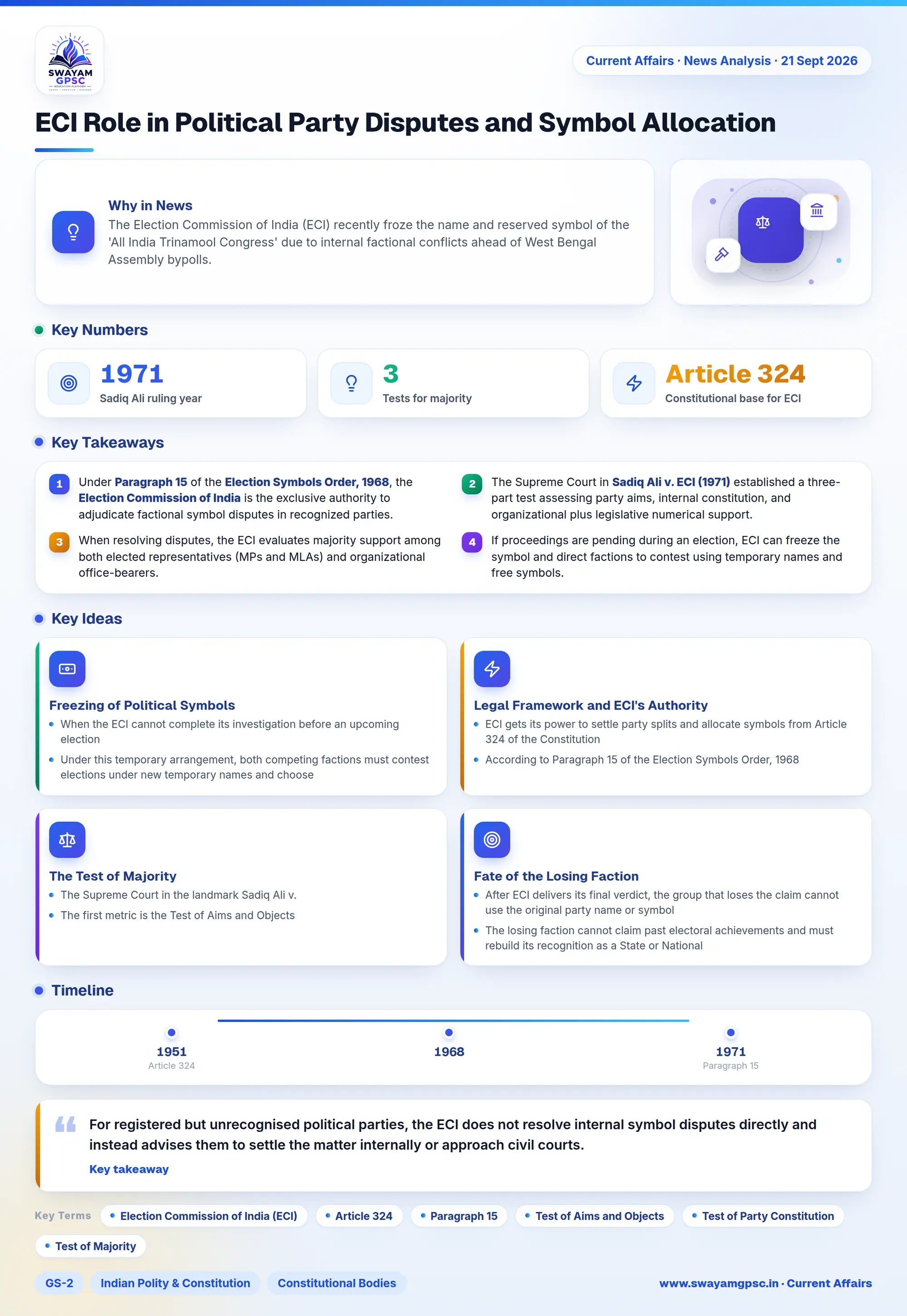
ECI Role in Political Party Disputes and Symbol Allocation
#GS-2 #Indian Polity & Constitution #Constitutional Bodies #Election Commission of India #Elections
Key takeaways
- Under Paragraph 15 of the Election Symbols Order, 1968, the Election Commission of India is the exclusive authority to adjudicate factional symbol disputes in recognized parties.
- The Supreme Court in Sadiq Ali v. ECI (1971) established a three-part test assessing party aims, internal constitution, and organizational plus legislative numerical support.
- When resolving disputes, the ECI evaluates majority support among both elected representatives (MPs and MLAs) and organizational office-bearers.
- If proceedings are pending during an election, ECI can freeze the symbol and direct factions to contest using temporary names and free symbols.
Why in News
- The Election Commission of India (ECI) recently froze the name and reserved symbol of the 'All India Trinamool Congress' due to internal factional conflicts ahead of West Bengal Assembly bypolls.
Freezing of Political Symbols
- When the ECI cannot complete its investigation before an upcoming election, it can issue an interim order to temporarily freeze the party's reserved symbol.
- Under this temporary arrangement, both competing factions must contest elections under new temporary names and choose separate symbols from the list of free symbols.
Legal Framework and ECI's Authority
- ECI gets its power to settle party splits and allocate symbols from Article 324 of the Constitution, the Representation of the People Act, 1951, and the Election Symbols (Reservation and Allotment) Order, 1968.
- According to Paragraph 15 of the Election Symbols Order, 1968, the ECI is the only authority that can legally decide which faction is the authentic party, and its decision is final and binding.
- For registered but unrecognised political parties, the ECI does not resolve internal symbol disputes directly and instead advises them to settle the matter internally or approach civil courts.
The Test of Majority
- The Supreme Court in the landmark Sadiq Ali v. Election Commission of India (1971) case confirmed ECI's authority under Paragraph 15 and laid down a three-test formula to identify the real political party.
- The first metric is the Test of Aims and Objects, where the ECI reviews the political party's constitution and core objectives.
- The second metric is the Test of Party Constitution, where the commission checks whether the factions followed internal democratic processes and organizational election rules.
- The most vital metric is the Test of Majority, where ECI counts the actual support each faction enjoys in both the organizational structure and among elected MPs and MLAs.
- As a fallback mechanism, if organizational support is unclear or disputed, ECI gives maximum weight to the majority support among elected legislative representatives.
Fate of the Losing Faction
- After ECI delivers its final verdict, the group that loses the claim cannot use the original party name or symbol, though it may register under a new name and symbol provided by ECI.
- The losing faction cannot claim past electoral achievements and must rebuild its recognition as a State or National party solely through its performance in future elections.