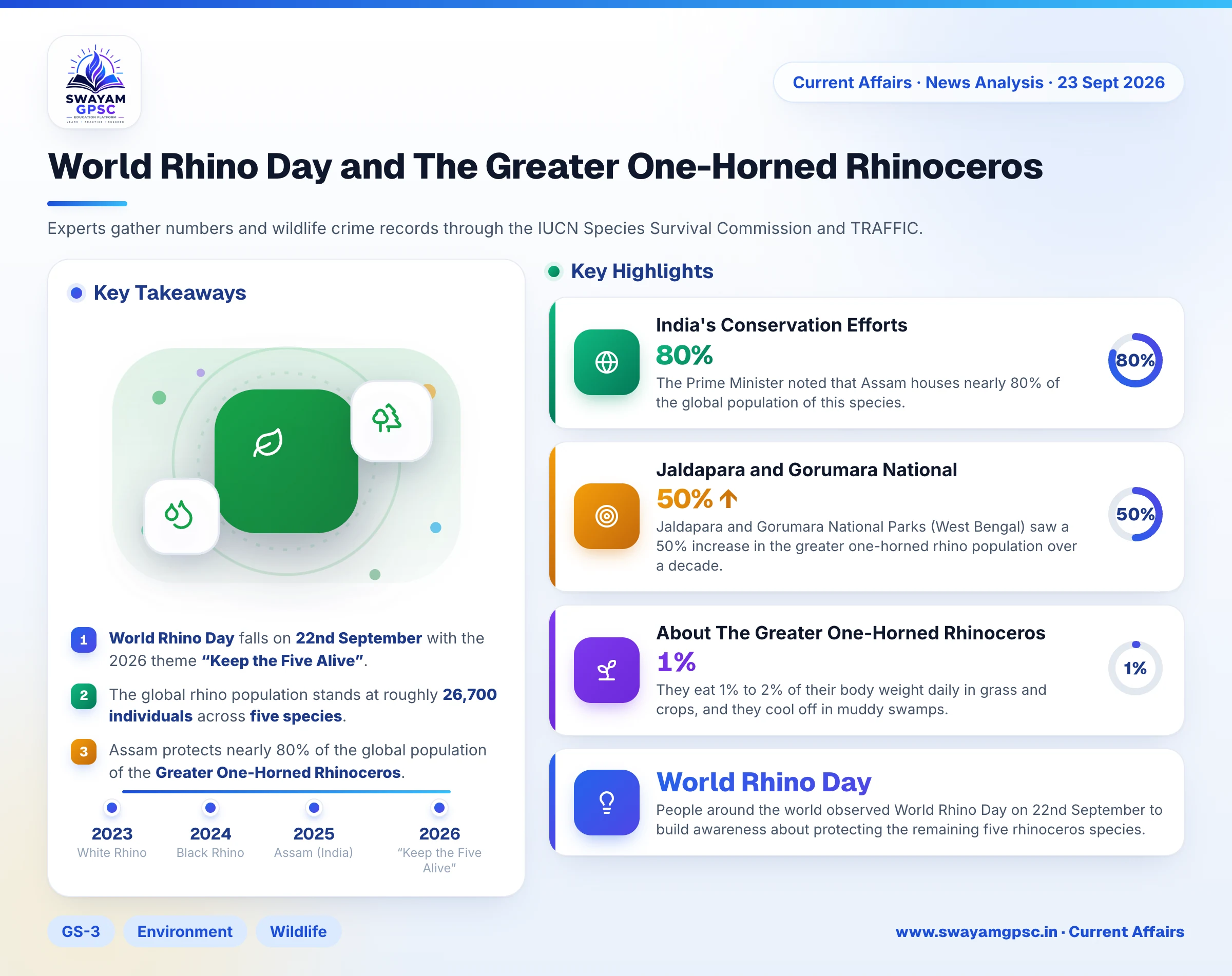
World Rhino Day and The Greater One-Horned Rhinoceros
#GS-3 #Environment #Wildlife #Conservation #Biodiversity #Protected Areas #National #Current Events
Key takeaways
- World Rhino Day falls on 22nd September with the 2026 theme “Keep the Five Alive”.
- The global rhino population stands at roughly 26,700 individuals across five species.
- Assam protects nearly 80% of the global population of the Greater One-Horned Rhinoceros.
- Assam and Nepal both recorded zero known rhino poaching in 2025.
- The IUCN Red List classifies the Greater One-Horned Rhino as Vulnerable (VU).
Why in News
- People around the world observed World Rhino Day on 22nd September to build awareness about protecting the remaining five rhinoceros species.
- The theme for 2026 is “Keep the Five Alive”, which concentrates on safeguarding rhino habitats and stopping illegal horn trading.
- The International Rhino Foundation (IRF) launched its 2026 State of the Rhino Report to share updates on rhino numbers and conservation hurdles.
Key Highlights of the Report
- The International Rhino Foundation (IRF) State of the Rhino Report evaluates population changes and protection obstacles every year.
- Experts gather numbers and wildlife crime records through the IUCN Species Survival Commission and TRAFFIC.
- The total worldwide rhino population is roughly 26,700 individuals, showing mixed results where some groups grow while others struggle.
- The Greater One-Horned Rhino population grew to about 4,075, proving that dedicated protection plans work well.
- The Black Rhino population rose from 6,195 in 2022 to 6,788 in 2024, showing steady improvement.
- The White Rhino population dropped from 17,464 in 2023 to 15,752 in 2024, mainly due to illegal hunting in South Africa.
- The Javan Rhino faces a high risk of extinction because illegal hunting between 2019 and 2023 caused steep population drops.
- The Sumatran Rhino deals with shrinking homes and breeding trouble, though captive breeding offers some hope.
- Illegal hunting, black market horn trade, and lost habitats remain the biggest dangers to rhino survival.
- Conservationists use animal movement programs to rebuild historical homes, though finding suitable land remains tough in Asian range countries.
- The Sumatran Rhino Sanctuary in Way Kambas National Park, Indonesia, runs semi-wild breeding programs to save the species.
- Teams use modern tracking gear like camera traps and footprint tracking to watch over rhino groups and protect them better.
- The report stresses that the world must act quickly to save critically endangered Javan and Sumatran rhinos.
India's Conservation Efforts
- India protects the Greater One-Horned Rhino, which lives mostly inside Kaziranga National Park, Assam.
- The Prime Minister noted that Assam houses nearly 80% of the global population of this species.
- Assam (India) reported zero known rhino poaching in 2025, marking only the second time since the 1970s.
- Nepal also reached zero rhino poaching in 2025, which is its 10th such achievement since 2011.
- The Dudhwa Tiger Reserve (Uttar Pradesh) grew its rhino count from 42 in 2022 to 53.
- Jaldapara and Gorumara National Parks (West Bengal) saw a 50% increase in the greater one-horned rhino population over a decade.
- India, Bhutan, Nepal, Indonesia, and Malaysia signed the New Delhi Declaration on Asian Rhinos to protect the animals.
- Authorities collect DNA Profiles of all Rhinos to stop illegal hunting and build strong court cases against wildlife criminals.
- The government introduced the National Rhino Conservation Strategy in 2019 to protect the species.
- India runs dedicated programs like Project Rhino and Indian Rhino Vision (IRV) 2020 to manage habitats and genetics.
About The Greater One-Horned Rhinoceros
- Also called the Indian Rhinoceros, it is the biggest Asian rhino and the second-largest plant-eating land animal in Asia after the elephant.
- It belongs to the three Asian rhino species alongside Javan and Sumatran rhinos, separate from African white and black rhinos.
- These animals prefer river floodplains, tall grasslands, swamps, and forests near the Himalayas.
- They live in small, scattered groups across northern India and southern Nepal.
- Key Indian homes include Assam, West Bengal, Uttar Pradesh, and Bihar.
- The IUCN Red List lists the animal as Vulnerable (VU) after its numbers crossed 4,000.
- Their single nasal horn grows 20 to 60 cm long and consists purely of keratin without bone attachment.
- Their thick skin forms deep folds that look like segmented body armor.
- Unlike African rhinos, they use sharp lower incisor tusks to fight instead of their horns.
- They eat 1% to 2% of their body weight daily in grass and crops, and they cool off in muddy swamps.
- They live alone and leave droppings in communal dung middens to talk to other rhinos through scents.