World Population Day and Demographic Trends in India
#GS-2 #GS-3 #Governance & Social Justice #Economy #Population #Employment #Poverty #Health #Current Events #National
Key takeaways
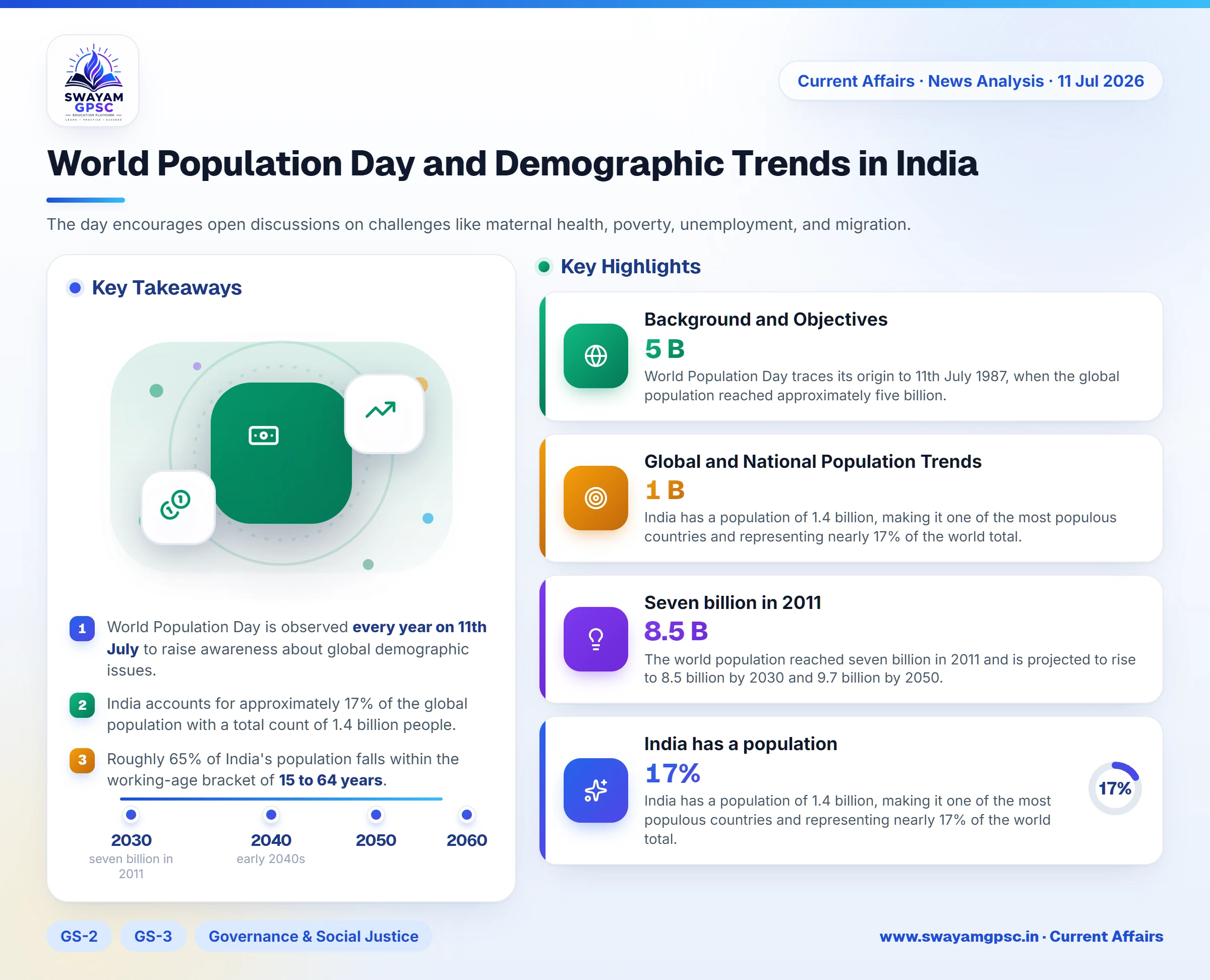
- World Population Day is observed every year on 11th July to raise awareness about global demographic issues.
- India accounts for approximately 17% of the global population with a total count of 1.4 billion people.
- Roughly 65% of India's population falls within the working-age bracket of 15 to 64 years.
- Educated youth unemployment in India remains high at approximately 18% when accounting for discouraged job seekers.
- Only 3% of India's total workforce has received formal vocational training.
Why in News
- World Population Day is observed every year on 11th July to raise awareness about global population issues.
- Recent analyses highlight that India is facing serious concerns regarding the erosion of its demographic dividend due to various institutional hurdles.
Background and Objectives
- World Population Day traces its origin to 11th July 1987, when the global population reached approximately five billion.
- The United Nations Development Programme formally established this observance in 1989 to address rapid population growth.
- The day encourages open discussions on challenges like maternal health, poverty, unemployment, and migration.
- The theme for 2026 is focused on realizing the hopes and aspirations of young people today and for the future.
Global and National Population Trends
- The global population took thousands of years to reach one billion, but expanded sevenfold within the next two centuries.
- The world population reached seven billion in 2011 and is projected to rise to 8.5 billion by 2030 and 9.7 billion by 2050.
- India has a population of 1.4 billion, making it one of the most populous countries and representing nearly 17% of the world total.
- India's population is expected to peak around 1.7 to 1.9 billion by the 2060s to 2080s before stabilizing.
Demographic Dividend and Employment Challenges
- Roughly 65% of India's population is in the working-age bracket of 15 to 64 years, creating a favorable dependency ratio.
- This unique demographic window will not recur and will reverse by the early 2040s as the population ages.
- Only 3% of India's workforce has received formal vocational training.
- Over 30 crore workers are currently registered on the e-Shram portal.
- While standard labor surveys record general youth unemployment at 8.2%, real youth joblessness among educated youth reaches approximately 18% when including discouraged youth.
- Urban female youth unemployment stands at 20.1%, while female labor-force participation remains just above one-fifth.
Institutional and Structural Challenges
- Distorted recruitment calendars and court cases often extend government job selections by 3 to 4 years.
- Pre-election spending often prioritizes short-term political visibility over timely project completion.
- Prolonged recruitment delays disproportionately harm first-generation learners and disadvantaged candidates.
- The growing reliance on contract labor reduces job security, worker protections, and long-term skill investments.
- Delayed welfare benefits under schemes like PMAY and PM-Kisan trap beneficiaries in prolonged verification loops.
Global and Domestic Lessons
- South Korea successfully linked industrial licenses and bank credit to export and employment targets.
- Brazil implemented Bolsa Família, a conditional cash transfer program reaching over 50 million people by linking benefits to school attendance.
- Kerala used decentralized accountability through the People's Plan Campaign to devolve 35 to 40% of plan funds to local bodies.
- Germany used worker representation in corporate governance to encourage long-term vocational training investments.
Way Forward
- Introduce legally binding deadlines and accountability mechanisms for delayed public works.
- Reform programs like Skill India and PMKVY to shift focus toward industry-linked, multi-year apprenticeships.
- Require central and state recruitment agencies to fill vacancies within fixed annual timelines, preferably within 12 months.
- Design welfare benefits to actively support families in transitioning toward stable formal employment.
- Protect contract workers by ensuring fair baseline wages, social protection, and skill development access.
Prelims in Focus
- The Lives, Choices and Futures report draws on views from over 108,000 internet-connected adults aged 18 to 39 across 73 countries.
- India accounts for approximately 17% of the total global population.