World Fisheries Day 2026: Strengthening Sustainable Blue Economy
#GS-3 #Economy #Environment #Current Events #Food Security #Agriculture #Climate Change #Sustainable Development #National
Key takeaways
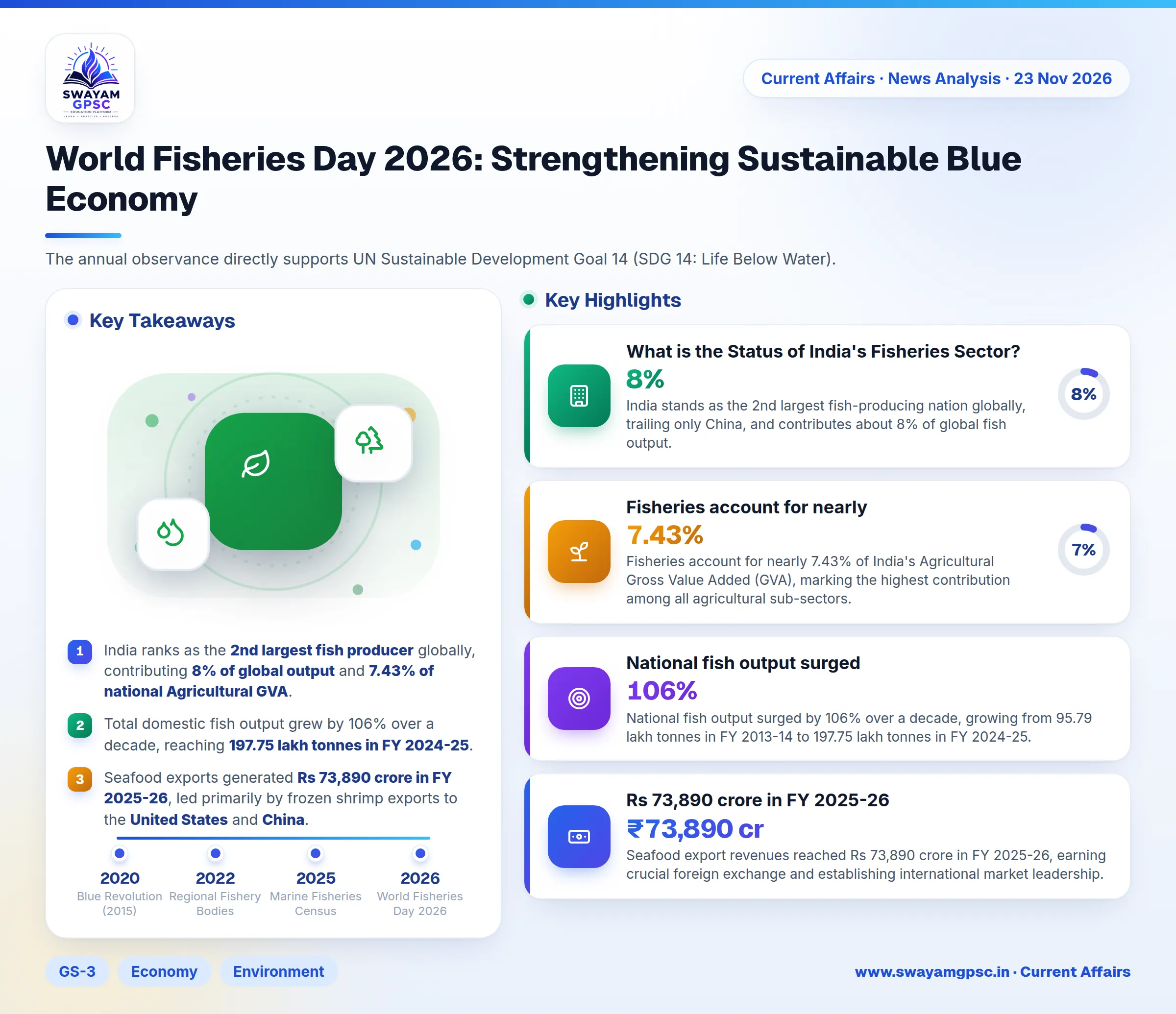
- India ranks as the 2nd largest fish producer globally, contributing 8% of global output and 7.43% of national Agricultural GVA.
- Total domestic fish output grew by 106% over a decade, reaching 197.75 lakh tonnes in FY 2024-25.
- Seafood exports generated Rs 73,890 crore in FY 2025-26, led primarily by frozen shrimp exports to the United States and China.
- The FAO SOFIA 2026 report shows 37.6% of global marine fish stocks are overfished, highlighting severe global sustainability risks.
- Major schemes like PMMSY and FIDF have generated 74.66 lakh direct and indirect jobs while supporting livelihoods for over 3 crore citizens.
Why in News
- The global community celebrated World Fisheries Day 2026 on 21st November 2026 to focus attention on sustainable aquatic resource management, marine biodiversity conservation, and the welfare of coastal communities.
- At the international level, the Food and Agriculture Organization (FAO) and the International Labour Organization (ILO) jointly organized the main global event in Rome.
- In India, the Department of Fisheries, National Fisheries Development Board (NFDB), and ICAR-CIFRI highlighted major digital, financial, and institutional upgrades under the Blue Economy framework targeting Viksit Bharat @2047.
Summary
- World Fisheries Day 2026 reinforces the need for marine conservation, sustainable aquatic management, and worker welfare in line with national Blue Economy goals.
- Key threats to sector stability include overfishing, global climate change, Illegal, Unreported, and Unregulated (IUU) fishing, poor cold-chain infrastructure, and fragmented regulation.
- Achieving UN Sustainable Development Goal 14 (SDG 14) and Viksit Bharat @2047 requires deep-sea fishing expansion, modern aquaculture technologies, digital traceability, and inclusive governance.
What is World Fisheries Day?
- This annual event traces its origin back to 21st November 1997 in New Delhi, India, when fishing representatives from 18 countries met to form the World Forum of Fish Harvesters and Fish Workers (WFF) and adopted a declaration on sustainable ocean management.
- The annual observance directly supports UN Sustainable Development Goal 14 (SDG 14: Life Below Water).
- The theme for 2026 is Empowering People for Change: Advancing Decent Work in Fisheries and Aquaculture, particularly for Youth and Women.
- The joint FAO and ILO event emphasized worker safety, fair employment practices, social safety nets, and equal opportunities for youth and women in the sector.
What is the Status of India's Fisheries Sector?
- India stands as the 2nd largest fish-producing nation globally, trailing only China, and contributes about 8% of global fish output.
- India holds the 1st global position in inland capture fisheries and ranks 2nd in aquaculture production.
- Fisheries account for nearly 7.43% of India's Agricultural Gross Value Added (GVA), marking the highest contribution among all agricultural sub-sectors.
- National fish output surged by 106% over a decade, growing from 95.79 lakh tonnes in FY 2013-14 to 197.75 lakh tonnes in FY 2024-25.
- Seafood export revenues reached Rs 73,890 crore in FY 2025-26, earning crucial foreign exchange and establishing international market leadership.
- Frozen shrimp remains India's primary export item, with the United States and China serving as the largest destination markets.
- The broader sector provides direct and indirect livelihoods to almost 3 crore people across farming, capture, processing, and trade.
- Major national programs like the Blue Revolution (2015), Fisheries and Aquaculture Infrastructure Development Fund (FIDF) (2018-19), Kisan Credit Card (KCC) for Fisheries (2019), Pradhan Mantri Matsya Sampada Yojana (PMMSY) (2020), and PM-MKSSY (2023-24) created an estimated 74.66 lakh jobs.
- Under PMMSY, project approvals exceeding Rs 4,155 crore over five years supported more than 1.28 lakh women through micro-enterprise and livelihood schemes.
- India possesses massive natural water assets, including 31.5 lakh hectares of inland reservoirs, an 11,099 km coastline, and an Exclusive Economic Zone (EEZ) of ~24 lakh sq. km supporting over 50 lakh marine fishers across 13 maritime States and UTs.
Major Government Initiatives for Fisheries Development
- To modernise production, PMMSY promotes water-efficient systems like Recirculatory Aquaculture Systems (RAS) and bio-floc technology.
- The government established 2,195 Fisheries Farmer Producer Organisations (FFPOs) and integrated many onto the Open Network for Digital Commerce (ONDC) platform.
- Under PM-MKSSY, authorities are strengthening 5,500 fisheries cooperatives to function effectively as enterprise-driven FFPOs.
- Financial security programs like PM-MKSSY, KCC for Fisheries, and FIDF enhance access to institutional credit, risk insurance, and post-harvest infrastructure.
- Digital platforms such as the National Fisheries Digital Platform (NFDP) and the Marine Fisheries Census 2025 streamline online registrations, supply chain tracking, and data-driven policy planning.
- Inland open-water bodies are developed under Mission Amrit Sarovar, while offshore resources are managed under the Rules and Guidelines for Sustainable Harnessing of Fisheries in the EEZ and High Seas (2025).
Global Challenges in the Fisheries Sector
- According to the FAO State of World Fisheries and Aquaculture (SOFIA) 2026 Report, biologically sustainable marine fish stocks dropped to 62.4%, meaning 37.6% of global stocks face overfishing.
- The FAO SOFIA 2026 report warns that global climate warming could cause an exploitable fish biomass drop of over 10% by 2050 in tropical regions, driving species toward colder waters.
- Despite record world aquatic production reaching 235 million tonnes, consumption inequality persists, with per capita availability at 26.3 kg/person in Asia compared to 9.1 kg/person in Africa.
- Widespread Illegal, Unreported, and Unregulated (IUU) fishing harms international waters due to weak enforcement by Regional Fishery Bodies (RFBs) and slow adoption of the WTO Agreement on Fisheries Subsidies (2022) and the UN BBNJ Agreement.
Challenges in the Indian Fisheries Sector
- Over 90% of India's marine fishing effort crowds into shallow coastal waters under 50 m depth, causing localized stock depletion while high-value oceanic species across the 24 lakh sq. km EEZ remain untouched.
- Illegal gear usage like pair trawling, bull trawling, LED lighting, and small mesh nets continues despite state laws and the annual 61-day monsoon fishing ban.
- Jurisdictional division splits control between States (up to 12 nautical miles) and the Union Government (12-200 nautical miles), complicating uniform enforcement of Minimum Legal Size (MLS) rules.
- Deficits in cold storage, insulated transport, and clean landing harbors create 15-25% post-harvest losses, forcing small-scale fishers into low-price distress sales.
- Intensive commercial shrimp culture along the East Coast faces severe losses from White Spot Syndrome Virus (WSSV), EHP, rising feed costs, and soil salinization.
- Abandoned, Lost, or Discarded Fishing Gear (ALDFG) creates persistent ghost fishing hazards that trap marine life and break down into microplastic pollution.
Measures Needed to Strengthen the Fisheries Sector
- Financial schemes under FIDF and PMMSY should incentivize fisher cooperatives to buy deep-sea vessels for harvesting high-value species like oceanic tuna in the 24 lakh sq. km EEZ.
- Modernizing post-harvest chains through solar cold storage, Smart Fishing Harbours, and NFDP tracking will reduce product loss and improve compliance with international safety standards.
- Aquaculture security requires expanding Specific Pathogen Free (SPF) broodstock centers, local diagnostic labs, and eco-friendly systems like RAS and mariculture.
- Protecting workers involves adopting the ILO Work in Fishing Convention (C188) standards, registering all workers on the NFDP, expanding insurance, and encouraging women-led FFPOs.
- Enforcing the WTO Agreement on Fisheries Subsidies (2022) along with indigenous satellite-based Vessel Monitoring Systems (VMS) will stop IUU fishing and help restore coastal mangroves.
- Harbors need structured gear collection points, gear marking requirements, and Extended Producer Responsibility (EPR) programs to recycle abandoned fishing nets.
Conclusion
- World Fisheries Day 2026 highlights that growing the Blue Economy requires balancing commercial growth with environmental safety and worker rights.
- Supported by funding allocations in the Union Budget 2026-27 and structural reforms like the EEZ Rules 2025, India is building a resilient fishing sector aligned with SDG 14: Life Below Water.