Unconditional Cash Transfers in India
#GS-2 #Governance & Social Justice #Poverty #Welfare Schemes #GS-3 #Economy #Growth #Taxation #Current Events #National
Key takeaways
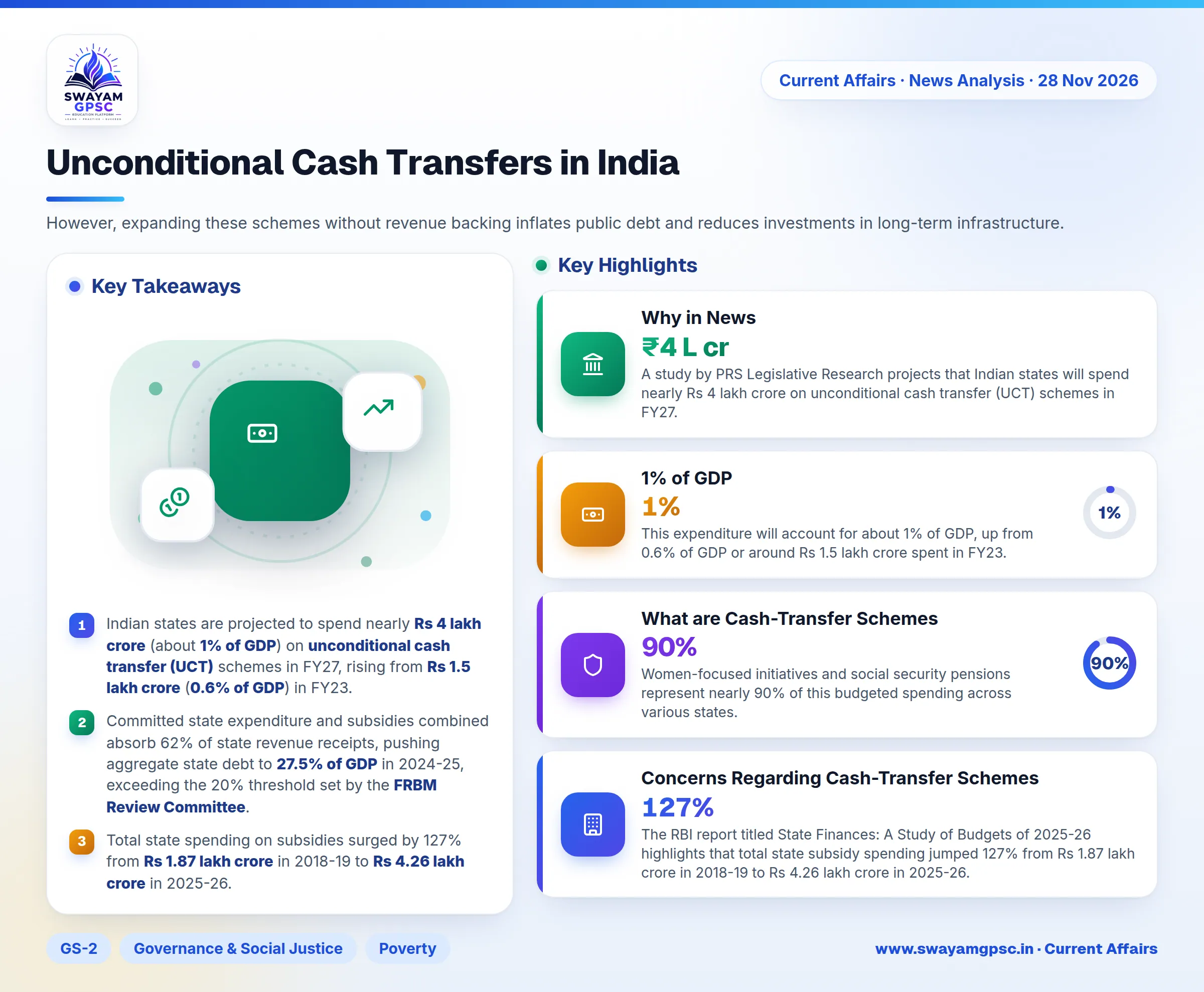
- Indian states are projected to spend nearly Rs 4 lakh crore (about 1% of GDP) on unconditional cash transfer (UCT) schemes in FY27, rising from Rs 1.5 lakh crore (0.6% of GDP) in FY23.
- Committed state expenditure and subsidies combined absorb 62% of state revenue receipts, pushing aggregate state debt to 27.5% of GDP in 2024-25, exceeding the 20% threshold set by the FRBM Review Committee.
- Total state spending on subsidies surged by 127% from Rs 1.87 lakh crore in 2018-19 to Rs 4.26 lakh crore in 2025-26.
- Women-centric initiatives and social security pensions make up almost 90% of the Rs 4 lakh crore budgeted across 128 identified UCT schemes for 2026-27.
- According to the Economic Survey 2025-26, cash transfer payouts account for 11-24% of monthly income for female casual laborers and 11-87% for self-employed women.
Why in News
- A study by PRS Legislative Research projects that Indian states will spend nearly Rs 4 lakh crore on unconditional cash transfer (UCT) schemes in FY27.
- This expenditure will account for about 1% of GDP, up from 0.6% of GDP or around Rs 1.5 lakh crore spent in FY23.
- Financial institutions including the Reserve Bank of India (RBI), the 16th Finance Commission, and the Economic Survey 2025-26 have expressed strong concerns regarding this trend.
- These official bodies warn that recurring cash commitments are widening revenue deficits, increasing total state debt, and reducing funds available for productive capital expenditure.
Summary
- Unconditional cash transfer commitments offer immediate social safety nets and boost financial independence for women.
- However, expanding these schemes without revenue backing inflates public debt and reduces investments in long-term infrastructure.
- To achieve sustainable growth, states must implement evidence-based evaluations, precise targeting, regular reviews, and outcome-oriented tracking.
What are Cash-Transfer Schemes
- Cash transfer programs deliver direct monetary payments from the government straight to individuals or households using the Direct Benefit Transfer (DBT) infrastructure powered by the JAM Trinity (Jan Dhan, Aadhaar, Mobile).
- Conditional Cash Transfers (CCTs) link payments to mandatory actions such as regular school attendance, child immunizations, or hospital deliveries like under Janani Suraksha Yojana.
- Unconditional Cash Transfers (UCTs) provide direct money without enforcing any behavioral rules or spending requirements on the recipients.
- Eligibility for UCT programs relies on specific demographic or socioeconomic factors like age, gender, residence, or income levels.
- Indian states have budgeted almost Rs 4 lakh crore across 128 identified UCT schemes for the year 2026-27.
- Women-focused initiatives and social security pensions represent nearly 90% of this budgeted spending across various states.
- Prominent state examples include Lakshmir Bhandar in West Bengal, Ladki Bahin in Maharashtra, Subhadra Yojana in Odisha, and Gruha Lakshmi in Karnataka.
Concerns Regarding Cash-Transfer Schemes
- The RBI report titled State Finances: A Study of Budgets of 2025-26 highlights that total state subsidy spending jumped 127% from Rs 1.87 lakh crore in 2018-19 to Rs 4.26 lakh crore in 2025-26.
- Fixed commitments like salaries, pensions, interest payouts, and growing subsidies now consume 62% of overall state revenue receipts.
- Total state debt expanded to 27.5% of GDP in 2024-25, surpassing the 20% threshold set by the FRBM Review Committee.
- Annual interest payments for states grew by 10%, outstripping their annual revenue receipt growth of 9.2%.
- Because of these fiscal pressures, state capital outlay has remained stagnant at 2.2-2.4% of GDP.
- States rely heavily on the Central Government's Special Assistance to States for Capital Investment (SASCI) loans, which funded 19% of state capital investments in 2024-25.
- The 16th Finance Commission pointed out that states offering large cash transfers frequently run revenue deficits because borrowing to fund daily consumption builds debt without creating income-generating assets.
- Major infrastructure projects undergo strict appraisal via a Detailed Project Report (DPR), but massive social cash welfare schemes launch without any prior formal evaluation.
- Without an initial assessment, oversight bodies, media, and citizens cannot verify if a cash transfer scheme actually met its intended social goals.
- Cash transfer programs can turn into tools for political gain because their payments are immediate, easily visible, and tied to specific individuals.
- Immediate political benefits often replace prudent public finance management, leading governments to favor cash handouts over core development spending.
- For instance, Tamil Nadu set aside Rs 1,000 crore in 2026-27 for college scholarships while keeping around 9,000 permanent college teaching posts vacant, which would cost Rs 1,080 crore annually to fill.
- Unlike public infrastructure, health, or education whose advantages spread across society, political pressures make cash transfers nearly impossible to cancel, creating rigid budgets.
- Targeted cash schemes create an inclusion-exclusion challenge: broad coverage gives money to affluent groups, whereas narrow targeting often leaves out deserving poor families who lack proper paperwork.
- Cash handouts alone cannot build long-term human capabilities or fix deep inequality within households without essential social services.
Arguments in Favour of Cash-Transfer Schemes
- Cash payouts offer essential extra income to female workers who operate in informal jobs or perform unpaid domestic labor.
- The Economic Survey 2025-26 highlighted that cash payouts contributed 11-24% of monthly earnings for female casual workers and 11-87% for self-employed women across seven states.
- These monetary transfers boost daily household consumption, protect families against financial instability, and increase a woman's decision-making power within her home.
- Direct monetary assistance shields vulnerable families against sudden economic shocks, sharp inflation, and illness, helping them afford food and schooling.
- The modern DBT platform removes middleman leakage and delivers funds straight to beneficiary bank accounts with minimal administrative overhead.
- Regular government payouts encourage lower-income families in rural regions to open bank accounts and engage with formal financial institutions.
Way Forward
- State governments should publish a comprehensive Social Detailed Project Report before introducing major cash schemes to outline baseline needs, targeting criteria, and ten-year cost projections.
- States must legally reserve a fixed minimum portion of their budget, such as 3% of GSDP, specifically for physical and social infrastructure to protect capital creation.
- Lawmakers should insert mandatory sunset clauses, conduct independent audits, and track real-time outcomes to prevent cash schemes from creating permanent financial burdens.
- Governments need to consolidate redundant subsidies while boosting local revenue collection through improved GST compliance and property tax collection.
- States should issue a single public ledger listing all cash transfer spending and off-budget liabilities to allow full legislative oversight.
- Cash payout amounts should adapt to rising inflation while linking recipients to skill development and job programs so families can transition off government welfare over time.
- In line with suggestions from the 16th Finance Commission, state authorities must regularly audit eligibility criteria to ensure cash reaches intended populations efficiently.
- The Election Commission of India (ECI) must enforce its May 2024 directive prohibiting political parties from registering citizens for post-election welfare benefits during campaigns.
Conclusion
- Unconditional cash transfers provide vital safety nets for poor households and strengthen financial autonomy for women.
- However, expanding these welfare programs requires balancing short-term relief with strict fiscal discipline, clear targeting, and protected capital investments to ensure sustainable economic progress.