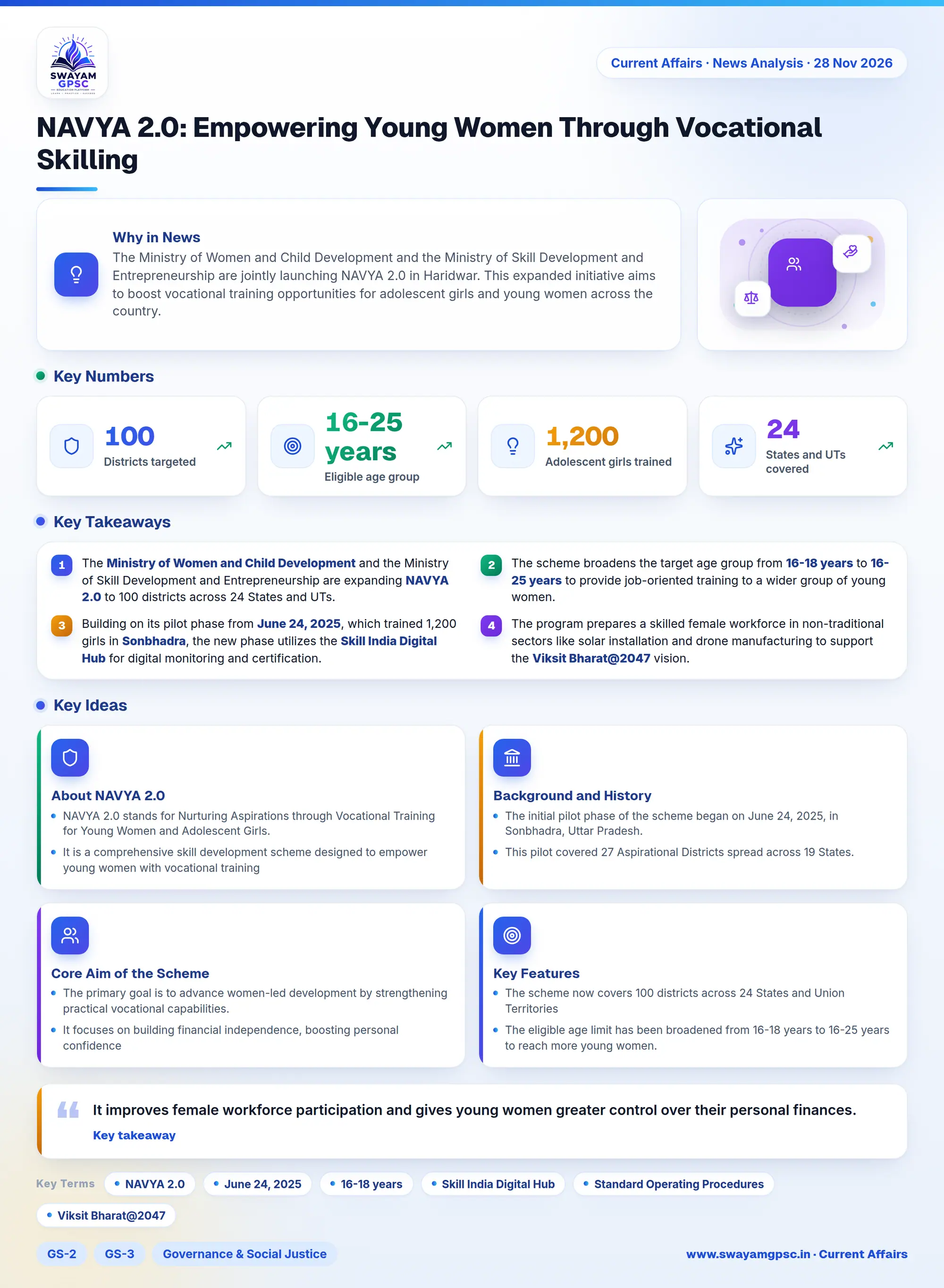
NAVYA 2.0: Empowering Young Women Through Vocational Skilling
#GS-2 #GS-3 #Governance & Social Justice #Economy #Women #Employment #Skill Development #Vulnerable Sections #NAVYA 2.0
Key takeaways
- The Ministry of Women and Child Development and the Ministry of Skill Development and Entrepreneurship are expanding NAVYA 2.0 to 100 districts across 24 States and UTs.
- The scheme broadens the target age group from 16-18 years to 16-25 years to provide job-oriented training to a wider group of young women.
- Building on its pilot phase from June 24, 2025, which trained 1,200 girls in Sonbhadra, the new phase utilizes the Skill India Digital Hub for digital monitoring and certification.
- The program prepares a skilled female workforce in non-traditional sectors like solar installation and drone manufacturing to support the Viksit Bharat@2047 vision.
Why in News
- The Ministry of Women and Child Development and the Ministry of Skill Development and Entrepreneurship are jointly launching NAVYA 2.0 in Haridwar.
- This expanded initiative aims to boost vocational training opportunities for adolescent girls and young women across the country.
About NAVYA 2.0
- NAVYA 2.0 stands for Nurturing Aspirations through Vocational Training for Young Women and Adolescent Girls.
- It is a comprehensive skill development scheme designed to empower young women with vocational training, career readiness, and sustainable livelihood options.
- The scheme is run as a collaborative initiative between the Ministry of Women and Child Development and the Ministry of Skill Development and Entrepreneurship.
Background and History
- The initial pilot phase of the scheme began on June 24, 2025, in Sonbhadra, Uttar Pradesh.
- This pilot covered 27 Aspirational Districts spread across 19 States.
- During the pilot phase, about 1,200 adolescent girls received practical training in modern sectors like drone manufacturing, solar PV installation, and fashion designing.
Core Aim of the Scheme
- The primary goal is to advance women-led development by strengthening practical vocational capabilities.
- It focuses on building financial independence, boosting personal confidence, and opening up long-term livelihood opportunities for young women.
Key Features
- The scheme now covers 100 districts across 24 States and Union Territories, giving special priority to aspirational and remote areas.
- The eligible age limit has been broadened from 16-18 years to 16-25 years to reach more young women.
- It offers targeted training in modern and non-traditional job fields, along with support for jobs, apprenticeships, and starting small businesses.
- The program uses the Skill India Digital Hub portal to manage student registration, daily attendance, training tracking, and digital certificate issuing.
- It sets up clear Standard Operating Procedures so district officials can work together effectively and track real results.
Significance
- It improves female workforce participation and gives young women greater control over their personal finances.
- It brings quality skill training right to the doorstep of young women living in backward and underserved regions.
- It helps build a skilled female workforce and encourages entrepreneurship, directly supporting the goal of Viksit Bharat@2047.