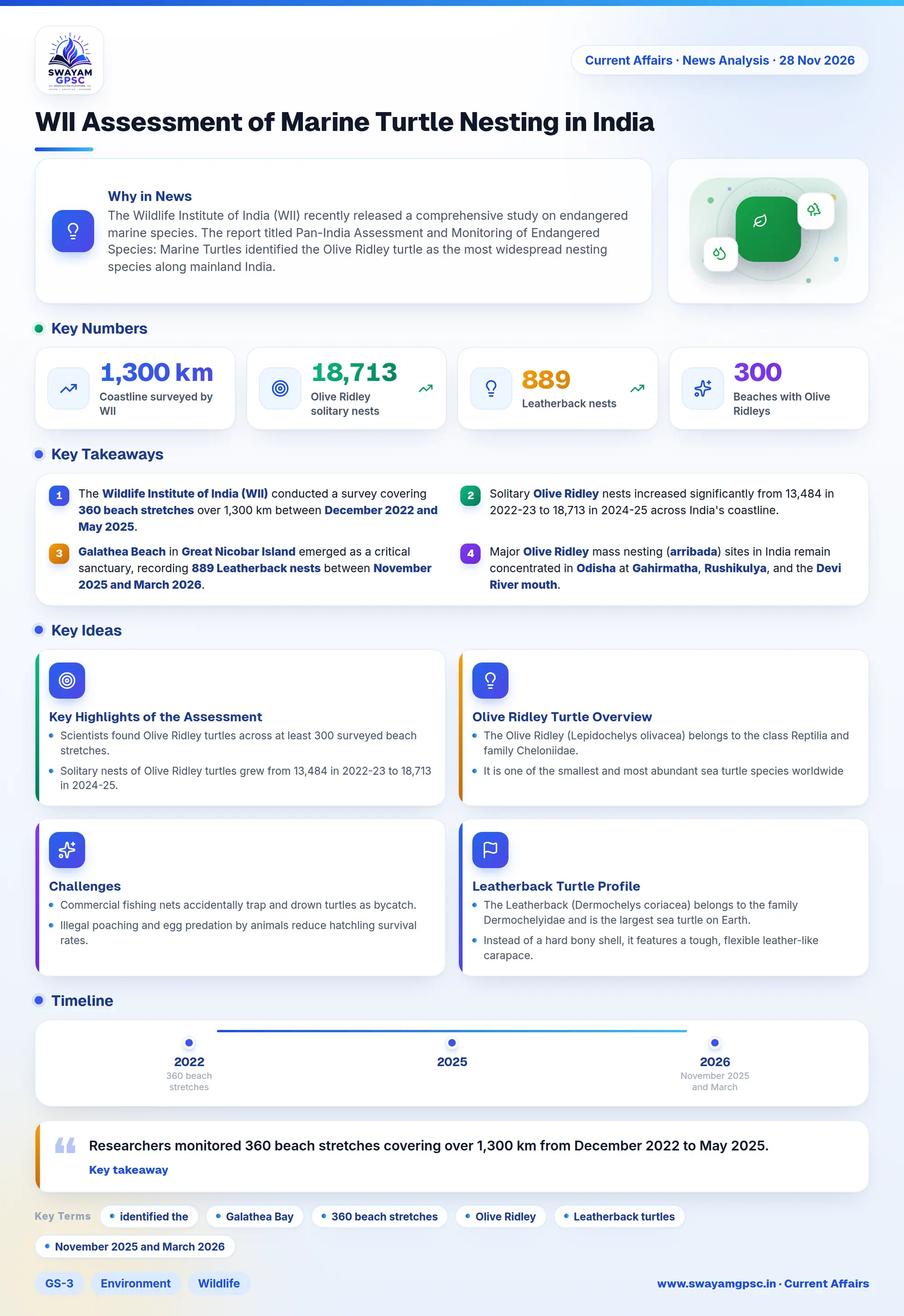
WII Assessment of Marine Turtle Nesting in India
#GS-3 #Environment #Wildlife #Biodiversity #Conservation #Rapid Fire CA #Quick Facts For Prelims
Key takeaways
- The Wildlife Institute of India (WII) conducted a survey covering 360 beach stretches over 1,300 km between December 2022 and May 2025.
- Solitary Olive Ridley nests increased significantly from 13,484 in 2022-23 to 18,713 in 2024-25 across ** India's coastline.
- Galathea Beach in Great Nicobar Island emerged as a critical sanctuary, recording 889 Leatherback nests between November 2025 and March 2026.
- Major Olive Ridley mass nesting (arribada) sites in India remain concentrated in Odisha at Gahirmatha, Rushikulya, and the Devi River mouth.
- Leatherback turtles enjoy the highest level of legal protection under Schedule I of the Wildlife (Protection) Act, 1972.
Why in News
- The Wildlife Institute of India (WII) recently released a comprehensive study on endangered marine species.
- The report titled Pan-India Assessment and Monitoring of Endangered Species: Marine Turtles identified the Olive Ridley turtle as the most widespread nesting species along mainland India.
- The survey also highlighted Galathea Bay on Great Nicobar Island as a vital nesting ground for Leatherback turtles.
Key Highlights of the Assessment
- Researchers monitored 360 beach stretches covering over 1,300 km from December 2022 to May 2025.
- Scientists found Olive Ridley turtles across at least 300 surveyed beach stretches.
- Solitary nests of Olive Ridley turtles grew from 13,484 in 2022-23 to 18,713 in 2024-25.
- Concentrated nesting of Leatherback turtles occurred mainly in the Andaman and Nicobar Islands.
- Between November 2025 and March 2026, Galathea Beach recorded 889 Leatherback nests and 108 Olive Ridley nests.
- Green Turtle nesting took place primarily in Gujarat, Lakshadweep, and the Andaman and Nicobar Islands.
- Hawksbill turtles showed sparse distribution across Lakshadweep and the Andaman and Nicobar Islands.
Olive Ridley Turtle Overview
- The Olive Ridley (Lepidochelys olivacea) belongs to the class Reptilia and family Cheloniidae.
- It is one of the smallest and most abundant sea turtle species worldwide, recognizable by its heart-shaped olive-green shell.
- These turtles inhabit the tropical regions of the Pacific, Indian, and Atlantic Oceans while migrating vast distances between feeding and breeding grounds.
- As omnivores, their diet consists mainly of algae, crustaceans, and molluscs.
- The species displays both solitary nesting and arribada, which is a massive synchronized nesting event involving thousands of females.
- Females typically nest one to three times per season, laying about 100 to 110 eggs in each clutch.
- The regular nesting season in India runs from late October to March.
- These turtles practice philopatry, meaning they return to their original birthplaces to lay their eggs.
- Sand temperatures determine the gender of hatchlings, as warmer conditions generally produce female turtles.
- Major mass nesting locations in Odisha include Gahirmatha, Rushikulya, and the Devi River mouth, alongside key sites in the Andaman Islands.
Challenges
- Commercial fishing nets accidentally trap and drown turtles as bycatch.
- Illegal poaching and egg predation by animals reduce hatchling survival rates.
- Rapid coastal development and artificial light disturb natural nesting behaviors.
- Plastic pollution and rising temperatures caused by climate change destroy marine and coastal habitats.
Leatherback Turtle Profile and Protection
- The Leatherback (Dermochelys coriacea) belongs to the family Dermochelyidae and is the largest sea turtle on Earth.
- Instead of a hard bony shell, it features a tough, flexible leather-like carapace.
- These turtles live in tropical and temperate oceans across the globe and feed mostly on jellyfish.
- In India, their nesting centers almost entirely around Great Nicobar Island within the Andaman and Nicobar Islands.
- The species receives top legal protection under Schedule I of India's Wildlife (Protection) Act, 1972.
- The IUCN Red List categorizes the species globally as Vulnerable.
- It is listed under Appendix I of CITES, strictly prohibiting its international commercial trade.