World Environment Day 2026
#GS-3 #Environment #Conservation #Environmental Pollution & Degradation #Climate Change #Sustainable Development #Infrastructure
Key takeaways
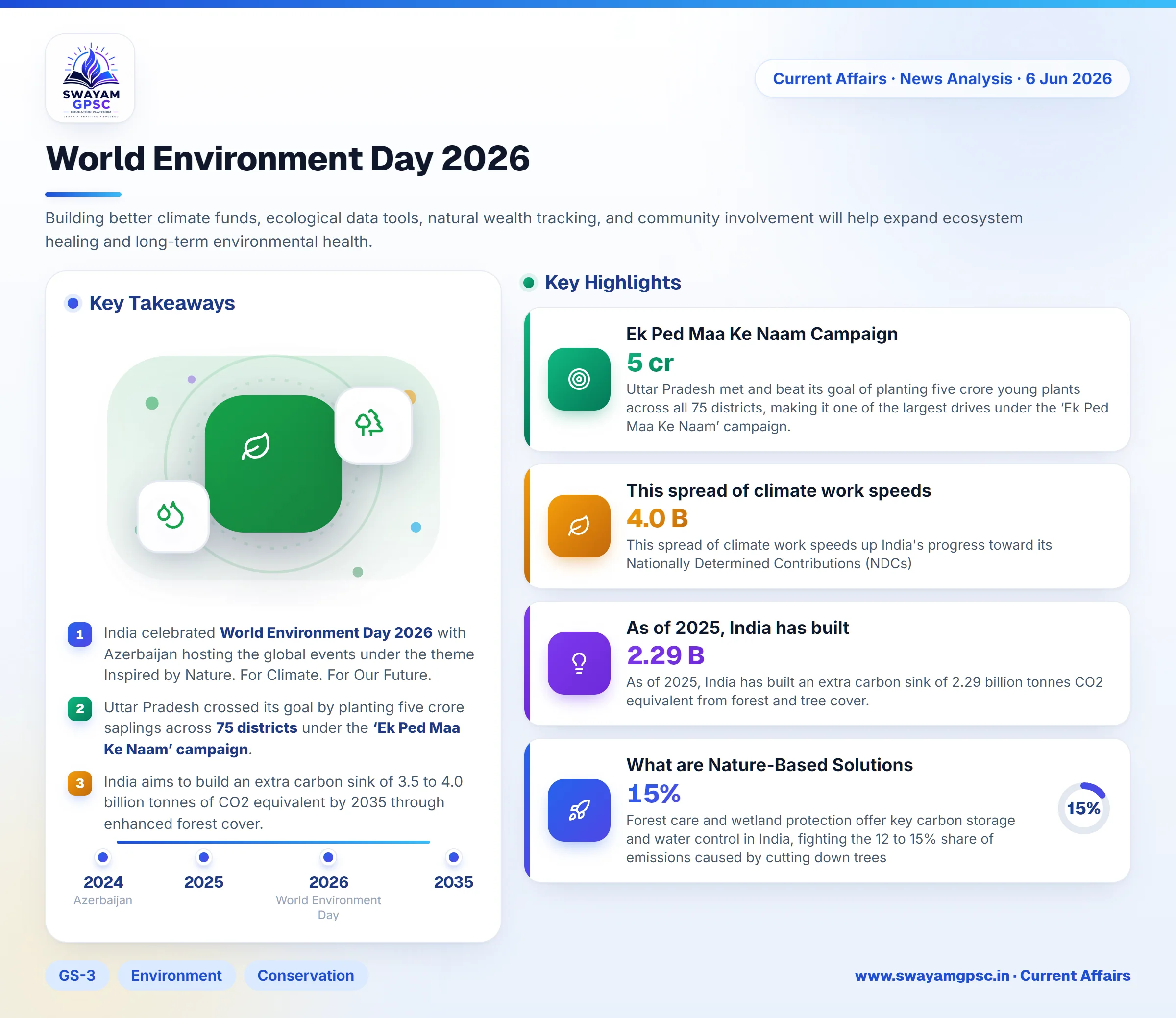
- India celebrated World Environment Day 2026 with Azerbaijan hosting the global events under the theme Inspired by Nature. For Climate. For Our Future.
- Uttar Pradesh crossed its goal by planting five crore saplings across 75 districts under the ‘Ek Ped Maa Ke Naam’ campaign.
- India aims to build an extra carbon sink of 3.5 to 4.0 billion tonnes of CO2 equivalent by 2035 through enhanced forest cover.
- As of 2025, India has already built a carbon sink of 2.29 billion tonnes CO2 equivalent from its forests and trees.
Why in News
- On World Environment Day celebrated on 5th June 2026, the Prime Minister congratulated Uttar Pradesh for a major tree-planting achievement.
- This success happened under the ‘Ek Ped Maa Ke Naam’ campaign, showing a big push for public participation in environmental protection across India.
Summary
- The ‘Ek Ped Maa Ke Naam’ campaign and World Environment Day 2026 highlight India's move toward people-focused environmental management and Nature-Based Solutions for climate strength.
- Building better climate funds, ecological data tools, natural wealth tracking, and community involvement will help expand ecosystem healing and long-term environmental health.
What is World Environment Day
- The United Nations General Assembly set up World Environment Day in 1972 to mark the start of the Stockholm Conference on the Human Environment (1972).
- People celebrated it for the first time in 1973 with the starting theme of Only One Earth.
- The United Nations Environment Programme (UNEP), based in Nairobi, Kenya, guides these yearly global campaigns.
- Led by UNEP, the global events for 2026 were hosted by the Republic of Azerbaijan in its main city, Baku.
- Choosing Azerbaijan was a smart step because hosting the UNFCCC COP29 in late 2024 gives the country a steady platform to lead world climate talks.
- The official theme for 2026 is Inspired by Nature. For Climate. For Our Future.
- The phrase Inspired by Nature pushes for Nature-based Solutions like tree planting, ecosystem repair, and wetland protection.
- The phrase For Climate focuses on fighting climate change by locking away carbon and building strength against weather shocks.
- The phrase For Our Future highlights keeping natural wealth safe for coming generations.
Ek Ped Maa Ke Naam Campaign
- The 'Ek Ped Maa Ke Naam' initiative means A Tree in the Name of Mother, and it is a worldwide tree-planting drive started on World Environment Day 2024.
- By connecting tree planting with respect for mothers, this campaign brings the core idea of Mission LiFE (Lifestyle for Environment) into action, pushing people to change personal habits to fight planetary dangers.
- Uttar Pradesh met and beat its goal of planting five crore young plants across all 75 districts, making it one of the largest drives under the ‘Ek Ped Maa Ke Naam’ campaign.
- This spread of climate work speeds up India's progress toward its Nationally Determined Contributions (NDCs), especially the goal of building an extra carbon sink of 3.5 to 4.0 billion tonnes of CO2 equivalent through better forest and tree cover by 2035.
- As of 2025, India has built an extra carbon sink of 2.29 billion tonnes CO2 equivalent from forest and tree cover.
- This work puts into practice the Directive Principles of State Policy under Article 48A for protecting the environment and forests, along with the Fundamental Duties under Article 51A(g) to protect nature.
What are Nature-Based Solutions
- Defined by the International Union for Conservation of Nature (IUCN) and approved by the United Nations Environment Assembly (UNEA), Nature-Based Solutions mean actions to protect, sustainably manage, and heal natural or changed ecosystems.
- These steps solve problems like climate change, disaster risks, and food security in smart ways, while also giving human health and biodiversity benefits.
- Unlike man-made gray structures like concrete sea walls, Nature-Based Solutions use natural plant processes to bring economic and ecological stability.
- In the famous court case M.C. Mehta v. Kamal Nath (1997), the Supreme Court of India set up the Public Trust Doctrine, stating that the State is the guardian of all natural resources like rivers, forests, and sea shores.
- Using Nature-Based Solutions fulfills the state duty under Article 48A and Article 21 to protect these assets from permanent damage.
- As shown by the globally known Dasgupta Review on the Economics of Biodiversity, normal economic measures like GDP fail to count the loss in value of natural wealth.
- Nature-Based Solutions offer a way to count the worth of ecosystem services such as water cleaning by wetlands or pollination by wild insects, stopping deep ecological loss.
- The core ideas of Nature-Based Solutions match closely with the advice of the Madhav Gadgil Committee (2010) Report on the Western Ghats, which asked to keep the local nature safe as a shield against unpredictable monsoons and landslides instead of building heavy structures.
- Forest care and wetland protection offer key carbon storage and water control in India, fighting the 12 to 15% share of emissions caused by cutting down trees, while city green spaces can lower local temperatures by 2 to 4 degrees Celsius.
Government Initiatives for Promoting NbS
- The National Mission for a Green India (GIM) helps expand forest cover.
- The National Mission on Sustainable Agriculture (NMSA) promotes farming methods that protect the environment.
- The National Water Mission works on saving water resources.
- The National Afforestation Programme (NAP) supports tree planting in degraded lands.
- Atal Mission for Rejuvenation and Urban Transformation (AMRUT) 2.0 improves green spaces and water bodies in cities.
- The Mangrove Initiative for Shoreline Habitats and Tangible Incomes (MISHTI) protects coastal mangrove forests.
- Mission Amrit Sarovar focuses on reviving water bodies across rural districts.
Challenges
- Fixing Nature-Based Solutions is very hard because India lacks a detailed National Environmental Survey (NES).
- Without a proper nationwide baseline to track plant loss, wetland damage, and forest health, measuring the real success of green projects becomes nearly impossible.
- Green projects usually take a long time before showing clear carbon storage or climate adaptation benefits.
- Developing countries face high borrowing costs, and relying only on government funds or Corporate Social Responsibility (CSR) is far too little to gather the money needed for large-scale projects.
- Standard economic scorecards like GDP do not count the money value of natural benefits.
- Without proper Natural Capital Accounting, green projects get ignored in cost-versus-profit checks when compared to commercial real estate.
- Bureaucratic tree-planting drives often plant single types of exotic trees instead of mixed native forests.
- This hurts soil health and uses up groundwater, which ruins the main goal of Nature-Based Solutions.
- In a crowded country like India, large land restoration projects often cause fights between farming needs and forest protection rules.
Way Forward
- The Ministry of Environment, Forest and Climate Change should release a yearly National Environmental Survey backed by law before the Union Budget.
- This survey must map local climate dangers and give the ecological data needed to design smart Nature-Based Solutions.
- To bridge the huge funding gap, the government must use Sovereign Green Bonds and mixed money models.
- Using public funds to take on early project risks will attract global institutional investors and private money funds.
- The Ministry of Finance and the Ministry of Statistics and Programme Implementation must add ecosystem values into the yearly Economic Survey to show the financial gains of green projects to policymakers.
- The government should use the Bhuvan Portal (ISRO) and computer dashboards to track plant survival rates and carbon levels in real time for schemes like MISHTI and Nagar Van Yojana.
- City and village planning should connect green patches into Blue-Green Corridors, such as restoring the Aravalli Green Wall to stop desert spread and clean Delhi's air.
- Carrying out the Forest Rights Act (FRA, 2006) properly ensures that nature repair helps local livelihoods and builds grassroots guardians.
- The Living Root Bridges (Jingkieng Jri) in Meghalaya built by local communities show how training tree roots can create lasting structures that survive floods and stop soil loss.