World Day to Combat Desertification and Drought 2026
#GS-3 #Economy #Environment #Agriculture #Infrastructure #Sustainable Development #Conservation #Environmental Pollution & Degradation
Key takeaways
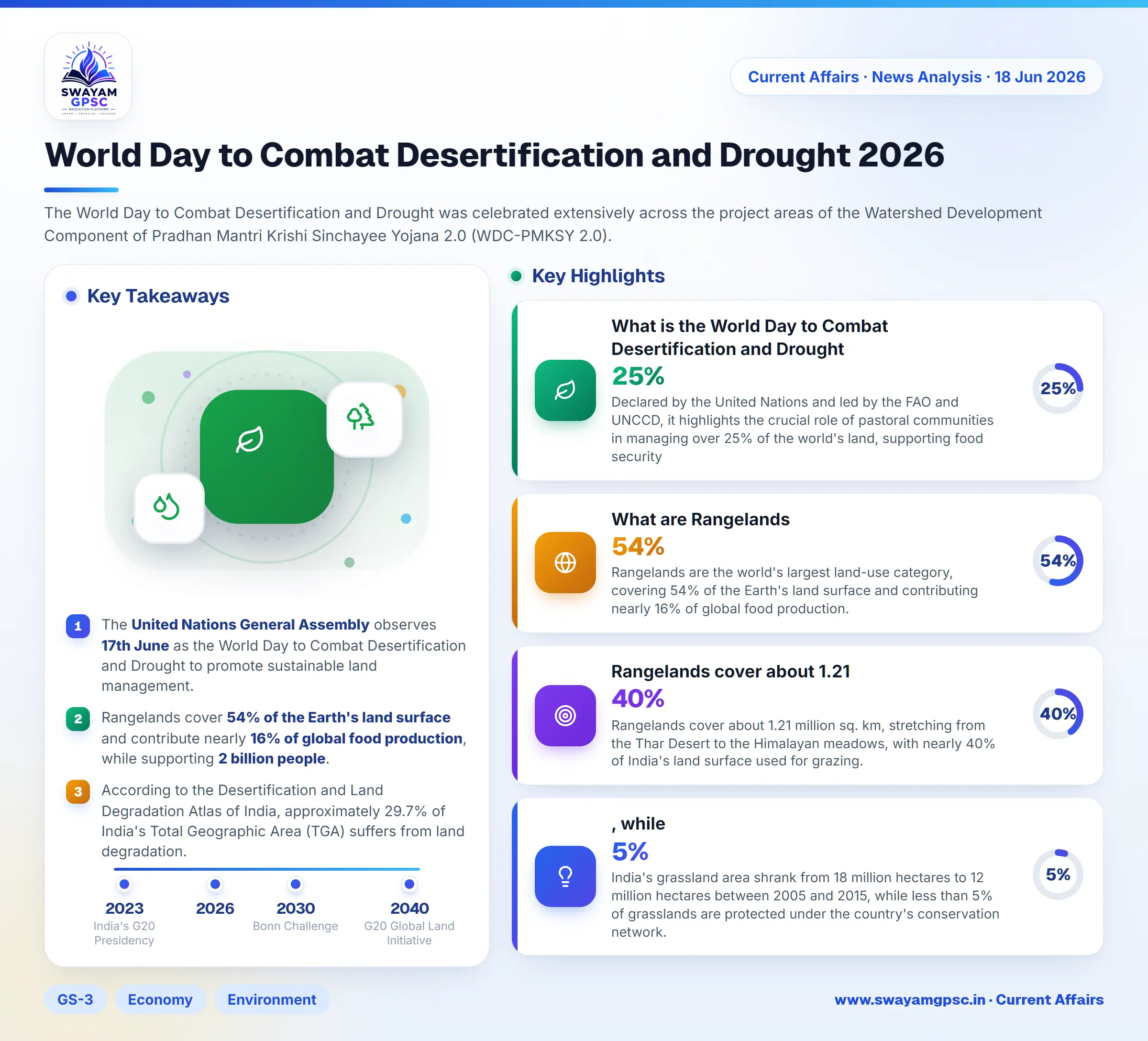
- The United Nations General Assembly observes 17th June as the World Day to Combat Desertification and Drought to promote sustainable land management.
- Rangelands cover 54% of the Earth's land surface and contribute nearly 16% of global food production, while supporting 2 billion people.
- According to the Desertification and Land Degradation Atlas of India, approximately 29.7% of India's Total Geographic Area (TGA) suffers from land degradation.
- Under India's G20 Presidency (2023), the Gandhinagar Implementation Roadmap (GIR) was adopted to accelerate collaborative ecological restoration.
Why in News
- The World Day to Combat Desertification and Drought was celebrated extensively across the project areas of the Watershed Development Component of Pradhan Mantri Krishi Sinchayee Yojana 2.0 (WDC-PMKSY 2.0).
What is the World Day to Combat Desertification and Drought
- In 1994, the United Nations General Assembly (UNGA) officially declared 17th June as the World Day to Combat Desertification and Drought.
- This day commemorates the adoption of the United Nations Convention to Combat Desertification (UNCCD), which stands as the sole legally binding international agreement linking environmental conservation and development directly to sustainable land management.
- The day serves as a global platform to raise awareness about land degradation and promote Land Degradation Neutrality (LDN) through sustainable practices and international cooperation.
- It highlights that desertification is largely driven by human activities and climate change, making it a preventable and reversible challenge.
- The theme for 2026 is Rangelands: Recognize. Respect. Restore. aligned with the International Year of Rangelands and Pastoralists (IYRP) 2026.
- Declared by the United Nations and led by the FAO and UNCCD, it highlights the crucial role of pastoral communities in managing over 25% of the world's land, supporting food security, and enhancing climate resilience.
What are Rangelands
- Rangelands are vast, open landscapes covered by natural vegetation such as grasslands, shrublands, deserts, and tundras.
- Rangelands are the world's largest land-use category, covering 54% of the Earth's land surface and contributing nearly 16% of global food production.
- Rangelands cover about 1.21 million sq. km, stretching from the Thar Desert to the Himalayan meadows, with nearly 40% of India's land surface used for grazing.
- India's grassland area shrank from 18 million hectares to 12 million hectares between 2005 and 2015, while less than 5% of grasslands are protected under the country's conservation network.
- They directly support the livelihoods of approximately 2 billion people worldwide, primarily indigenous communities and nomadic pastoralists.
- They act as massive carbon sinks, regulate localized water cycles, prevent soil erosion, and harbor unique biodiversity adapted to hyper-arid conditions.
- Up to 50% of the world’s rangelands are currently degraded or facing severe ecological stress.
- Primary drivers include inappropriate land-use changes, unscientific agricultural expansion, overgrazing, and escalating climate-induced droughts.
- The degradation of drylands directly affects the world's poorest populations, triggering acute food and water insecurity, accelerating the loss of biodiversity, and dismantling traditional rural livelihoods.
What is the Watershed Development Component of PMKSY 2.0
- The scheme originated as the centrally sponsored scheme named the Integrated Watershed Management Programme (IWMP) in 2009-10. It was amalgamated into the Pradhan Mantri Krishi Sinchayee Yojana (PMKSY) in 2015-16.
- The Government of India approved its continuation as WDC-PMKSY 2.0 for the project period of 2021-2026.
- It aims to cover a physical target of 49.50 lakh hectares.
- It is implemented by the Department of Land Resources (DoLR) under the Ministry of Rural Development.
- Key objectives include rejuvenating degraded and rainfed lands to restore ecological balance.
- It focuses on enhancing agricultural productivity and groundwater recharge.
- It aims at diversifying farming systems to increase rural incomes.
- Based on NITI Aayog's recommendations, the comprehensive treatment and rejuvenation of springsheds has been incorporated as a new core activity, which is crucial for mountainous regions.
- States and Union Territories are mandated to use GIS and Remote Sensing techniques for precise project planning and mapping to ensure convergence in a saturation mode.
- Targeted end results include a visible reduction in soil erosion, enhanced green cover, and a rise in the groundwater table.
- Gram Panchayats willingly take over the operation and maintenance of the created assets.
- Economic growth targets include increased cropping intensity, higher agricultural output, and substantive increases in average household income.
- Resource governance involves the establishment of strict regulatory norms for water use, such as water budgeting, adhered to by local communities.
- Livelihood security ensures the provision of alternate livelihood options for all community members, including landless agricultural laborers, artisans, and livestock keepers.
What is the Status of Desertification in India
- Desertification is the degradation of land in arid, semi-arid, and dry sub-humid areas resulting from various factors, including climatic variations and human activities, and it does not mean the expansion of existing deserts.
- According to the Desertification and Land Degradation Atlas of India published by the Space Applications Centre, ISRO, approximately 29.7% of India's Total Geographic Area (TGA) is undergoing land degradation.
- Water erosion is the most significant cause of land degradation, washing away fertile topsoil and contributing to over 10% of total degradation.
- Vegetal degradation is caused by deforestation, overgrazing, and shifting cultivation.
- Wind erosion is prevalent in arid zones like Rajasthan and Gujarat.
- Salinity and alkalinity often result from unscientific irrigation practices and waterlogging.
Initiatives to Combat Land Degradation
- The Bonn Challenge is a global effort to bring 150 million hectares of the world’s deforested and degraded land into restoration by 2020, and 350 million hectares by 2030.
- The Great Green Wall is an initiative led by the African Union to restore Africa's degraded landscapes and transform millions of lives in the Sahel region.
- The G20 Global Land Initiative was launched in 2020 during the Saudi Arabian G20 Presidency, targeting a 50% reduction in degraded land globally by 2040.
- Under India's G20 Presidency (2023), the Gandhinagar Implementation Roadmap (GIR) was adopted to accelerate collaborative ecological restoration.
- Sustainable Development Goal Target 15.3 explicitly mandates the global community to combat desertification and strive to achieve a Land Degradation Neutrality (LDN) world by 2030.
- India hosted the 14th Conference of Parties (COP14) to the UNCCD in New Delhi in 2019 and raised its ambition to restore 26 million hectares of degraded land by 2030.
- The Aravalli Green Wall Project aims to create a 5-km eco-buffer zone around the Aravalli hill range to prevent the eastward expansion of the Thar Desert, and it has already surpassed its annual targets in FY 2025-26.
- The Desert Development Programme (DDP) was launched to minimize the adverse effects of drought, control desertification, and restore ecological balance.
- The National Mission for a Green India (GIM) is one of the eight missions under the National Action Plan on Climate Change (NAPCC), aimed at protecting, restoring, and enhancing India's diminishing forest cover.