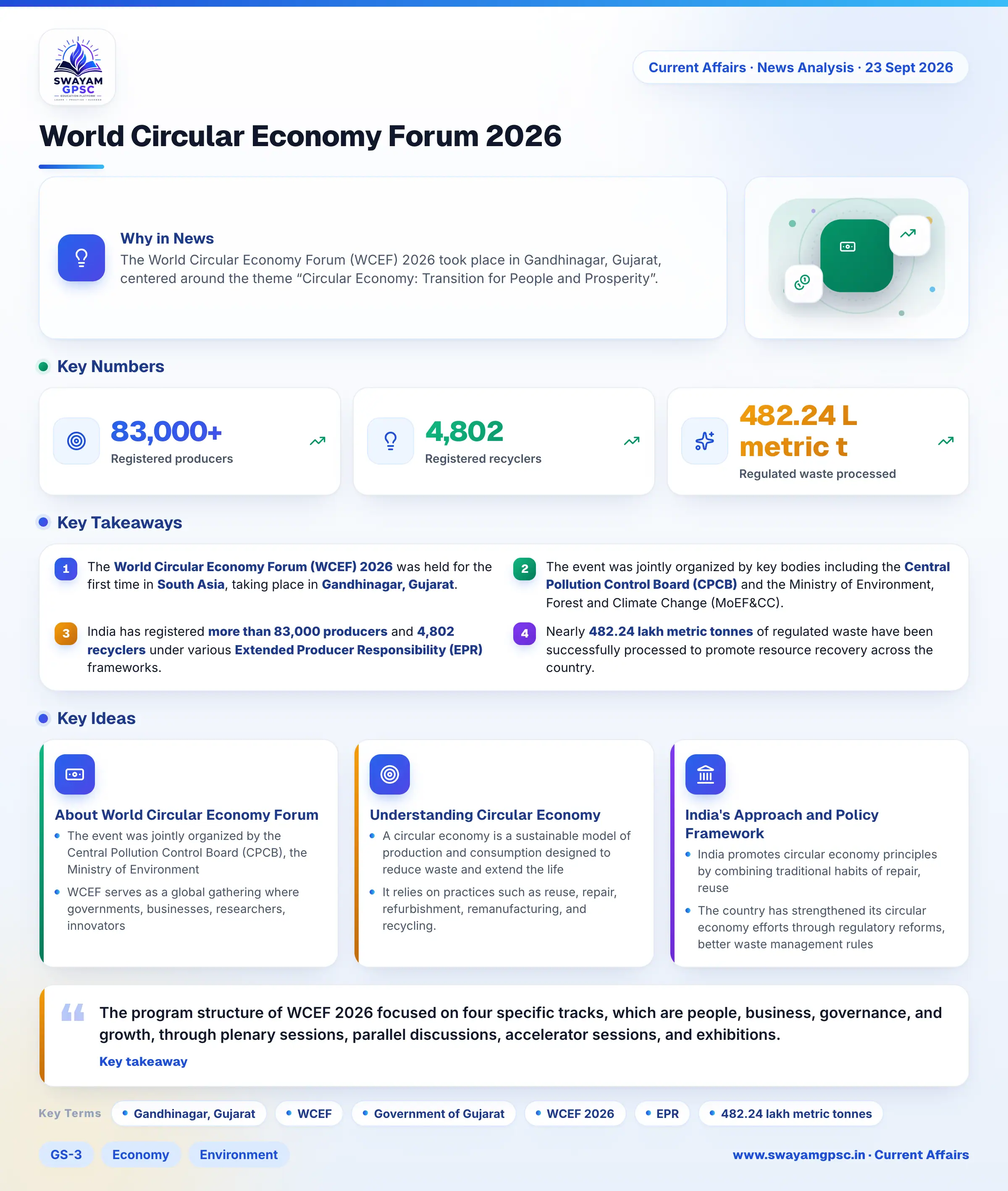
World Circular Economy Forum 2026
#GS-3 #Economy #Environment #Infrastructure #Sustainable Development #World Circular Economy Forum #Gujarat
Key takeaways
- The World Circular Economy Forum (WCEF) 2026 was held for the first time in South Asia, taking place in Gandhinagar, Gujarat.
- The event was jointly organized by key bodies including the Central Pollution Control Board (CPCB) and the Ministry of Environment, Forest and Climate Change (MoEF&CC).
- India has registered more than 83,000 producers and 4,802 recyclers under various Extended Producer Responsibility (EPR) frameworks.
- Nearly 482.24 lakh metric tonnes of regulated waste have been successfully processed to promote resource recovery across the country.
Why in News
- The World Circular Economy Forum (WCEF) 2026 took place in Gandhinagar, Gujarat, centered around the theme “Circular Economy: Transition for People and Prosperity”.
- This event marked a major milestone because it was the first time WCEF was hosted anywhere in South Asia, focusing on practical and scalable green solutions.
About World Circular Economy Forum
- The event was jointly organized by the Central Pollution Control Board (CPCB), the Ministry of Environment, Forest and Climate Change (MoEF&CC), the Government of Gujarat, the Gujarat Pollution Control Board (GPCB), and the Finnish Innovation Fund Sitra.
- WCEF serves as a global gathering where governments, businesses, researchers, innovators, and civil society members meet to discuss and promote circular economy solutions.
- The program structure of WCEF 2026 focused on four specific tracks, which are people, business, governance, and growth, through plenary sessions, parallel discussions, accelerator sessions, and exhibitions.
Understanding Circular Economy
- A circular economy is a sustainable model of production and consumption designed to reduce waste and extend the life cycle of products.
- It relies on practices such as reuse, repair, refurbishment, remanufacturing, and recycling.
- The main goal is to keep materials and resources in circulation for as long as possible to create extra value and reduce dependence on the traditional linear take-make-consume-dispose model.
India's Approach and Policy Framework
- India promotes circular economy principles by combining traditional habits of repair, reuse, and resource conservation with modern sustainable lifestyle strategies.
- The country has strengthened its circular economy efforts through regulatory reforms, better waste management rules, Extended Producer Responsibility (EPR) frameworks, and digital compliance systems.
- Under various EPR frameworks, more than 83,000 producers and 4,802 recyclers have registered themselves.
- Nearly 482.24 lakh metric tonnes of regulated waste have been processed, helping the country shift away from simple waste disposal toward resource recovery.
- The Forum heavily emphasizes the Lifestyle for Environment (LiFE) initiative as a foundation for encouraging sustainable consumption and making circular habits a part of everyday life.
- India also highlighted the importance of global cooperation through platforms like the Resource Efficiency and Circular Economy Industry Coalition (RECEIC), which was launched during India's G20 Presidency.