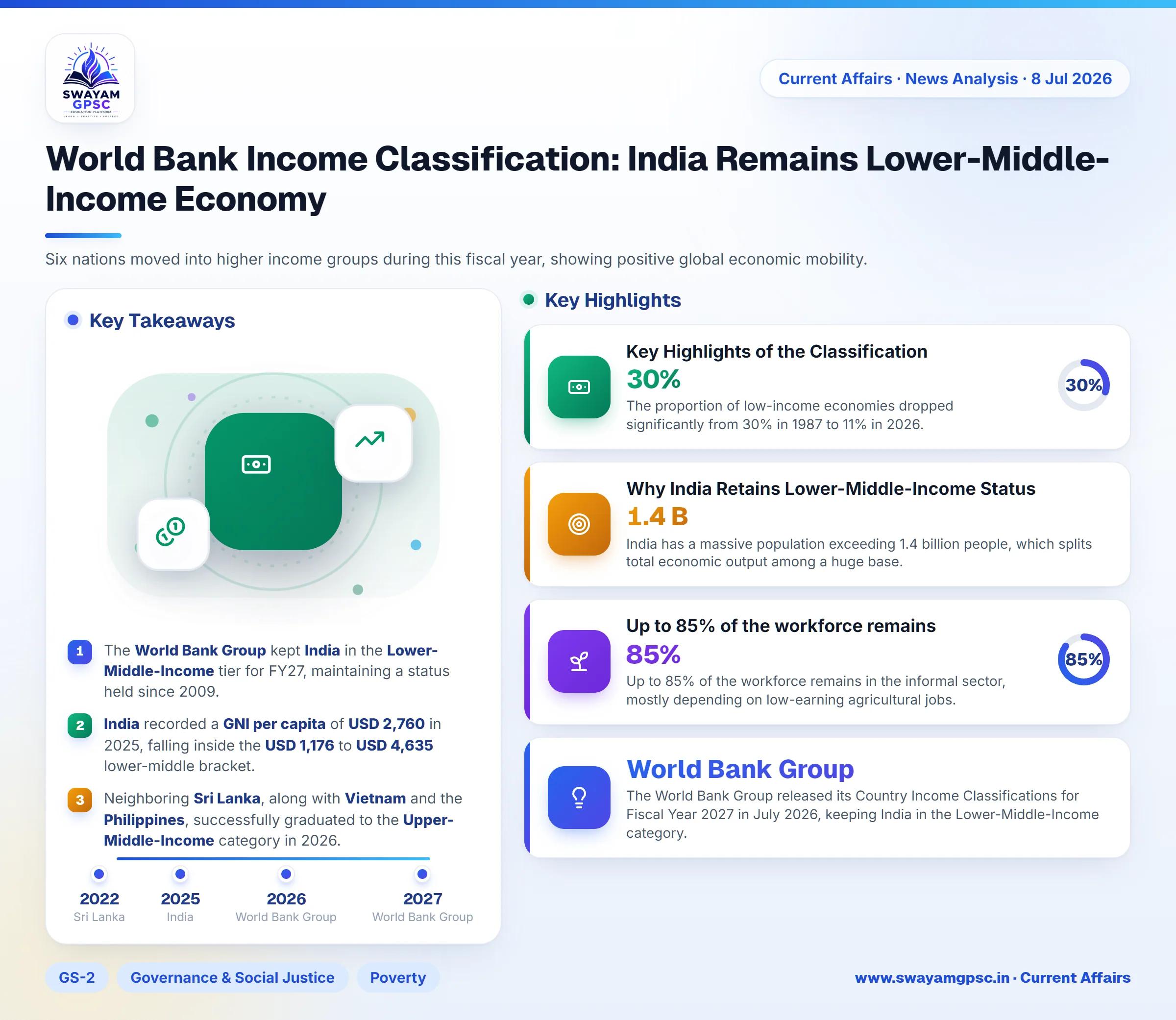
World Bank Income Classification: India Remains Lower-Middle-Income Economy
#GS-2 #Governance & Social Justice #Poverty #GS-3 #Economy #Growth #Current Events #International #World Bank Group #Income Classification
Key takeaways
- The World Bank Group kept India in the Lower-Middle-Income tier for FY27, maintaining a status held since 2009.
- India recorded a GNI per capita of USD 2,760 in 2025, falling inside the USD 1,176 to USD 4,635 lower-middle bracket.
- Neighboring Sri Lanka, along with Vietnam and the Philippines, successfully graduated to the Upper-Middle-Income category in 2026.
- The global share of low-income countries decreased sharply from 30% in 1987 to 11% by 2026.
- Around 85% of India's workforce works in informal jobs, which suppresses average national wage levels.
Why in News
- The World Bank Group released its Country Income Classifications for Fiscal Year 2027 in July 2026, keeping India in the Lower-Middle-Income category.
- India has maintained this Lower-Middle-Income status continuously since 2009.
- In contrast, Sri Lanka, Vietnam, and the Philippines moved up to the Upper-Middle-Income group.
- Sri Lanka achieved this upgrade by recovering from its severe 2022 economic crisis through tourism and financial revivals.
Key Highlights of the Classification
- Six nations moved into higher income groups during this fiscal year, showing positive global economic mobility.
- The proportion of low-income economies dropped significantly from 30% in 1987 to 11% in 2026.
- Sri Lanka, Vietnam, the Philippines, Jordan, and Micronesia advanced from lower-middle to upper-middle income status.
- Togo moved up from the low-income bracket into the lower-middle-income bracket.
- Export-focused factory growth and rising Gross National Income (GNI) drove progress in Vietnam and the Philippines.
- Updated census figures and new statistical methods helped Jordan and Togo reach higher income categories.
- India held steady in the lower-middle-income bracket with a GNI per capita of USD 2,760 in 2025.
How the World Bank Classifies Economies
- The World Bank Group divides world economies into four groups: Low, Lower-Middle, Upper-Middle, and High-Income.
- Classifications update every year on 1st July based on the previous calendar year's GNI per capita.
- The Atlas Method converts local national income figures into US dollars to compare countries fairly.
- This conversion technique uses a three-year average exchange rate to reduce the impact of currency fluctuations.
- A country must achieve real economic growth that exceeds its population growth and inflation to move up a category.
- Income cutoffs are updated every July using the Special Drawing Rights (SDR) deflator to account for global inflation.
- For FY27, Low-Income is defined as USD 1,175 or less, while Lower-Middle-Income spans USD 1,176 to USD 4,635.
- Upper-Middle-Income covers USD 4,636 to USD 14,375, and High-Income includes economies above USD 14,375.
- Low-income nations access cheap grants from the International Development Association (IDA), while middle-income nations borrow from the International Bank for Reconstruction and Development (IBRD).
- Donor nations rely on these income brackets to decide where to direct international development assistance.
- Income categories help establish eligibility for special trade preferences and benefits for developing nations.
- Global financial bodies use these income brackets to allocate climate adaptation funding to vulnerable countries.
- Investors review income classifications as a standard measure of a nation's economic stability and maturity.
- Governments track these income tiers to evaluate progress and design policies to avoid the Middle-Income Trap.
Limitations of GNI per Capita
- GNI per capita is a simple mathematical average that conceals income gaps and deep local poverty.
- This single measurement fails to capture public health, education levels, institutional strength, and environmental health.
- The World Bank Group relies on income classification as an operational sorting tool rather than a full measure of human development.
Why India Retains Lower-Middle-Income Status
- India has a massive population exceeding 1.4 billion people, which splits total economic output among a huge base.
- Strong aggregate economic expansion gets diluted on a per-person basis, making income upgrades mathematically challenging.
- High-performing industrial states like Tamil Nadu, Maharashtra, and Gujarat earn income far above national averages.
- Populous states like Bihar and Uttar Pradesh experience lower productivity, which pulls down the national average.
- Up to 85% of the workforce remains in the informal sector, mostly depending on low-earning agricultural jobs.
- High informal employment keeps average wages low and limits the growth of national tax revenues.
- India only moved out of the low-income tier in 2009, meaning its economic climb started relatively recently.
- Reaching the upper-middle threshold requires doubling per capita earnings, a process that historically takes several decades of sustained growth.