Real-World Asset Tokenisation in India
#GS-3 #Economy #Infrastructure #Science & Technology #ICT #GS-2 #Current Events #National #Blockchain #Real-World Asset Tokenisation
Key takeaways
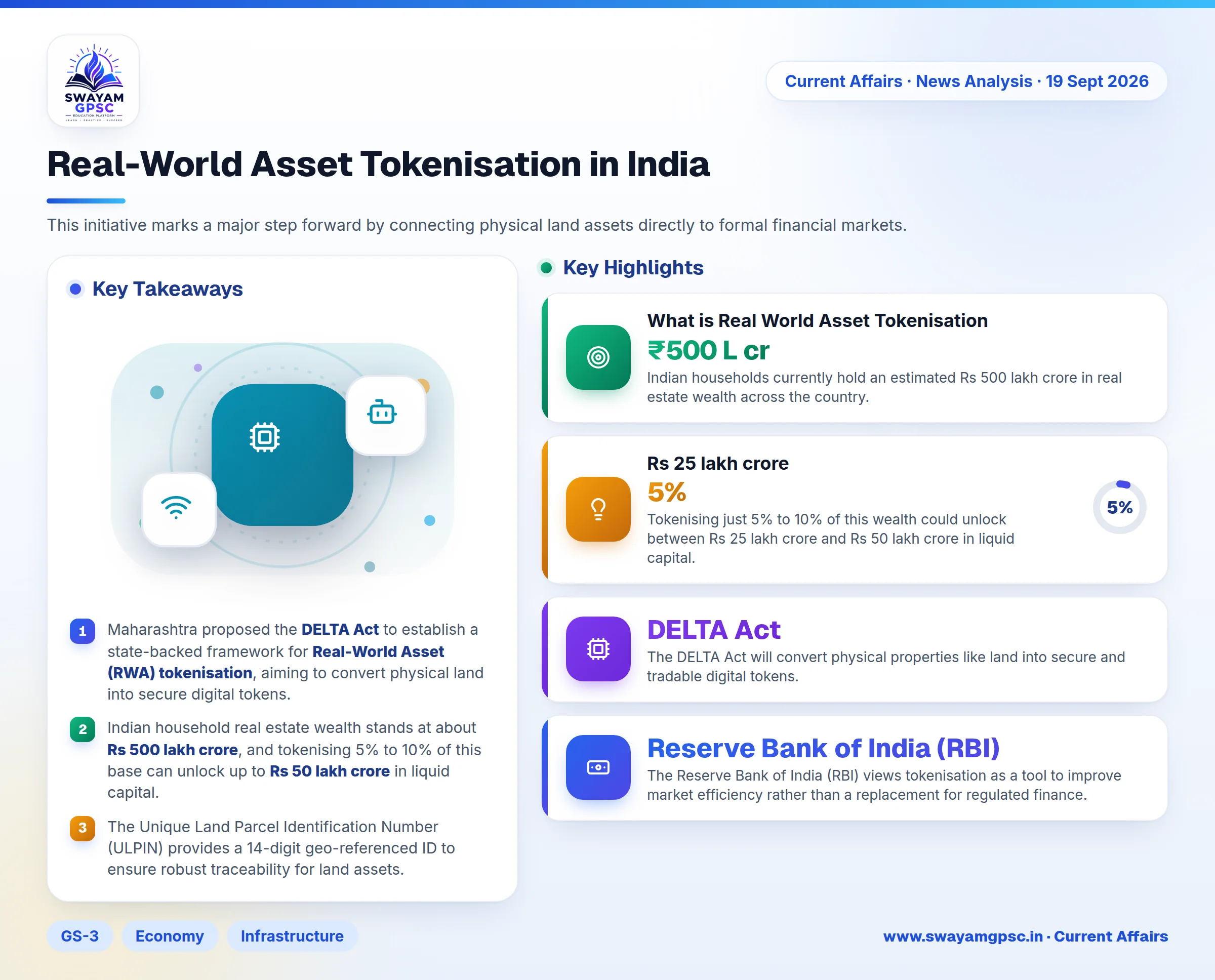
- Maharashtra proposed the DELTA Act to establish a state-backed framework for Real-World Asset (RWA) tokenisation, aiming to convert physical land into secure digital tokens.
- Indian household real estate wealth stands at about Rs 500 lakh crore, and tokenising 5% to 10% of this base can unlock up to Rs 50 lakh crore in liquid capital.
- The Unique Land Parcel Identification Number (ULPIN) provides a 14-digit geo-referenced ID to ensure robust traceability for land assets.
- The RBI and SEBI launched Demat 2.0 to issue tokenised corporate bonds settled instantly using the wholesale digital rupee (e₹).
Why in News
- The Government of Maharashtra has proposed a new law called the Digitisation and Exchange of Land Token Assets (DELTA) Act.
- This new framework will help Maharashtra become the first state in India to adopt Real-World Asset (RWA) tokenisation on a large scale.
- The DELTA Act will convert physical properties like land into secure and tradable digital tokens.
- Land is currently one of the largest but most illiquid forms of wealth in India.
- This initiative marks a major step forward by connecting physical land assets directly to formal financial markets.
What is Real World Asset Tokenisation
- Real-World Asset (RWA) tokenisation uses blockchain and distributed ledger technology to turn physical assets into digital tokens.
- These secure tokens represent the actual ownership, rights, or economic value of physical items like real estate.
- Digital tokens can represent small fractions of an asset to enable fractional ownership for multiple buyers.
- This process lowers financial barriers so that retail and institutional investors can buy small shares of high-value properties.
- The Reserve Bank of India (RBI) views tokenisation as a tool to improve market efficiency rather than a replacement for regulated finance.
- The RBI and SEBI recently introduced Demat 2.0 to issue tokenised corporate bonds using distributed ledger technology.
- This system allows instant settlements using the wholesale digital rupee (e₹) through the Unified Market Interface (UMI).
- In contrast, SEBI uses Small and Medium Real Estate Investment Trusts (SM REITs) to split real estate ownership through regulated trusts.
- Blockchain-based tokenisation completely decentralises the record ledger and can theoretically reduce intermediary costs much further.
- By moving property transfers to a digital ledger, tokenisation makes transaction histories highly transparent and easy to track.
- This technology speeds up verification, automates legal compliance, and reduces fraud in a similar way to UPI for digital payments.
- Land holds immense wealth in India, but slow transactions and complex paperwork keep much of this capital locked up.
- Indian households currently hold an estimated Rs 500 lakh crore in real estate wealth across the country.
- Tokenising just 5% to 10% of this wealth could unlock between Rs 25 lakh crore and Rs 50 lakh crore in liquid capital.
- This process connects dormant physical wealth directly to active retail and institutional financial markets.
Digital Evolution of India's Land Administration
- Under the Digital India Land Records Modernization Programme (DILRMP), the government has digitized paper land records and cadastral maps.
- The Unique Land Parcel Identification Number (ULPIN), also called Bhu-Aadhaar, gives a 14-digit geographic ID to every land parcel.
- This unique identification number improves land traceability and helps prevent fraudulent transactions across different states.
- The government uses the SVAMITVA Scheme to map rural areas with drones and distribute formal property cards to village households.
- These physical property cards help rural families connect their assets to the formal banking system.
- Many states use cloud platforms like the National Generic Document Registration System (NGDRS) to build secure, real-time land registries.
- These modern cloud-based systems provide the digital foundation needed to make asset tokenisation work effectively.
Challenges
- Current property laws like the Registration Act, 1908 require formal physical registration for all land transfers.
- A digital blockchain token does not serve as a legally recognized substitute for a registered property deed today.
- Smart contracts on a blockchain execute automatically, but courts can freeze property transfers during disputes.
- This situation creates a direct conflict between automatic digital execution and necessary judicial intervention.
- The Indian Contract Act, 1872 does not specifically cover self-executing smart contracts, which causes legal confusion.
- Traditional property transfers require stamp duty, but tokenisation allows frequent and tiny fractional transfers.
- The government has not yet decided how to calculate and collect stamp duty for these micro-transactions.
- Land is a State subject under the Indian Constitution, while central bodies like SEBI and RBI regulate financial securities.
- This division of power means tokenised land might fall into a regulatory grey area between state and central authorities.
- Indian land records usually show presumptive ownership rather than absolute, conclusive proof of title.
- Tokenising a disputed land title will only digitize the conflict and expose retail investors to fraud.
- Current tax rules for Virtual Digital Assets (VDAs) do not distinguish between speculative cryptocurrencies and asset-backed tokens.
- This lack of clarity creates confusion about how the government will tax real-world asset tokens.
- Blockchain transactions are permanent and remain extremely difficult to reverse once completed.
- If an investor loses private keys, experiences fraud, or faces court-ordered asset seizures, recovering the tokens is extremely hard.
- Investors face high risks from fraudulent tokens that lack real, verified backing by actual physical assets.
- Public blockchains store transactions permanently, which may conflict with the privacy rules of the DPDP Act, 2023.
- These systems also face cyber threats and require strong security to prevent hacking and data theft.
Way Forward
- The central government and states must work together to build a unified regulatory framework for tokenised assets.
- This framework must clarify how state land laws connect with financial rules set by SEBI and RBI.
- Authorities should only allow the tokenisation of properties that have verified and completely dispute-free records.
- Every token must have verified physical backing, clear disclosures, and systems to resolve disputes or lost digital keys.
- Other states can use Maharashtra and its proposed DELTA Act as a pilot model to test these systems.
- Large real estate markets like Karnataka, Tamil Nadu, and Delhi can adopt similar frameworks to unlock household wealth.
- India should connect tokenisation with its Digital Public Infrastructure (DPI), including UPI and Account Aggregators.
- This deep integration will ensure smooth identity verification and secure financial settlements across the country.
- After proving the real estate model, India can expand tokenisation to debt markets, gold, commodities, and carbon credits.
- States can collect stamp duty centrally through stock exchanges and depositories, similar to the amended Indian Stamp Act, 1899.
International Best Practices
- Switzerland created legal certainty by formally recognizing digital records and DLT-based financial market infrastructure.
- Singapore launched Project Guardian to safely test tokenised bonds, funds, and foreign exchange for institutional investors.
- Hong Kong is exploring tokenised deposits and asset settlements through its Project Ensemble initiative.
- The UAE uses regulatory sandboxes and dedicated virtual-asset frameworks to encourage rapid financial innovation.
- The European Union created structured rules for crypto-assets using the Markets in Crypto Assets (MiCA) framework.
- The United Kingdom launched the Digital Securities Sandbox to let companies test blockchain-based securities under controlled conditions.
Frequently Asked Questions
- Real-World Asset (RWA) tokenisation converts physical assets like land into secure digital tokens using blockchain technology.
- The proposed DELTA Act is a legal framework in Maharashtra designed to turn land into digital tokens.
- The ULPIN is a 14-digit geographic identification number that provides the digital foundation for land tokenisation.
- The main challenges include the Registration Act, 1908, presumptive land titles, tax uncertainty, and regulatory overlaps between states and the center.
- Safe tokenisation requires a unified regulatory framework, verified land titles, and integration with India's Digital Public Infrastructure (DPI).