Pradhan Mantri Khanij Kshetra Kalyan Yojana (PMKKKY) Progress and Key Highlights
#GS-2 #Governance & Social Justice #Vulnerable Sections #Current Events #National #GS-3 #Economy #Infrastructure #Environment #Sustainable Development #Geography #Resources
Key takeaways
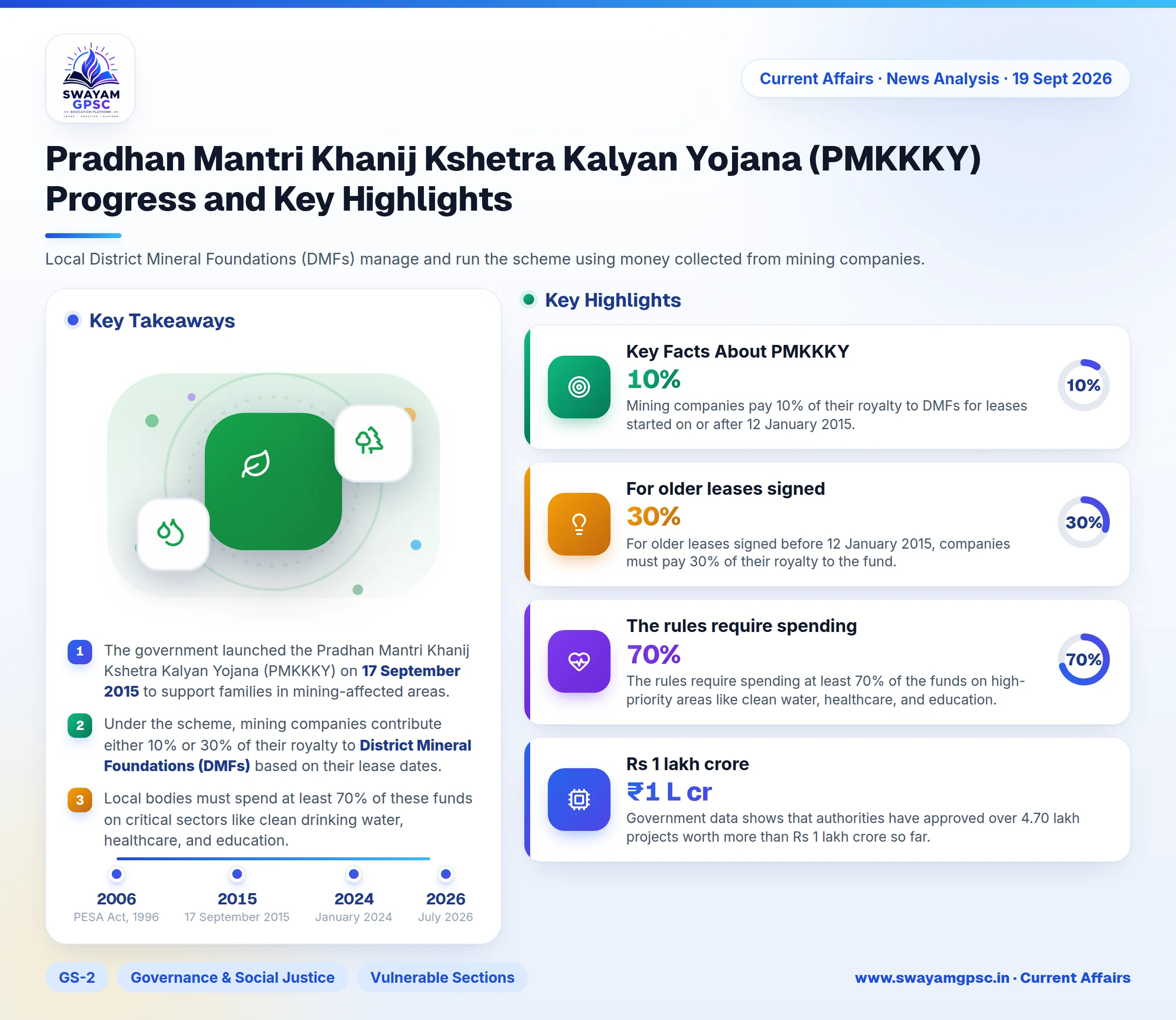
- The government launched the Pradhan Mantri Khanij Kshetra Kalyan Yojana (PMKKKY) on 17 September 2015 to support families in mining-affected areas.
- Under the scheme, mining companies contribute either 10% or 30% of their royalty to District Mineral Foundations (DMFs) based on their lease dates.
- Local bodies must spend at least 70% of these funds on critical sectors like clean drinking water, healthcare, and education.
- As of July 2026, authorities have approved over 4.70 lakh projects worth more than Rs 1 lakh crore across 656 districts.
Why in News
- The Pradhan Mantri Khanij Kshetra Kalyan Yojana (PMKKKY) has made great progress in helping communities affected by mining.
- This scheme achieves its goals by using funds collected through District Mineral Foundations (DMFs).
Key Facts About PMKKKY
- The government launched this welfare scheme on 17 September 2015 to help families living near mining sites.
- Local District Mineral Foundations (DMFs) manage and run the scheme using money collected from mining companies.
- The main goal is to build better social infrastructure and improve the overall quality of life in these areas.
- The scheme also works to reduce the bad effects of mining on health, environment, and local livelihoods.
- DMFs are non-profit trusts created under the 2015 amendment to the Mines and Minerals (Development and Regulation) Act, 1957.
- These trusts work under state governments and currently operate in 656 districts across 23 Indian states.
- Under the Mines and Minerals (Development and Regulation) Act, 1957, states must include PMKKKY rules in their local DMF guidelines.
- The government released updated guidelines in January 2024 to make the planning and use of DMF funds more effective.
- Since mining often happens in tribal regions, DMF rules must protect Scheduled Tribes under the PESA Act, 1996 and the Forest Rights Act, 2006.
- Mining companies pay 10% of their royalty to DMFs for leases started on or after 12 January 2015.
- For older leases signed before 12 January 2015, companies must pay 30% of their royalty to the fund.
- The rules require spending at least 70% of the funds on high-priority areas like clean water, healthcare, and education.
- Authorities can spend the remaining 30% of the funds on other needs like roads, electricity, and irrigation.
- Government data shows that authorities have approved over 4.70 lakh projects worth more than Rs 1 lakh crore so far.
- Out of these, workers have finished over 2.92 lakh projects, while 78,809 projects are still going on as of July 2026.
Way Forward
- The PMKKKY scheme is a vital tool to ensure that local communities get a fair share of the wealth generated from their land.
- Spending mining money on healthcare and education helps create a more balanced and sustainable model of development.