World Antimicrobial Resistance Awareness Week 2026
#GS-2 #GS-3 #Governance & Social Justice #Science & Technology #Current Events #Health #Biotechnology #National #Quick Facts For Prelims #Government Policies & Interventions #Achievements of Indians in Science & Technology
Key takeaways
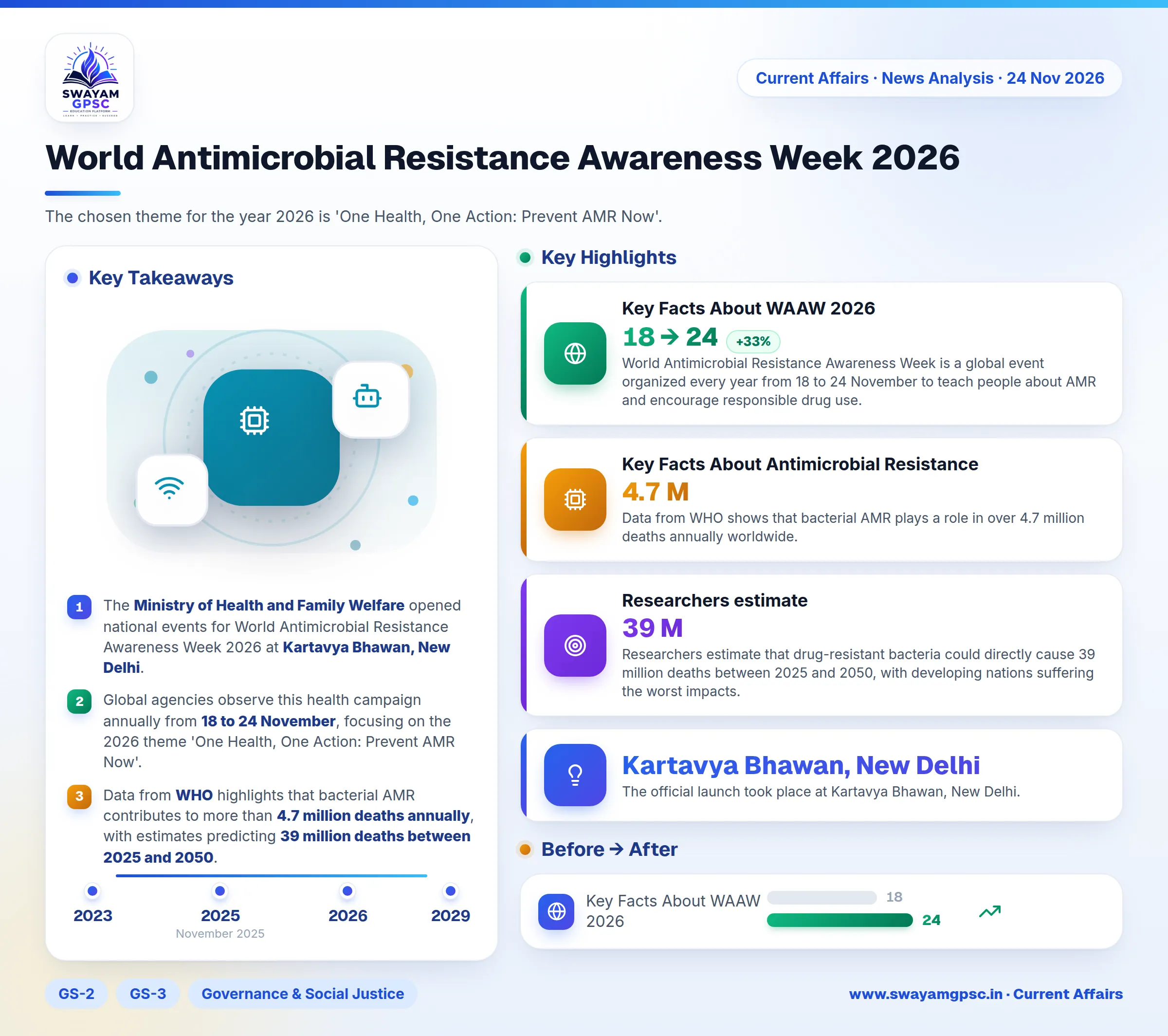
- The Ministry of Health and Family Welfare opened national events for World Antimicrobial Resistance Awareness Week 2026 at Kartavya Bhawan, New Delhi.
- Global agencies observe this health campaign annually from 18 to 24 November, focusing on the 2026 theme 'One Health, One Action: Prevent AMR Now'.
- Data from WHO highlights that bacterial AMR contributes to more than 4.7 million deaths annually, with estimates predicting 39 million deaths between 2025 and 2050.
- India launched its National Action Plan on AMR 2.0 in November 2025 to direct surveillance and infection control initiatives through 2029.
Why in News
- The Ministry of Health and Family Welfare (MoHFW) started the national events for World Antimicrobial Resistance Awareness Week (WAAW) 2026.
- The official launch took place at Kartavya Bhawan, New Delhi.
- Officials stressed the need for joint action against antimicrobial resistance (AMR) using the One Health approach.
Key Facts About WAAW 2026
- World Antimicrobial Resistance Awareness Week is a global event organized every year from 18 to 24 November to teach people about AMR and encourage responsible drug use.
- This campaign originally started in 2015 as World Antibiotic Awareness Week before officials changed its name to World AMR Awareness Week in 2023.
- The chosen theme for the year 2026 is 'One Health, One Action: Prevent AMR Now'.
- This theme focuses on coordinating actions across human health, animal care, crop farming, food networks, and environmental safety.
- Four global bodies lead this effort as the Quadripartite Alliance, including the World Health Organization (WHO), Food and Agriculture Organization (FAO), United Nations Environment Programme (UNEP), and World Organisation for Animal Health (WOAH).
- The 79th World Health Assembly approved the Global Action Plan on AMR (2026-2036) in May 2026 to cut down AMR deaths and limit drug residue in the environment.
- India launched its National Action Plan on AMR 2.0 in November 2025 to guide national strategies over the 2025-2029 period.
- This updated national framework builds upon India's initial AMR plan that first came out in 2017.
- The government started the National Programme on AMR Containment back in 2013 during the 12th Five-Year Plan.
- The National Centre for Disease Control (NCDC) coordinates this program to improve laboratory testing networks, track drug resistance, and educate the public.
Key Facts About Antimicrobial Resistance
- Antimicrobial resistance occurs when bacteria, viruses, fungi, and parasites stop responding to standard medicines, which makes ordinary infections hard to cure.
- The term antimicrobials covers several medicine types, including antibiotics, antivirals, antifungals, and antiparasitics.
- Microorganisms develop resistance over time due to genetic changes, rather than humans or animals building the resistance themselves.
- Main causes of AMR include overusing medicines, getting wrong prescriptions, self-treating illnesses, weak hygiene, and dumping untreated industrial waste into water bodies.
- Data from WHO shows that bacterial AMR plays a role in over 4.7 million deaths annually worldwide.
- Researchers estimate that drug-resistant bacteria could directly cause 39 million deaths between 2025 and 2050, with developing nations suffering the worst impacts.
- Rising resistance leads to longer hospital stays, extra medical bills, higher mortality, and riskier routine surgeries or organ transplants.
- Antibiotic resistance is a specific form of AMR where bacteria resist treatments, though antibiotics remain completely useless against common viral infections like colds.
- Preventing resistance requires routine vaccinations, clean drinking water, good personal sanitation, reliable lab testing, and strict pollution controls.
- Containing the crisis demands proper clinical prescriptions, stopping unnecessary drug sales, avoiding leftover pill usage, and curbing illegal low-quality medicines.
Frequently Asked Questions
- World Antimicrobial Resistance Awareness Week takes place annually between 18 and 24 November, using 'One Health, One Action: Prevent AMR Now' as its 2026 theme.
- Antimicrobial resistance develops when disease-causing germs change, rendering common treatments like antibiotics, antivirals, and antifungals ineffective.
- The global Quadripartite Alliance consists of WHO, FAO, UNEP, and WOAH, working together to combat AMR across multiple sectors.
- The One Health approach connects human healthcare, veterinary medicine, and environmental policies to stop resistance from spreading.
- India rolled out its National Action Plan on AMR 2.0 in November 2025 to run through 2029, aiming to boost lab tracking and infection management.