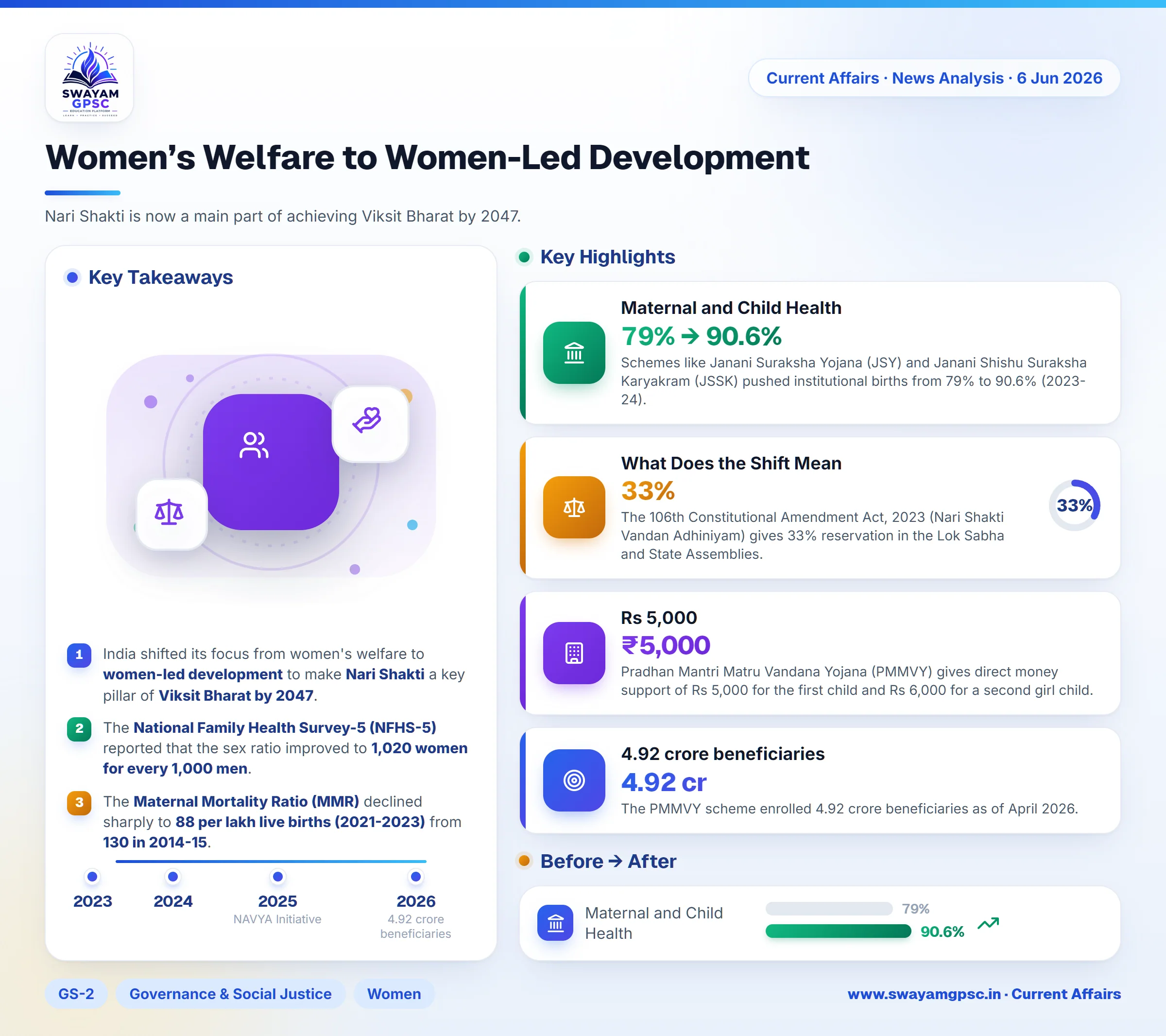
Women’s Welfare to Women-Led Development
#GS-2 #Governance & Social Justice #Women #Vulnerable Sections #GS-3 #Economy #Inclusive Growth #Quick Facts For Prelims
Key takeaways
- India shifted its focus from women's welfare to women-led development to make Nari Shakti a key pillar of Viksit Bharat by 2047.
- The National Family Health Survey-5 (NFHS-5) reported that the sex ratio improved to 1,020 women for every 1,000 men.
- The Maternal Mortality Ratio (MMR) declined sharply to 88 per lakh live births (2021-2023) from 130 in 2014-15.
- Rural women formed 93.85 lakh Self-Help Groups (SHGs) with over 10.07 crore members under the DAY-NRLM scheme.
- The Pradhan Mantri Mudra Yojana (PMMY) increased cumulative sanctioned loans to Rs 40.07 lakh crore by March 2026.
Why in News
- India changed its approach to helping women from basic welfare to women-led development.
- Programs now focus on education, health, skills, money access, and leadership training for women.
- Women now drive economic growth and social change instead of just receiving aid.
- Nari Shakti is now a main part of achieving Viksit Bharat by 2047.
What Does the Shift Mean
- Under the old welfare system, women were treated as passive receivers of government help and subsidies.
- The new development approach gives women tools like capital, property ownership, and leadership training to succeed.
- Old welfare programs only gave basic food rations or low-wage work to help families survive.
- The new development model helps women become business owners and job creators.
- Women now get collateral-free business loans through schemes like Mudra and Stand-Up India to join the formal economy.
- Old policies were made by men for women, where women only participated by voting.
- The 106th Constitutional Amendment Act, 2023 (Nari Shakti Vandan Adhiniyam) gives 33% reservation in the Lok Sabha and State Assemblies.
- Articles 243D and 243T of the Constitution guarantee one-third reservation for women in Panchayats and Municipalities.
- Women officers received Permanent Commission following the 2020 Supreme Court judgment in Secretary, Ministry of Defence v. Babita Puniya.
- Admissions to the National Defence Academy (NDA) opened to women in 2021 to strengthen national security roles.
Maternal and Child Health
- Beti Bachao Beti Padhao (BBBP) launched in 2015 to stop gender-biased sex selection.
- The National Family Health Survey-5 (NFHS-5) shows the sex ratio improved to 1,020 women for every 1,000 men, up from 943 in the 2011 Census.
- Pradhan Mantri Matru Vandana Yojana (PMMVY) gives direct money support of Rs 5,000 for the first child and Rs 6,000 for a second girl child.
- The PMMVY scheme enrolled 4.92 crore beneficiaries as of April 2026.
- Pradhan Mantri Surakshit Matritva Abhiyan (PMSMA) offers free health check-ups on the 9th of every month.
- PMSMA completed over 6.85 crore check-ups and tracked 1.03 crore high-risk pregnancies.
- The Maternal Mortality Ratio (MMR) dropped to 88 per lakh live births (2021-2023) from 130 in 2014-15.
- Schemes like Janani Suraksha Yojana (JSY) and Janani Shishu Suraksha Karyakram (JSSK) pushed institutional births from 79% to 90.6% (2023-24).
Healthcare and Nutrition Support
- Ayushman Bharat (AB-PMJAY) created 43.52 crore health cards by February 2026.
- Women account for nearly 49% (21 crore) of these health cards and 48% of hospital admissions.
- Ayushman Bharat Digital Mission (ABDM) linked over 95 crore records using ABHA accounts, helping women access digital health services.
- Saksham Anganwadi and Poshan 2.0 upgraded 1.03 lakh Anganwadi Centres and trained 10.58 lakh frontline workers.
- Frontline workers use diet diversity and NEP tools to fight child malnutrition.
- Mission Indradhanush vaccinated over 1.32 crore pregnant women using the digital U-WIN portal.
- Healthcare workers screened 8.73 crore women for cervical cancer by February 2026.
Education as a Catalyst
- National Education Policy (NEP) 2020 puts gender inclusion at the center of the school system using the Gender Inclusion Fund.
- Female school enrollment rose from 1.57 crore (32%) in 2014-15 to 11.93 crore (48%) today through Samagra Shiksha.
- Kasturba Gandhi Balika Vidyalayas (KGBVs) provide residential schooling, growing to 7.58 lakh girls by 2026.
- School infrastructure improved with 97.3% of schools having separate toilets for girls and 99.3% having clean drinking water in 2024-25.
- The AICTE PRAGATI Scholarship helped add over 12 lakh women to higher education between 2014-15 and 2022-23.
- The Vigyan Jyoti Scheme trained over 1.12 lakh girls across 300 districts for STEM careers.
- Supernumerary seats at IITs and NITs raised women student numbers from below 10% to over 20%.
Skilling and Digital Inclusion
- Women form nearly 45% of all beneficiaries in the Pradhan Mantri Kaushal Vikas Yojana (PMKVY).
- The new PMKVY 4.0 teaches modern skills like AI, drones, green energy, and electronics.
- The NAVYA Initiative started in 2025 for girls aged 16 to 18 in Aspirational districts to build financial and digital skills.
Financial Empowerment
- Rural women formed 93.85 lakh Self-Help Groups (SHGs) with over 10.07 crore members under the DAY-NRLM scheme.
- These groups received over Rs 12 lakh crore in bank credit to start businesses.
- Programs like Krishi Sakhis, Pashu Sakhis, and SVEP supported over 5.88 lakh enterprises for steady income.
- The Lakhpati Didi plan aims to help 6 crore SHG members earn at least Rs 1 lakh every year.
- The NaMo Drone Didi scheme started in 2023 trains women to fly agricultural drones.
- Pradhan Mantri Jan Dhan Yojana (PMJDY) gave universal bank accounts to women for direct benefit transfers.
- Pradhan Mantri Mudra Yojana (PMMY) grew loan amounts from Rs 1.37 lakh crore in 2015-16 to Rs 40.07 lakh crore by March 2026.
- PM SVANidhi gives working capital to street vendors, where women make up 46% of beneficiaries.
- The *Womaniya* platform on GeM lets over 2.1 lakh women-led businesses sell directly to the government.
- The Union Budget 2026-27 introduced *SHE-Marts* to create physical shops for 1 crore SHG women.
Safety and Living Standards
- Mission Shakti runs 973 One Stop Centres that helped 14.49 lakh women, along with a 24/7 helpline number 181.
- Mission Shakti uses *Nari Adalats* for local dispute resolution at the village level.
- Swachh Bharat Mission (SBM) built over 12 crore household toilets and 6.3 lakh public toilets, declaring over 5 lakh villages ODF Plus.
- Pradhan Mantri Awas Yojana-Urban (PMAY-U 2.0) registered 96% of houses directly in women's names.
- PMUY provided 10.55 crore free LPG connections to stop indoor air pollution.
- Jal Jeevan Mission gave tap water to nearly 16 crore rural families, saving women from walking long distances for water.
Governance and Leadership
- In the 2024 elections, women made up 48.62% of voters with a 65.78% turnout rate.
- The 2024 elections sent 75 women to the Lok Sabha, while women form nearly 17% of the Rajya Sabha.
- Over 14.5 lakh elected women serve in local Panchayati Raj Institutions, making up 46% of local leaders.
- The first batch of 17 women cadets graduated from the National Defence Academy (NDA) in 2025.
- By early 2026, 158 women cadets joined the academy.
- Leaders like Air Marshal Padmavathy Bandopadhyay, Lt Gen Punita Arora, and Sub-Lieutenant Shivangi broke major defence barriers.
- Colonel Sofiya Qureshi and Wing Commander Vyomika Singh became the faces of Operation Sindoor.