Wildlife Conservation in India: Achievements, Gaps, and the Road Ahead
#GS-3 #Environment #Conservation #GS-2 #Governance & Social Justice #Regulatory Bodies #Government Policies & Interventions
Key takeaways
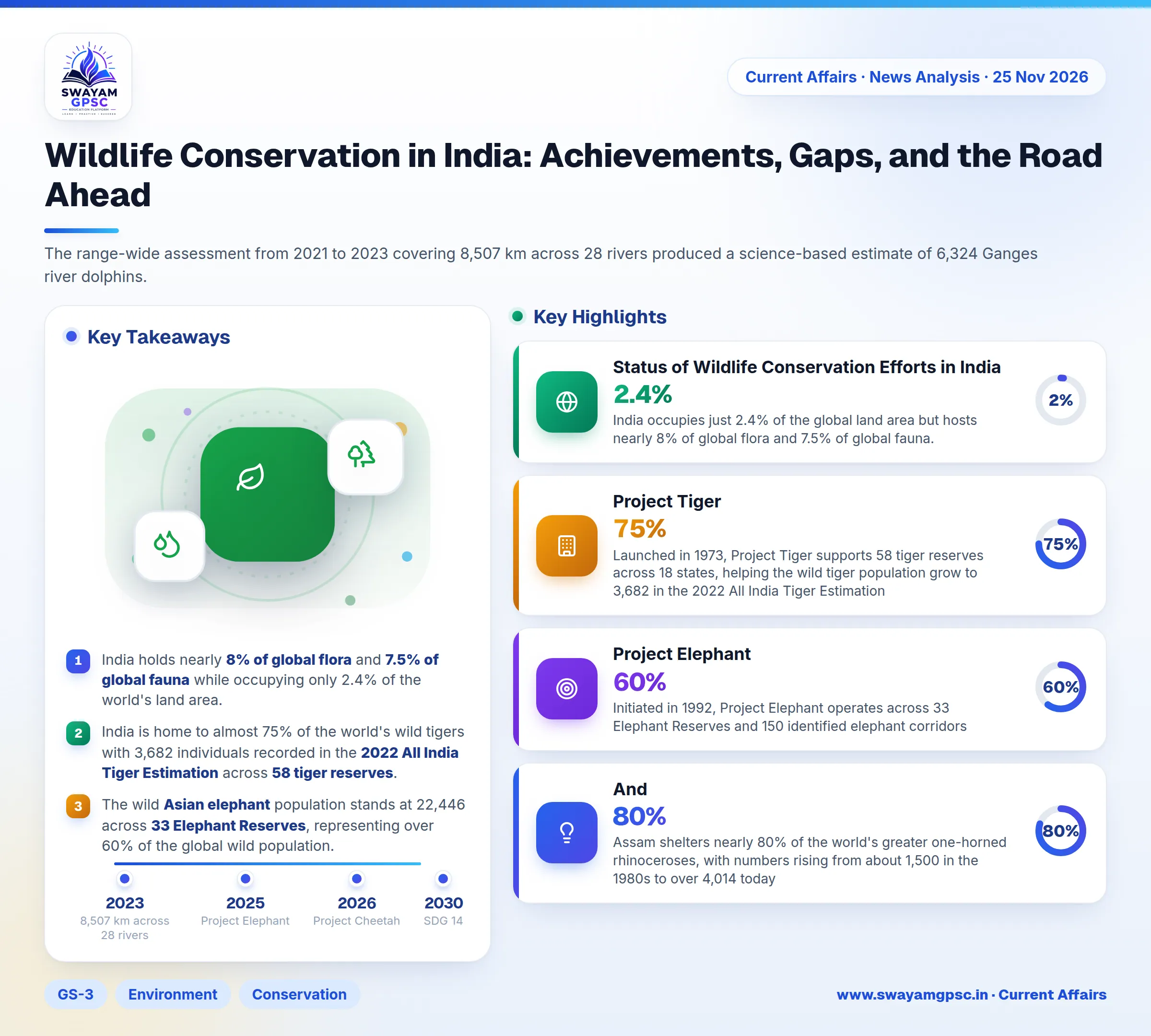
- India holds nearly 8% of global flora and 7.5% of global fauna while occupying only 2.4% of the world's land area.
- India is home to almost 75% of the world's wild tigers with 3,682 individuals recorded in the 2022 All India Tiger Estimation across 58 tiger reserves.
- The wild Asian elephant population stands at 22,446 across 33 Elephant Reserves, representing over 60% of the global wild population.
- Fewer than 5.4% of India's land falls under formal protected area networks, creating serious corridor fragmentation and human-wildlife conflicts.
- To meet international targets, India aims to align its policies with the Kunming-Montreal Global Biodiversity Framework to conserve 30% of land and water ecosystems by 2030.
Why in News
- India has achieved remarkable success in wildlife conservation despite facing high human population density and limited land resources.
- The nation outperforms several wealthier Western countries by combining an ancient cultural ethos of coexistence, strong statutory legal frameworks, and modern scientific management.
Status of Wildlife Conservation Efforts in India
- India occupies just 2.4% of the global land area but hosts nearly 8% of global flora and 7.5% of global fauna.
- The country is recognized as one of the 17 megadiverse countries and contains portions of 4 of the 36 global biodiversity hotspots, including the Himalaya, Indo-Burma, Western Ghats-Sri Lanka, and Sundaland/Nicobar Islands.
- Launched in 1973, Project Tiger supports 58 tiger reserves across 18 states, helping the wild tiger population grow to 3,682 in the 2022 All India Tiger Estimation, which represents almost 75% of the world total.
- Initiated in 1992, Project Elephant operates across 33 Elephant Reserves and 150 identified elephant corridors, safeguarding an estimated 22,446 wild Asian elephants based on the 2021-2025 DNA-based national estimation, accounting for over 60% of the global wild population.
- Under Project Lion, Gujarat's Asiatic lion population expanded from 674 in 2020 to 891 in 2025 according to the 16th Asiatic Lion Census 2025, driven by habitat restoration, veterinary care, prey management, and corridor development outside Gir.
- Assam shelters nearly 80% of the world's greater one-horned rhinoceroses, with numbers rising from about 1,500 in the 1980s to over 4,014 today, supported by the National Conservation Strategy for the Indian One-Horned Rhinoceros (2019) and Indian Rhino Vision 2020.
- India holds an estimated 13,874 common leopards, while the first nationwide assessment under Project Snow Leopard identified 718 snow leopards.
- Launched in 2022, Project Cheetah represents the world's first intercontinental wild carnivore translocation initiative, reaching 62 individuals by late 2026, including 43 Indian-born cubs.
- The range-wide assessment from 2021 to 2023 covering 8,507 km across 28 rivers produced a science-based estimate of 6,324 Ganges river dolphins.
- Tamil Nadu established the Palk Bay Dugong Conservation Reserve covering 448 sq km, protecting an estimated population of 270 dugongs in Palk Bay and the Gulf of Mannar based on a 2025 assessment.
- Synchronized surveys recorded a 4.7% increase in the Nilgiri Tahr population from 1,303 in 2025 to 1,364 in 2026.
- Vulture populations are recovering following the national ban on veterinary diclofenac and successful captive breeding programs at the Jatayu Conservation Breeding Centre in Pinjore, Haryana.
Factors Driving India's Conservation Success
- Centuries before Western national parks emerged, ancient India established Abhayaranyas in 300 BCE, recorded wildlife management policies in Kautilya's Arthashastra, and emphasized environmental protection in the Vedic Aranyakas.
- Article 48A of the Constitution instructs the State to protect the environment and safeguard forests and wildlife.
- Article 51A(g) makes protecting the natural environment and showing compassion for living creatures a fundamental duty of every citizen.
- The Wildlife (Protection) Act, 1972 and dedicated programs like Project Tiger, Project Elephant, and Integrated Development of Wildlife Habitats established strong statutory safeguards against poaching and habitat destruction.
- The Wild Life (Protection) Amendment Act, 2022 enhanced statutory protection measures and aligned domestic law with CITES commitments.
- The National Board for Wildlife (NBWL), a statutory body under the 1972 Act chaired by the Prime Minister, advises the central government on national wildlife policies.
- The National Wildlife Action Plan (2017-2031) focuses on landscape-level conservation, local community engagement, and integrating climate considerations into wildlife management.
- The National Human-Wildlife Conflict Mitigation Strategy and Action Plan (2021-26) combines institutional, scientific, and community mechanisms to minimize conflict.
- Following the Sariska tiger crisis, India established the National Tiger Conservation Authority (NTCA) and the Wildlife Crime Control Bureau (WCCB) to strengthen scientific oversight and anti-poaching operations.
- Establishing strictly protected core zones alongside managed buffer zones across 58 tiger reserves and national parks has provided safe breeding grounds for top predators.
- Equitable voluntary relocation packages offering Rs 15 lakh per family have successfully reduced human pressure on core habitats while improving living standards for forest communities.
- Modern monitoring methods like camera traps, DNA analysis, M-STrIPES patrolling, and an umbrella species conservation approach have yielded measurable ecological recoveries.
Challenges in Sustaining Wildlife Conservation
- The 2022 All India Tiger Estimation revealed uneven outcomes, showing that 10 of the 53 reserves contained fewer than 10 tigers each, while 5 reserves had no tigers at all.
- The WWF Living Planet Report 2026 highlights global systemic pressures such as habitat loss, overexploitation, climate change, pollution, invasive species, and wildlife diseases.
- With less than 5.4% of land designated as protected areas, expanding wildlife numbers encounter severe corridor fragmentation and heightened conflict with humans.
- A major evaluation gap exists because only 7.2% of India's animal species have been assessed on the IUCN Red List, leaving 1,012 species classified as threatened while non-charismatic species remain largely unmonitored.
- Transitioning cheetahs from fenced enclosures into open ecosystems faces ongoing delays in inter-state coordination between Madhya Pradesh and Rajasthan alongside poaching risks, while fragile island ecosystems in Lakshadweep and Andaman & Nicobar face developmental pressures.
- Misguided animal welfare activism driven by sentiment can undermine broader, scientific population management and habitat conservation goals.
- Organized illegal trade networks continue targeting wildlife, while limited forensic capabilities, low conviction rates, and weak agency coordination hamper law enforcement.
- Strict top-down conservation models that ignore local rights under the Forest Rights Act, 2006 or delay ex-gratia compensation for lost livestock and crops alienate local communities and spark retaliatory killings.
Way Forward
- India must align national policy with the Kunming-Montreal Global Biodiversity Framework target to protect 30% of terrestrial, inland water, coastal, and marine ecosystems by 2030 while advancing SDG 14 and SDG 15.
- Conservation must expand beyond protected pockets to legally safeguard wildlife corridors, restore degraded grasslands, and incorporate ecological designs into linear infrastructure projects.
- Accelerating the National Red List initiative by 2030 will close assessment gaps, while models like Tamil Nadu's Endangered Species Conservation Fund and Kerala's digitized HAWK system linked with e-Courts can transform judicial enforcement.
- Development projects in vulnerable island ecosystems must undergo independent ecological reviews, while freshwater conservation should expand across India's 103 Ramsar sites.
- States should leverage the Green Credit Programme (GCP), Corporate Social Responsibility (CSR) funds, and innovative conservation bonds alongside cross-border agreements with Nepal, Bangladesh, and Bhutan.
- Deploying genomic tracking through facilities like LaCONES (CCMB, Hyderabad) and establishing a One Health Wildlife Disease Surveillance Network will protect genetic diversity and stop zoonotic outbreaks.
- Expanding smart technology like AI, remote sensing, and the Indian Railways' Gajraj System using fiber optic sensors can prevent wildlife mortality along transport routes.
- Empowering local communities through ecotourism, homestays, and sustainable forest livelihoods will foster long-term human-wildlife coexistence.