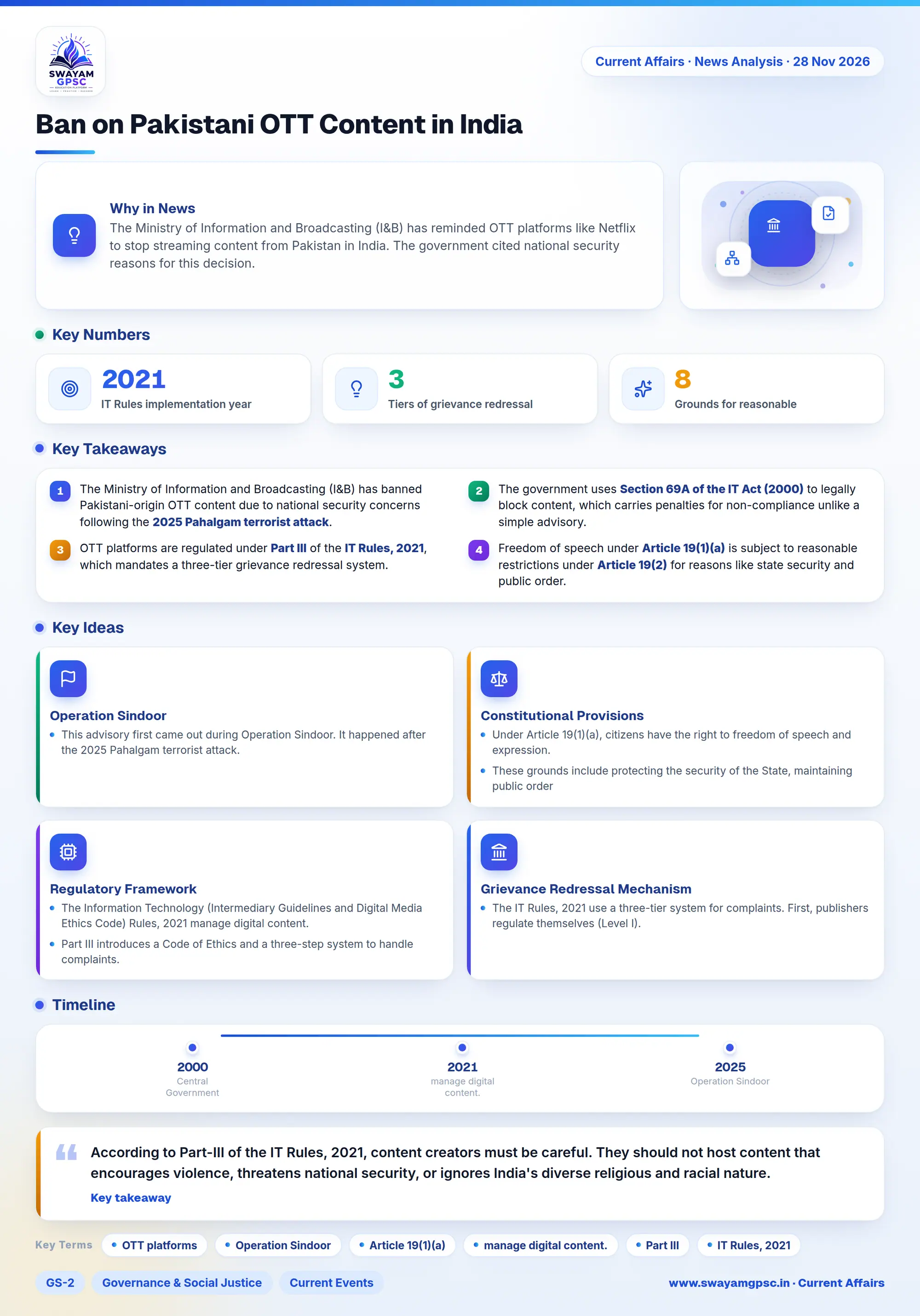
Ban on Pakistani OTT Content in India
#GS-2 #Governance & Social Justice #Current Events #National #IT Act #OTT Regulation
Key takeaways
- The Ministry of Information and Broadcasting (I&B) has banned Pakistani-origin OTT content due to national security concerns following the 2025 Pahalgam terrorist attack.
- The government uses Section 69A of the IT Act (2000) to legally block content, which carries penalties for non-compliance unlike a simple advisory.
- OTT platforms are regulated under Part III of the IT Rules, 2021, which mandates a three-tier grievance redressal system.
- Freedom of speech under Article 19(1)(a) is subject to reasonable restrictions under Article 19(2) for reasons like state security and public order.
Why in News
- The Ministry of Information and Broadcasting (I&B) has reminded OTT platforms like Netflix to stop streaming content from Pakistan in India. The government cited national security reasons for this decision.
Background
- This advisory first came out during Operation Sindoor. It happened after the 2025 Pahalgam terrorist attack. The ban applies to all Pakistani films, web series, songs, and podcasts, even if they are part of a paid subscription.
Constitutional Provisions
- Under Article 19(1)(a), citizens have the right to freedom of speech and expression. However, Article 19(2) allows the government to put reasonable limits on this right based on eight specific grounds.
- These grounds include protecting the security of the State, maintaining public order, and keeping friendly relations with other countries.
Regulatory Framework
- The Information Technology (Intermediary Guidelines and Digital Media Ethics Code) Rules, 2021 manage digital content. Part II focuses on intermediaries, while Part III governs OTT platforms and digital news publishers.
- Part III introduces a Code of Ethics and a three-step system to handle complaints.
Grievance Redressal Mechanism
- The IT Rules, 2021 use a three-tier system for complaints. First, publishers regulate themselves (Level I). Second, industry bodies oversee them (Level II). Finally, the Ministry of Information and Broadcasting (I&B) provides government oversight (Level III).
Code of Ethics and Due Diligence
- According to Part-III of the IT Rules, 2021, content creators must be careful. They should not host content that encourages violence, threatens national security, or ignores India's diverse religious and racial nature.
- Under Part-II, Rule 3(1)(b), intermediaries must try their best to stop users from sharing information that harms India's unity and sovereignty.
Blocking Powers of the Government
- The Central Government has the power to block online content under Section 69A of the IT Act (2000). This is done to protect national security or prevent a serious crime.
- There is a difference between an advisory and a blocking order. An advisory suggests a position, but a Section 69A order is a legal requirement. If a platform ignores it, they face penalties.
Emergency Powers and Review
- The I&B Secretary can order the immediate blocking of content in emergencies without a prior hearing.
- If a takedown is challenged, such as the case of the film Satluj on ZEE5, an Inter-Departmental Committee reviews the decision.
Regulation of Foreign Content
- India does not have a separate law just for foreign OTT content. Instead, it follows the general rules of the IT Act, 2000 and the IT Rules, 2021.