WHO Global Tuberculosis Report 2026: India's Progress and Challenges
#GS-2 #Governance & Social Justice #Health #Current Events #International #WHO Global Tuberculosis Report 2026 #NTEP
Key takeaways
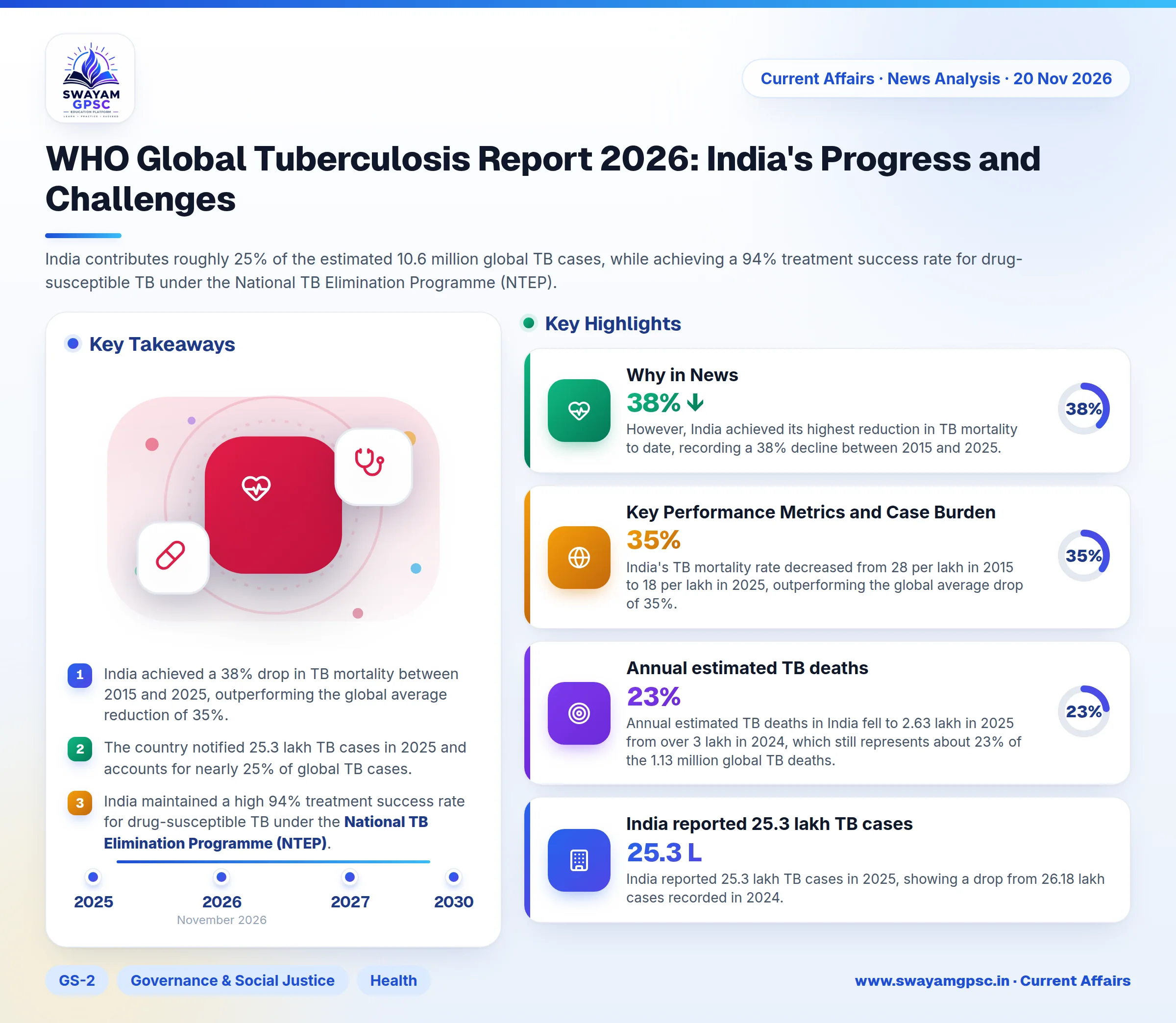
- India achieved a 38% drop in TB mortality between 2015 and 2025, outperforming the global average reduction of 35%.
- The country notified 25.3 lakh TB cases in 2025 and accounts for nearly 25% of global TB cases.
- India maintained a high 94% treatment success rate for drug-susceptible TB under the National TB Elimination Programme (NTEP).
- Despite progress, India missed its national target of eliminating TB by 2025 and remains on all three WHO high-burden lists for 2026-2030.
Why in News
- The World Health Organization (WHO) released its Global Tuberculosis Report 2026 in November 2026.
- The report highlights that India missed its national target of eliminating TB by 2025, which was set five years before the global 2030 deadline.
- However, India achieved its highest reduction in TB mortality to date, recording a 38% decline between 2015 and 2025.
Key Performance Metrics and Case Burden
- India's TB mortality rate decreased from 28 per lakh in 2015 to 18 per lakh in 2025, outperforming the global average drop of 35%.
- Annual estimated TB deaths in India fell to 2.63 lakh in 2025 from over 3 lakh in 2024, which still represents about 23% of the 1.13 million global TB deaths.
- India reported 25.3 lakh TB cases in 2025, showing a drop from 26.18 lakh cases recorded in 2024.
- India contributes roughly 25% of the estimated 10.6 million global TB cases, while achieving a 94% treatment success rate for drug-susceptible TB under the National TB Elimination Programme (NTEP).
- India stays on all three WHO high-burden lists for the 2026-2030 period, which track high loads of overall TB, TB/HIV co-infections, and MDR/RR-TB.
National Targets versus Global Benchmarks
- India's National Strategic Plan for TB Elimination (2017-2025) aimed for an 80% drop in TB incidence and a 90% drop in TB mortality by 2025 relative to 2015 levels.
- In comparison, the global WHO End TB Strategy set interim 2025 goals of a 50% cut in incidence and a 75% cut in deaths, targeting an 80% reduction in incidence and a 90% reduction in deaths by 2030.
Challenges in Eliminating Tuberculosis
- Remote regions face uneven access to diagnostic tools, which leads to delayed diagnoses and gaps in reporting cases from the private healthcare sector.
- Social and economic issues like undernutrition, crowded homes, poor ventilation, and non-medical costs like travel and lost income create major barriers despite free public medicine.
- Managing MDR/RR-TB remains difficult due to the need for advanced testing, even though shorter all-oral six-month BPaLM regimens have simplified care for eligible patients.
- Diagnosing extrapulmonary TB and child cases remains tough due to difficulties in obtaining sputum samples, and while the BCG vaccine prevents severe forms like TB meningitis in children, it does not offer complete immunity.
- Conditions like HIV, diabetes, and undernutrition complicate patient recovery, with many survivors suffering from long-term lung damage.
Review of India's TB Incidence Data
- The WHO temporarily held back India's official 2025 TB incidence figures to evaluate new data collected from 50 representative districts in 2025.
- The revised estimates will be published in early 2027 after evaluating the new sentinel data together with the 2020-21 National TB Prevalence Survey.