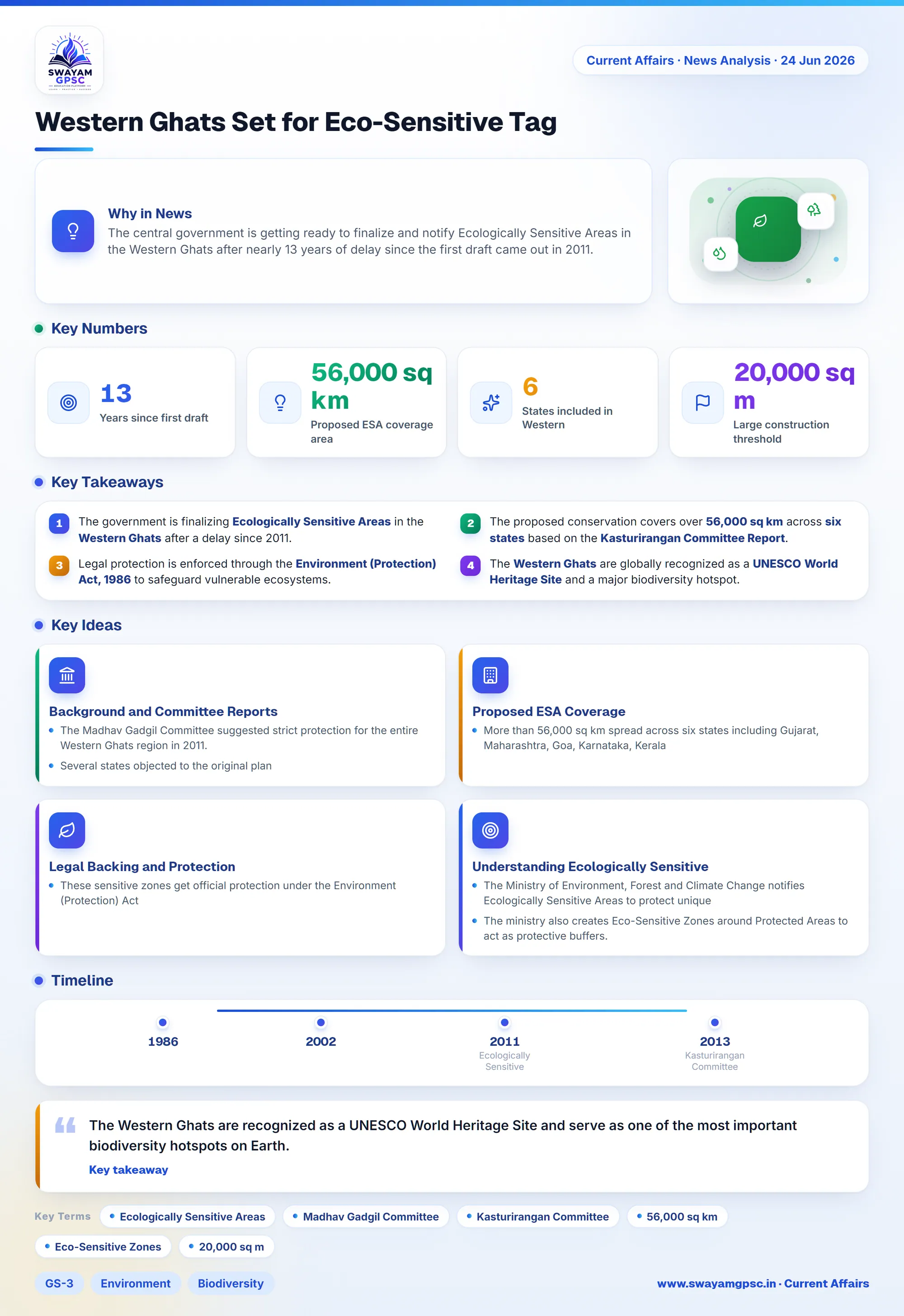
Western Ghats Set for Eco-Sensitive Tag
#GS-3 #Environment #Biodiversity #Sustainable Development #Geography #Physical Geography #Rapid Fire CA #Quick Facts For Prelims
Key takeaways
- The government is finalizing Ecologically Sensitive Areas in the Western Ghats after a delay since 2011.
- The proposed conservation covers over 56,000 sq km across six states based on the Kasturirangan Committee Report.
- Legal protection is enforced through the Environment (Protection) Act, 1986 to safeguard vulnerable ecosystems.
- The Western Ghats are globally recognized as a UNESCO World Heritage Site and a major biodiversity hotspot.
Why in News
- The central government is getting ready to finalize and notify Ecologically Sensitive Areas in the Western Ghats after nearly 13 years of delay since the first draft came out in 2011.
Background and Committee Reports
- The Madhav Gadgil Committee suggested strict protection for the entire Western Ghats region in 2011.
- Several states objected to the original plan, so the Kasturirangan Committee adjusted the boundaries in 2013 by dividing the region into natural landscapes and cultural landscapes to reduce the protected area.
Proposed ESA Coverage
- More than 56,000 sq km spread across six states including Gujarat, Maharashtra, Goa, Karnataka, Kerala, and Tamil Nadu will be marked as an Ecologically Sensitive Area based on the K. Kasturirangan Committee Report, 2013.
Legal Backing and Protection
- These sensitive zones get official protection under the Environment (Protection) Act, 1986 to safeguard fragile ecosystems from activities that harm forests, wildlife, and water systems.
Understanding Ecologically Sensitive Areas
- The Ministry of Environment, Forest and Climate Change notifies Ecologically Sensitive Areas to protect unique biological resources that need special conservation efforts.
- The ministry also creates Eco-Sensitive Zones around Protected Areas to act as protective buffers.
Buffer Zones and Restrictions
- Since 2002, these buffer zones have acted like shock absorbers to guard wildlife areas against outside pressures.
- Plans ban or strictly limit new mining, thermal power plants, highly polluting industries, and large construction projects covering 20,000 sq m or more.
- Eco-friendly practices like organic farming, rainwater harvesting, green technology, and sustainable jobs will still be promoted.
Significance of Western Ghats
- The Western Ghats are recognized as a UNESCO World Heritage Site and serve as one of the most important biodiversity hotspots on Earth.
- People often call the region the water tower of peninsular India because it controls monsoon patterns and feeds major rivers.