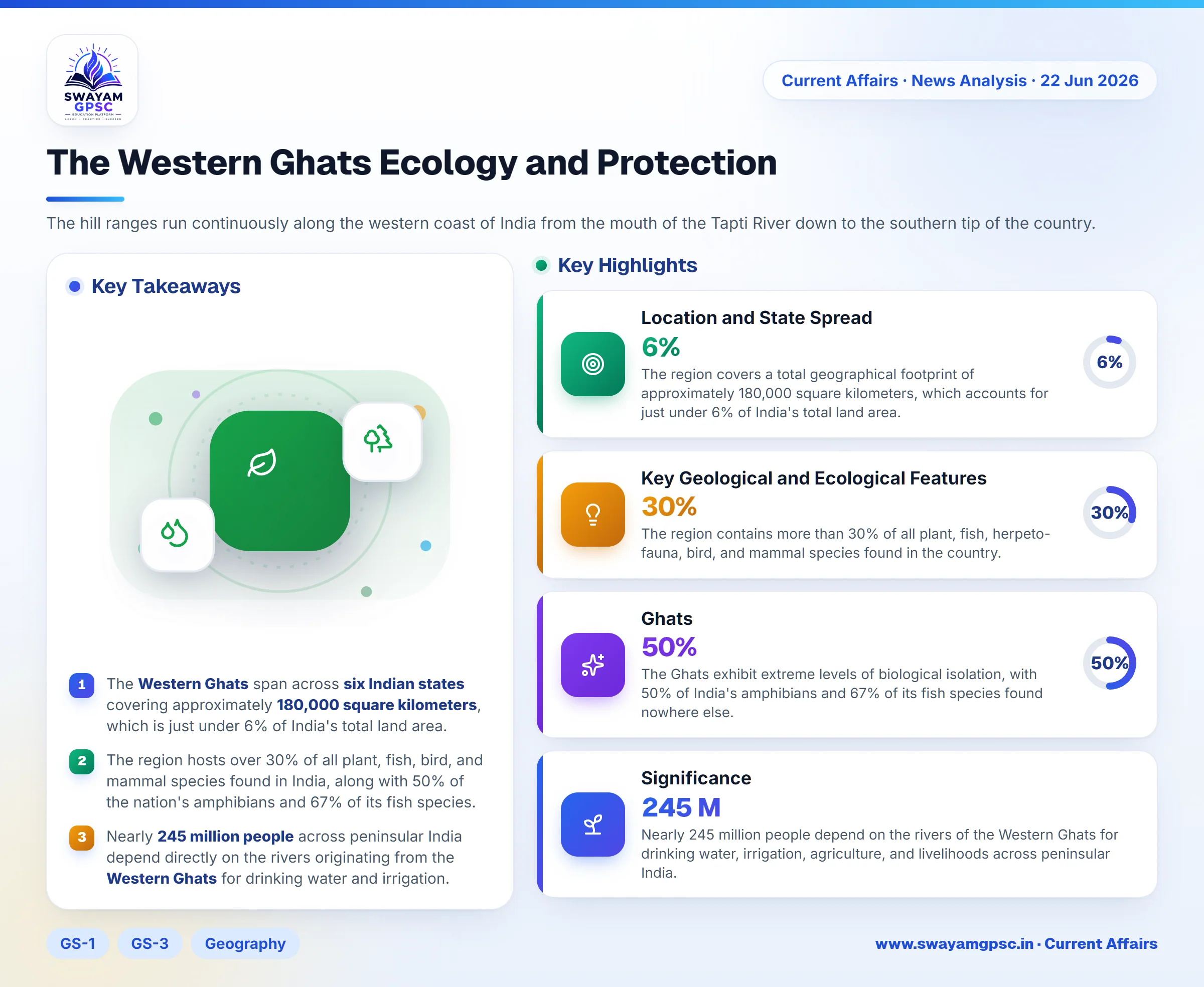
The Western Ghats Ecology and Protection
#GS-1 #GS-3 #Geography #Environment #Biodiversity #Sustainable Development #Gujarat
Key takeaways
- The Western Ghats span across six Indian states covering approximately 180,000 square kilometers, which is just under 6% of India's total land area.
- The region hosts over 30% of all plant, fish, bird, and mammal species found in India, along with 50% of the nation's amphibians and 67% of its fish species.
- Nearly 245 million people across peninsular India depend directly on the rivers originating from the Western Ghats for drinking water and irrigation.
- The mountain range supports critical global wildlife populations, including 30% of the world's Asian elephants and 17% of the world's tigers.
Why in News
- Twelve years after releasing its first draft notification, the Central Government is preparing to finalize and notify Ecologically Sensitive Areas across portions of the Western Ghats.
About the Western Ghats
- The Western Ghats is an ancient and fragile mountain chain that forms one of the world's eight hottest biodiversity hotspots.
- Recognized globally for its unique ecosystems, the mountain range is designated as a UNESCO World Heritage Site.
Location and State Spread
- The hill ranges run continuously along the western coast of India from the mouth of the Tapti River down to the southern tip of the country.
- The Western Ghats span across six Indian states, namely Gujarat, Maharashtra, Goa, Karnataka, Kerala, and Tamil Nadu.
- The region covers a total geographical footprint of approximately 180,000 square kilometers, which accounts for just under 6% of India's total land area.
Key Geological and Ecological Features
- The range features an uneven terrain with low hills, steep structural escarpments, and high-altitude granitic ridges.
- It includes key sub-landscapes such as the Nilgiris Eastern Ghats Landscape and the Wayanad plateau.
- The area features the unique shola ecosystem, which consists of montane grasslands mixed with patches of tropical wet evergreen forest.
- These forest patches host numerous medicinal plants and rare genetic resources.
- The region contains more than 30% of all plant, fish, herpeto-fauna, bird, and mammal species found in the country.
- The Ghats exhibit extreme levels of biological isolation, with 50% of India's amphibians and 67% of its fish species found nowhere else.
- It serves as an exclusive home for threatened native animals like the Nilgiri tahr and the lion-tailed macaque.
- The range forms one of the largest continuous blocks of healthy forest cover in Southern India.
- It supports 30% of the world's Asian elephant population and 17% of the world's existing tigers.
Significance
- The Western Ghats feed major rivers such as the Godavari, Krishna, and Cauvery.
- The mountain range plays a vital role in regulating the Indian monsoon.
- Nearly 245 million people depend on the rivers of the Western Ghats for drinking water, irrigation, agriculture, and livelihoods across peninsular India.
- Ecologically Sensitive Area notifications provide legal backing to restrict mining, quarrying, polluting industries, and large townships in fragile zones.