Voyager 1 Reaches Historic One Light-Day Distance
#GS-3 #Science & Technology #Space #Current Events #International #NASA #Voyager 1
Key takeaways
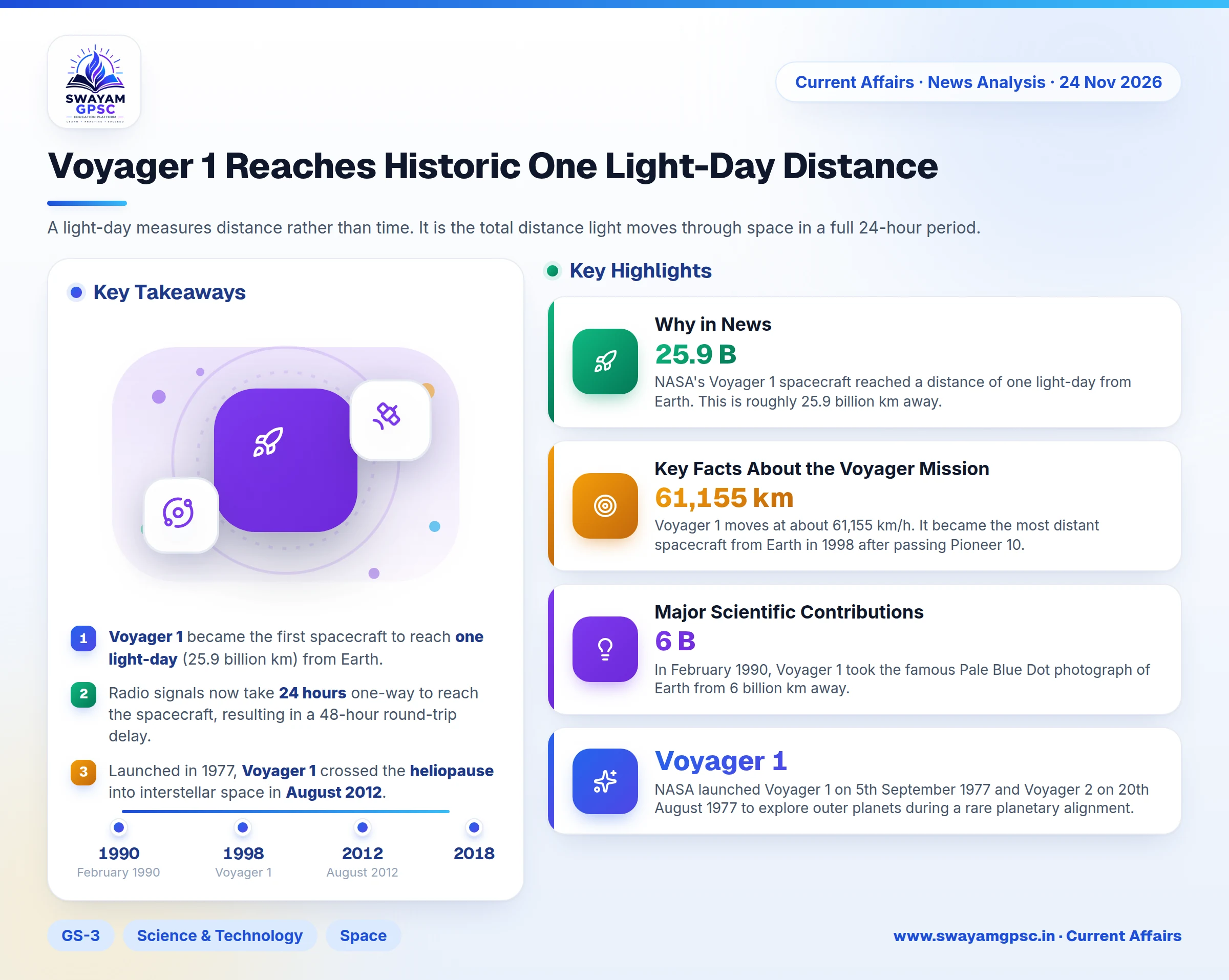
- Voyager 1 became the first spacecraft to reach one light-day (25.9 billion km) from Earth.
- Radio signals now take 24 hours one-way to reach the spacecraft, resulting in a 48-hour round-trip delay.
- Launched in 1977, Voyager 1 crossed the heliopause into interstellar space in August 2012.
- The spacecraft operates on Plutonium-238 RTGs, losing roughly 4 watts of electrical power annually.
- Only two instruments, the Magnetometer and Plasma Wave Subsystem, remain operational today.
Why in News
- NASA's Voyager 1 spacecraft reached a distance of one light-day from Earth. This is roughly 25.9 billion km away.
- It is the farthest human-made object from Earth and achieved this milestone during its 49-year journey through space.
Key Facts About the Voyager Mission
- NASA launched Voyager 1 on 5th September 1977 and Voyager 2 on 20th August 1977 to explore outer planets during a rare planetary alignment.
- Both spacecraft used the gravity-assist technique to change their speed and path by using a planet's gravitational force.
- Voyager 1 studied Jupiter and Saturn. Voyager 2 remains the only probe to visit all four outer giant planets: Jupiter, Saturn, Uranus, and Neptune.
- Voyager 1 moves at about 61,155 km/h. It became the most distant spacecraft from Earth in 1998 after passing Pioneer 10.
- A light-day measures distance rather than time. It is the total distance light moves through space in a full 24-hour period.
- Radio signals traveling at the speed of light take 24 hours to reach Voyager 1. This creates a round-trip message delay of about 48 hours.
- Voyager 2 is expected to complete its own one-light-day milestone in November 2035.
- In August 2012, Voyager 1 became the first man-made object to cross the heliopause into interstellar space, and Voyager 2 followed it in November 2018.
- The heliosphere is a huge bubble controlled by solar wind and the Sun's magnetic field. It shields our solar system from cosmic rays.
- The heliopause marks the outer boundary of the heliosphere where solar wind pressure balances out against the interstellar medium.
- Crossing this boundary does not mean leaving the solar system completely because the probes still must travel past the distant Oort Cloud.
Major Scientific Contributions
- At Jupiter, the mission recorded stormy atmospheric patterns, found faint rings, and gathered detailed data on its moons.
- At Saturn, it mapped ring structures, measured particle density, and analyzed Titan's nitrogen-dense atmosphere, temperature, and pressure.
- The spacecraft recorded key scientific data about galactic cosmic rays and the surrounding interstellar environment.
- The mission improved our knowledge of heliophysics by revealing how the Sun's magnetic field interacts with space plasma.
- In February 1990, Voyager 1 took the famous Pale Blue Dot photograph of Earth from 6 billion km away.
- Both probes carry identical gold-plated copper records containing 115 pictures, sounds, and music, created under astronomer Carl Sagan.
Power, Communication, and Future Trajectory
- The probes rely on Radioisotope Thermoelectric Generators (RTGs) that convert heat from decaying Plutonium-238 into electricity.
- Each probe loses about 4 watts of power each year, forcing operators to turn off non-essential instruments over time.
- NASA uses the Deep Space Network (DSN) with giant radio dishes in California, Madrid, and Canberra to keep constant contact.
- Voyager 1 is heading toward star Gliese 445 in the Ursa Minor constellation and will pass near it in 40,000 years.
- Engineers turned off the camera systems to preserve power. Only the Magnetometer (MAG) and Plasma Wave Subsystem (PWS) remain active.
- Engineers confirmed the distance milestone using carrier signals and trajectory tracking despite aging hardware and severe data delays.