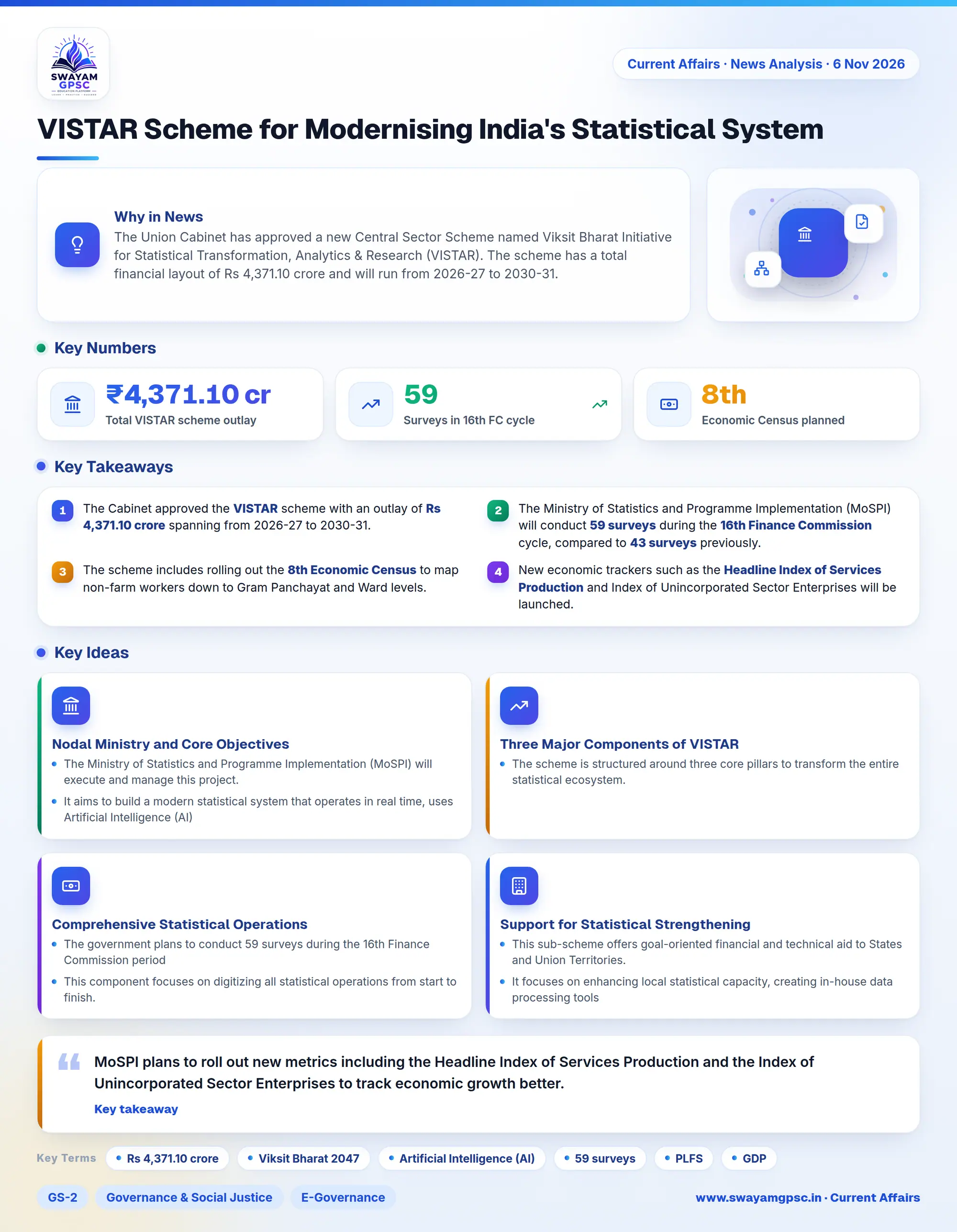
VISTAR Scheme for Modernising India's Statistical System
#GS-2 #Governance & Social Justice #E-Governance #Government Policies & Interventions #GS-3 #Economy #Infrastructure #Science & Technology #Artificial Intelligence #Current Events #National
Key takeaways
- The Cabinet approved the VISTAR scheme with an outlay of Rs 4,371.10 crore spanning from 2026-27 to 2030-31.
- The Ministry of Statistics and Programme Implementation (MoSPI) will conduct 59 surveys during the 16th Finance Commission cycle, compared to 43 surveys previously.
- The scheme includes rolling out the 8th Economic Census to map non-farm workers down to Gram Panchayat and Ward levels.
- New economic trackers such as the Headline Index of Services Production and Index of Unincorporated Sector Enterprises will be launched.
- The scheme adopts modern technologies like AI, ML, mobile data, and e-commerce records to enhance data accuracy and reduce reporting burdens.
Why in News
- The Union Cabinet has approved a new Central Sector Scheme named Viksit Bharat Initiative for Statistical Transformation, Analytics & Research (VISTAR).
- The scheme has a total financial layout of Rs 4,371.10 crore and will run from 2026-27 to 2030-31.
- This initiative aims to modernize the national official statistical structure in line with the Viksit Bharat 2047 vision.
Nodal Ministry and Core Objectives
- The Ministry of Statistics and Programme Implementation (MoSPI) will execute and manage this project.
- It aims to build a modern statistical system that operates in real time, uses Artificial Intelligence (AI), and allows seamless data sharing across platforms.
- The main objective is to improve data quality, ensure faster data delivery, offer local-level data, and enable better evidence-based policy decisions.
Three Major Components of VISTAR
- The scheme is structured around three core pillars to transform the entire statistical ecosystem.
Comprehensive Statistical Operations and Strengthening Ecosystem
- The government plans to conduct 59 surveys during the 16th Finance Commission period, an increase from 43 major surveys conducted previously.
- This component focuses on digitizing all statistical operations from start to finish.
Support for Statistical Strengthening (SSS 2.0)
- This sub-scheme offers goal-oriented financial and technical aid to States and Union Territories.
- It focuses on enhancing local statistical capacity, creating in-house data processing tools, and generating detailed district-level data.
- It will enable district-level and large-city estimates for key surveys like PLFS, HCES, and ASUSE.
- It will also assist States in calculating State and District GDP along with the State-level Index of Industrial Production (IIP).
The 8th Economic Census
- The government will conduct the 8th Economic Census alongside State and Union Territory administrations.
- This survey will gather complete data on non-farm businesses and workers down to the Gram Panchayat and urban Ward levels.
- The data collected will serve as the foundation for the National Statistical Business Register (SBR).
- It will aid focused business surveys and help calculate the unorganized sector's true contribution to national GDP.
AI and Digital Transformation
- The scheme integrates AI and Machine Learning (ML) tools into data processing, validation, and analytics.
Introduction of New Statistical Indicators
- MoSPI plans to roll out new metrics including the Headline Index of Services Production and the Index of Unincorporated Sector Enterprises to track economic growth better.
Use of Alternative Data Sources
- The system will use new sources like mobile phone trends, barcode scanner logs, and e-commerce transactions alongside standard field surveys.
- This approach reduces the response burden on citizens and fills existing data gaps faster.
Data Governance and Capacity Building
- The government will focus on systematic data cataloging, standardization, machine readability, inter-system integration, and privacy protection.
- To build skilled human resources, the initiative supports student internships, university research projects, and specialized technical training.