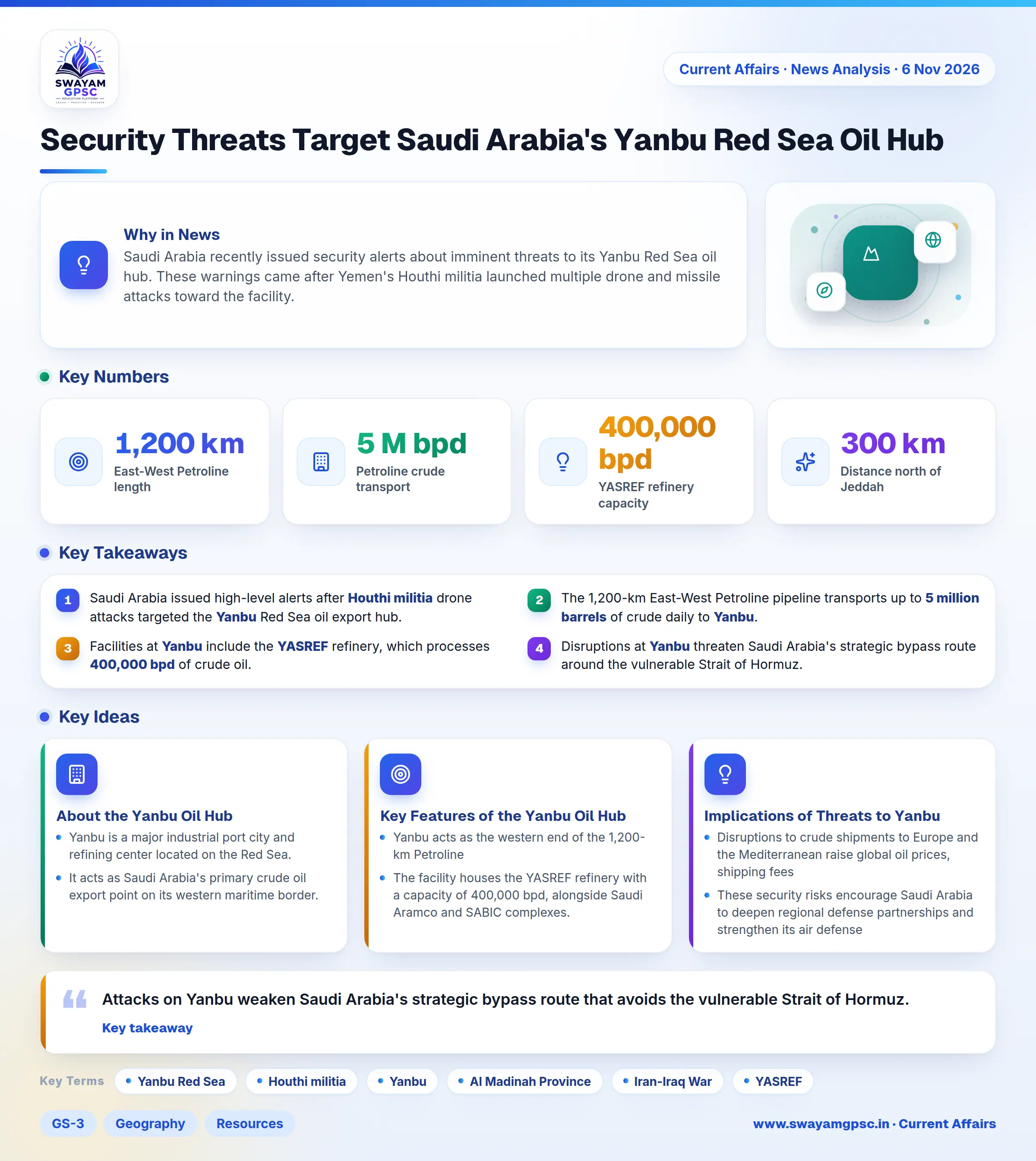
Security Threats Target Saudi Arabia's Yanbu Red Sea Oil Hub
#GS-3 #Geography #Resources #Current Events #International #Yanbu Oil Hub #Saudi Arabia #Red Sea #Strait of Hormuz
Key takeaways
- Saudi Arabia issued high-level alerts after Houthi militia drone attacks targeted the Yanbu Red Sea oil export hub.
- The 1,200-km East-West Petroline pipeline transports up to 5 million barrels of crude daily to Yanbu.
- Facilities at Yanbu include the YASREF refinery, which processes 400,000 bpd of crude oil.
- Disruptions at Yanbu threaten Saudi Arabia's strategic bypass route around the vulnerable Strait of Hormuz.
Why in News
- Saudi Arabia recently issued security alerts about imminent threats to its Yanbu Red Sea oil hub.
- These warnings came after Yemen's Houthi militia launched multiple drone and missile attacks toward the facility.
About the Yanbu Oil Hub
- Yanbu is a major industrial port city and refining center located on the Red Sea.
- It acts as Saudi Arabia's primary crude oil export point on its western maritime border.
- The city sits in the Al Madinah Province, about 300 km north of Jeddah and 160 km southwest of Medina.
- Saudi Arabia built this hub in the mid-1970s under the Royal Commission for Jubail and Yanbu to diversify its economy.
- Planners designed it during the Iran-Iraq War in the 1980s to bypass risky shipping lanes in the Persian Gulf and the Strait of Hormuz.
Key Features of the Yanbu Oil Hub
- Yanbu acts as the western end of the 1,200-km Petroline, which carries up to 5 million barrels of crude daily from eastern oil fields.
- The facility houses the YASREF refinery with a capacity of 400,000 bpd, alongside Saudi Aramco and SABIC complexes.
- The King Fahd Industrial Port features deep-water terminals and large storage tanks that handle massive crude tankers.
- Under Vision 2030, the hub is adding green hydrogen, mineral processing, and desalination projects linked with the NEOM megacity.
Implications of Threats to Yanbu
- Attacks on Yanbu weaken Saudi Arabia's strategic bypass route that avoids the vulnerable Strait of Hormuz.
- Disruptions to crude shipments to Europe and the Mediterranean raise global oil prices, shipping fees, and insurance costs.
- These security risks encourage Saudi Arabia to deepen regional defense partnerships and strengthen its air defense systems.