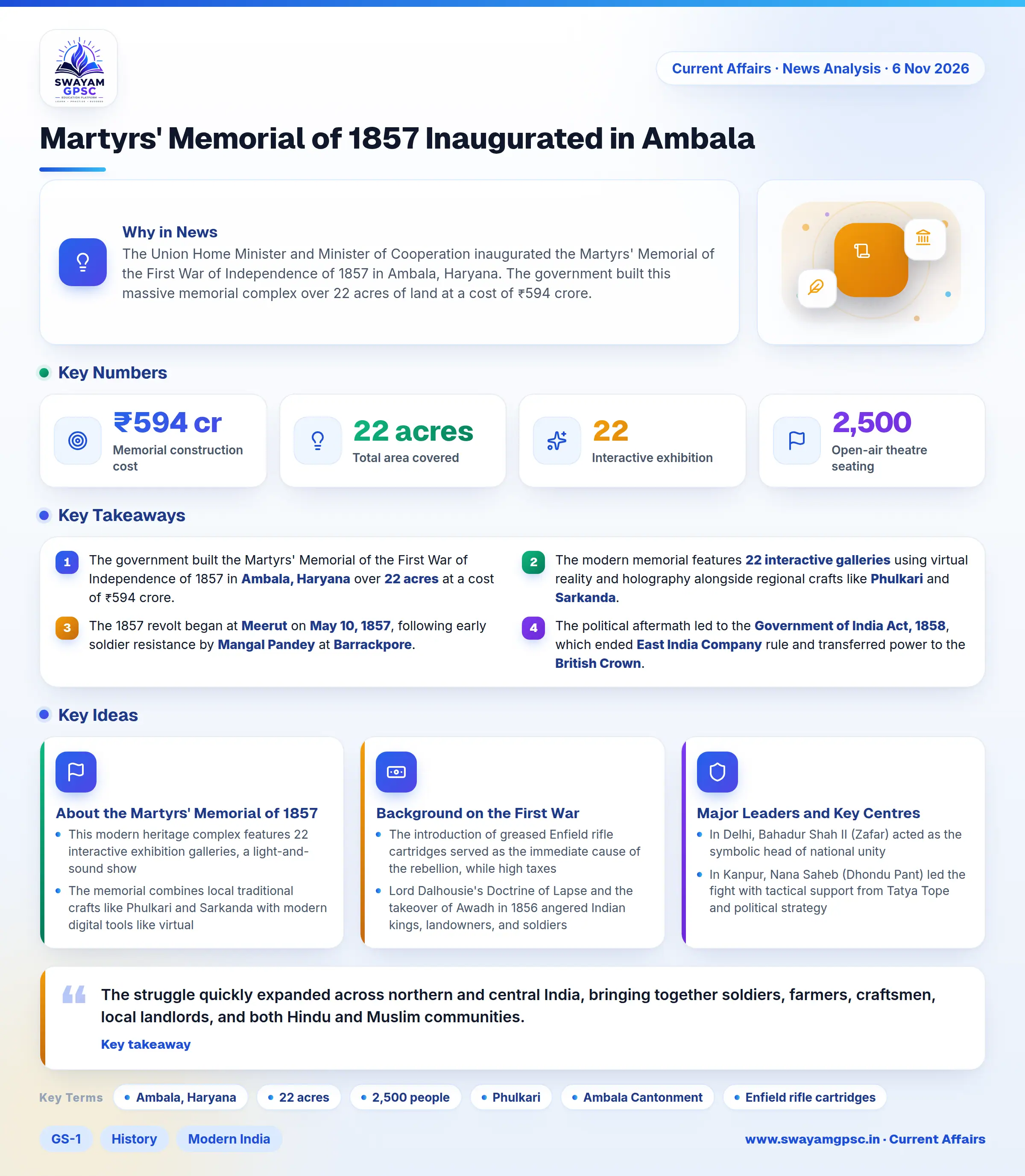
Martyrs' Memorial of 1857 Inaugurated in Ambala
#GS-1 #History #Modern India #Freedom Struggle #Culture #Heritage #GS-2 #Current Events #National
Key takeaways
- The government built the Martyrs' Memorial of the First War of Independence of 1857 in Ambala, Haryana over 22 acres at a cost of ₹594 crore.
- The modern memorial features 22 interactive galleries using virtual reality and holography alongside regional crafts like Phulkari and Sarkanda.
- The 1857 revolt began at Meerut on May 10, 1857, following early soldier resistance by Mangal Pandey at Barrackpore.
- The political aftermath led to the Government of India Act, 1858, which ended East India Company rule and transferred power to the British Crown.
- Prominent leaders included Rani Lakshmibai in Jhansi, Nana Saheb in Kanpur, Begum Hazrat Mahal in Lucknow, and Kunwar Singh in Bihar.
Why in News
- The Union Home Minister and Minister of Cooperation inaugurated the Martyrs' Memorial of the First War of Independence of 1857 in Ambala, Haryana.
- The government built this massive memorial complex over 22 acres of land at a cost of ₹594 crore.
About the Martyrs' Memorial of 1857
- This modern heritage complex features 22 interactive exhibition galleries, a light-and-sound show, and an open-air theatre that seats 2,500 people.
- The memorial combines local traditional crafts like Phulkari and Sarkanda with modern digital tools like virtual reality, projection mapping, and holography to tell the story of forgotten freedom fighters.
- It stands along the historic Grand Trunk Road in Ambala Cantonment, a major military hub that saw early soldier uprisings during the 1857 revolt.
Background on the First War of Independence (1857)
- The introduction of greased Enfield rifle cartridges served as the immediate cause of the rebellion, while high taxes, land loss, military bias, and broken local crafts built up long-term anger.
- Lord Dalhousie's Doctrine of Lapse and the takeover of Awadh in 1856 angered Indian kings, landowners, and soldiers, driving them to fight British rule.
- Following Mangal Pandey's resistance at Barrackpore, the main rebellion erupted at Meerut on May 10, 1857, along with matching soldier unrest in Ambala.
- The struggle quickly expanded across northern and central India, bringing together soldiers, farmers, craftsmen, local landlords, and both Hindu and Muslim communities.
- The revolt forced the passage of the Government of India Act, 1858, which removed the East India Company and placed Indian governance directly under the British Crown.
Major Leaders and Key Centres of the 1857 Revolt
- In Delhi, Bahadur Shah II (Zafar) acted as the symbolic head of national unity, while General Bakht Khan led the military defense using troops from Bareilly.
- In Kanpur, Nana Saheb (Dhondu Pant) led the fight with tactical support from Tatya Tope and political strategy from Azimullah Khan.
- In Jhansi, Rani Lakshmibai led a fierce revolt against the Doctrine of Lapse and died fighting near Gwalior alongside Tatya Tope.
- In Lucknow (Awadh), Begum Hazrat Mahal declared her minor son Birjis Qadr as ruler and led local landowners and soldiers against the British Residency.
- In Jagdishpur (Bihar), the 80-year-old Rajput landlord Kunwar Singh and his brother Amar Singh ran effective guerrilla warfare across Bihar and Uttar Pradesh.
- In Faizabad, religious scholar Maulvi Ahmadullah Shah led troops into direct combat against British military forces.
- In Bareilly, Khan Bahadur Khan set up a local rebel government and led large military forces across Rohilkhand.
- In Haryana, Rao Tula Ram freed Rewari and fought at Nasibpur, while Raja Nahar Singh protected the southern approaches to Delhi.
- In Allahabad, Maulvi Liaquat Ali set up his rebel base at Khusro Bagh and governed the area until British forces retook it.