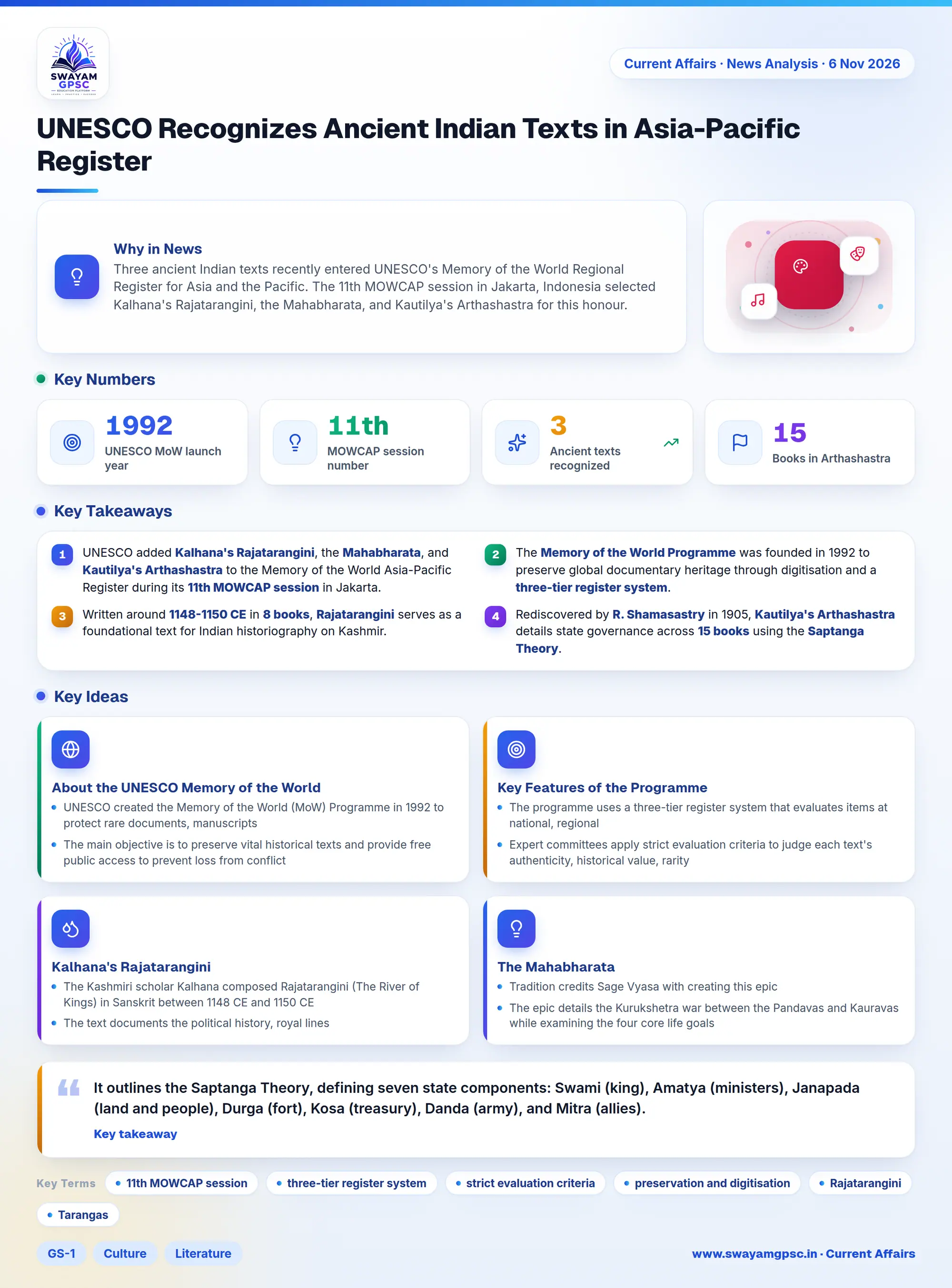
UNESCO Recognizes Ancient Indian Texts in Asia-Pacific Register
#GS-1 #Culture #Literature #GS-2 #Current Events #International #Ancient Texts #UNESCO #Memory of the World
Key takeaways
- UNESCO added Kalhana's Rajatarangini, the Mahabharata, and Kautilya's Arthashastra to the Memory of the World Asia-Pacific Register during its 11th MOWCAP session in Jakarta.
- The Memory of the World Programme was founded in 1992 to preserve global documentary heritage through digitisation and a three-tier register system.
- Written around 1148-1150 CE in 8 books, Rajatarangini serves as a foundational text for Indian historiography on Kashmir.
- Rediscovered by R. Shamasastry in 1905, Kautilya's Arthashastra details state governance across 15 books using the Saptanga Theory.
Why in News
- Three ancient Indian texts recently entered UNESCO's Memory of the World Regional Register for Asia and the Pacific.
- The 11th MOWCAP session in Jakarta, Indonesia selected Kalhana's Rajatarangini, the Mahabharata, and Kautilya's Arthashastra for this honour.
About the UNESCO Memory of the World Programme
- UNESCO created the Memory of the World (MoW) Programme in 1992 to protect rare documents, manuscripts, sound recordings, and archives globally.
- The main objective is to preserve vital historical texts and provide free public access to prevent loss from conflict, decay, or neglect.
Key Features of the Programme
- The programme uses a three-tier register system that evaluates items at national, regional, and international levels based on their cultural reach.
- Expert committees apply strict evaluation criteria to judge each text's authenticity, historical value, rarity, and current preservation state.
- It supports preservation and digitisation methods such as digital archiving and microfilming to keep fragile manuscripts safe for future generations.
- This recognition strengthens international protection of cultural heritage and prevents the loss of historical knowledge systems.
Kalhana's Rajatarangini
- The Kashmiri scholar Kalhana composed Rajatarangini (The River of Kings) in Sanskrit between 1148 CE and 1150 CE during the rule of King Jayasimha.
- The text documents the political history, royal lines, and administrative developments of Kashmir across eight distinct chapters called Tarangas.
- Kalhana established early historical standards by cross-checking earlier written records, royal inscriptions, land grants, and coins.
- The book details feudal conflicts, tax systems, famines, temple management, and religious practices in medieval Kashmir.
The Mahabharata
- Tradition credits Sage Vyasa with creating this epic, which grew from Jaya (8,800 verses) to Bharata (24,000 verses) and finally to the full Mahabharata.
- The epic details the Kurukshetra war between the Pandavas and Kauravas while examining the four core life goals: Dharma, Artha, Kama, and Moksha.
- It includes the 700-verse Bhagavad Gita inside the Bhishma Parva, which explains selfless action (Nishkama Karma), knowledge (Jnana), and devotion (Bhakti).
- This masterwork inspired traditional theatre, dance forms, and regional literature across South and Southeast Asia, including Yakshagana, Kathakali, and Wayang.
Kautilya's Arthashastra
- Attributed to Kautilya (Chanakya or Vishnugupta), the advisor to Chandragupta Maurya, this text was rediscovered by R. Shamasastry in 1905 and published in 1909.
- The treatise consists of 15 books focusing on public administration, taxation models, financial management, legal codes, and overall governance.
- It outlines the Saptanga Theory, defining seven state components: Swami (king), Amatya (ministers), Janapada (land and people), Durga (fort), Kosa (treasury), Danda (army), and Mitra (allies).
- It details classical foreign relations using the Mandala Theory, the sixfold policy (Shadgunya), and four diplomatic approaches (Sama, Dana, Bheda, and Danda).