Viksit Bharat Shiksha Adhishthan Bill 2025: Key Provisions and Concerns
#GS-2 #Governance & Social Justice #Education #Good Governance #Regulatory Bodies #Indian Polity & Constitution #Federalism #Viksit Bharat Shiksha Adhishthan Bill 2025 #NEP 2020 #Higher Education
Why in News
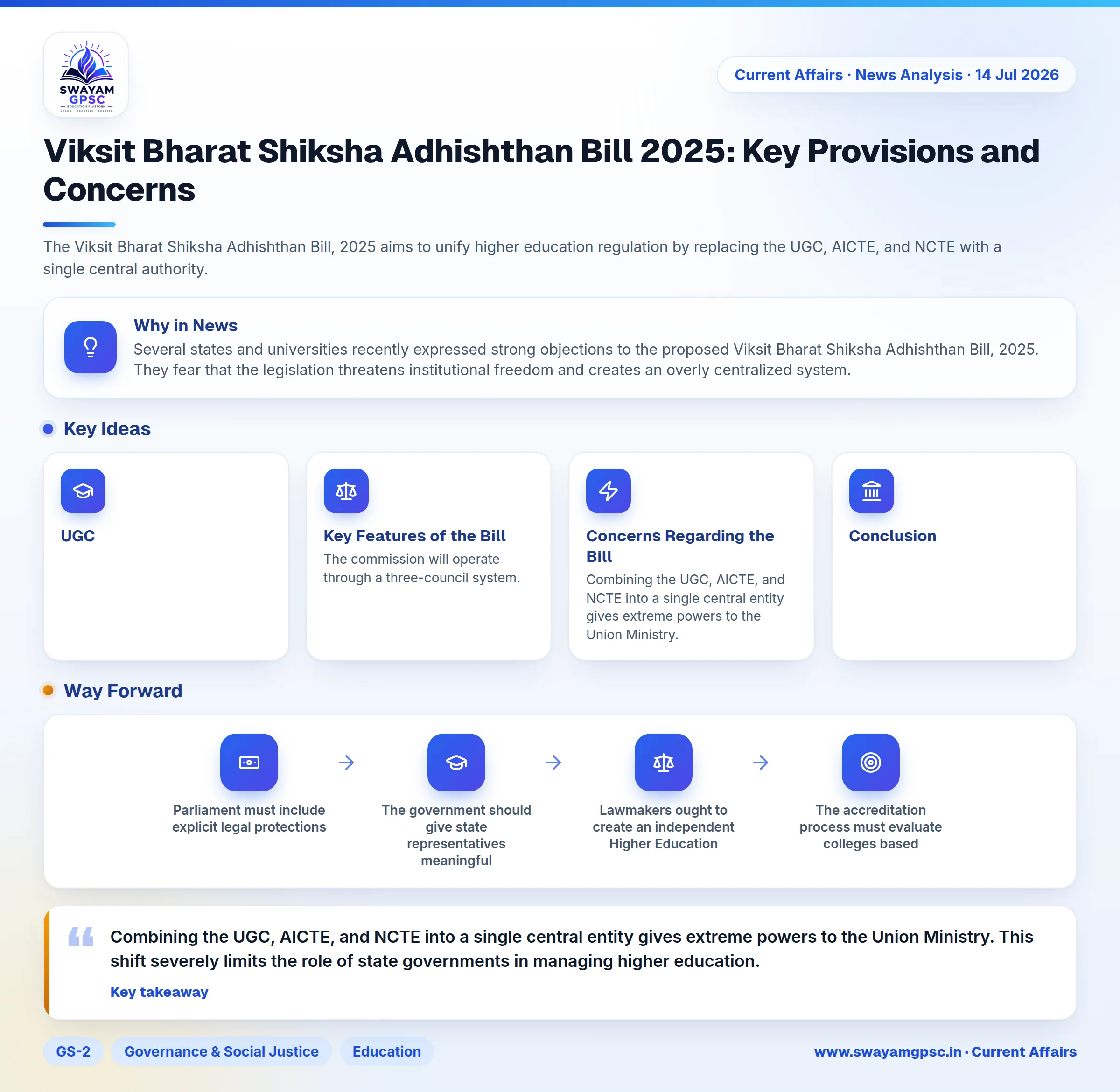
- Several states and universities recently expressed strong objections to the proposed Viksit Bharat Shiksha Adhishthan Bill, 2025. They fear that the legislation threatens institutional freedom and creates an overly centralized system. Currently, a Joint Parliamentary Committee (JPC) is reviewing the draft law.
Summary
- The Viksit Bharat Shiksha Adhishthan Bill, 2025 aims to unify higher education regulation by replacing the UGC, AICTE, and NCTE with a single central authority.
- The legislation introduces three specialised bodies for regulation, accreditation, and standard-setting. This structure intends to simplify governance and align education with NEP 2020 and Viksit Bharat 2047.
- Top institutes like IITs, IIMs, and IISERs worry about central control, loss of autonomy, unclear legal status, weak accreditation capacity, and harsh financial penalties.
Key Features of the Bill
- The proposed law creates the Viksit Bharat Shiksha Adhishthan as the main regulatory body for higher education, replacing the UGC, AICTE, and NCTE. It will oversee technical education, teacher training, and architecture, but excludes medicine and law.
- The commission will operate through a three-council system. These include the Regulatory Council, the Accreditation Council, and the Standards Council to separate distinct administrative tasks.
- The primary regulatory body will consist of a Chairperson and up to 12 members. This leadership includes the heads of the three councils, the Union Higher Education Secretary, and state representatives.
- Under the proposed duties, the Regulatory Council sets minimum operating standards, the Standards Council decides learning outcomes, and the Accreditation Council handles quality evaluation.
- The Central Government will directly appoint the Chairperson. Meanwhile, council presidents and members will be chosen through a dedicated selection committee, with strict rules for removal.
- Only universities established by law or approved by Parliament can grant degrees. Other higher education institutions need permission from the Regulatory Council and the Central Government.
- Unapproved institutions face strict punishments, including minimum fines of ₹2 crore and immediate shutdown. Any legal appeals against regulatory orders must go to the Central Government.
Concerns Regarding the Bill
- Combining the UGC, AICTE, and NCTE into a single central entity gives extreme powers to the Union Ministry. This shift severely limits the role of state governments in managing higher education.
- Top institutions like IITs, IIMs, and IISERs fear losing their decision-making power. They worry that centralized control will restrict their research work, degree structure, and administrative choices.
- While the legislation claims to safeguard Institutes of National Importance (INIs), some rules clash with existing acts passed by Parliament. This situation creates dangerous legal uncertainty.
- A uniform rulebook cannot work for every institution. Research universities, rural colleges, and tribal institutes have completely different operational realities and financial constraints.
- India's current accreditation structure suffers from low coverage and operational bottlenecks. Recent controversies within the National Assessment and Accreditation Council (NAAC) raise doubts about fair evaluations.
- Heavy penalties like ₹2 crore fines and immediate closures could ruin small, rural institutions. Many of these colleges suffer from genuine staff shortages rather than intentional malpractice.
- The draft law ignores key structural issues in Indian education. It fails to address low Gross Enrolment Ratio (GER), regional inequality, and funding that remains far below 1.5% of GDP.
Way Forward
- Parliament must include explicit legal protections to preserve the administrative, academic, and financial freedom of institutes like IITs and IIMs.
- The government should give state representatives meaningful voting power in the new commission. Since education sits on the Concurrent List, central authorities must respect cooperative federalism.
- Lawmakers ought to create an independent Higher Education Grants Council (HEGC) to distribute public funds transparently, separate from regulatory oversight.
- The accreditation process must evaluate colleges based on their local challenges. In addition, major penalties should require review by an independent legal board before implementation.
- Disagreements over regulatory orders should go to an independent education tribunal rather than the Central Government. The commission must remain accountable directly to Parliament.
Conclusion
- The Viksit Bharat Shiksha Adhishthan Bill, 2025 offers a valuable framework to streamline higher education governance under NEP 2020. However, its long-term success requires balancing strong regulatory oversight with institutional freedom, federal cooperation, and fair funding allocation.
Frequently Asked Questions
- What is the main objective of the Viksit Bharat Shiksha Adhishthan Bill, 2025? In simple terms, it creates a single central regulatory authority for higher education in India.
- Which existing statutory bodies will be replaced by this law? The Bill will dissolve the UGC, AICTE, and NCTE.
- Why are premier institutions like IITs and IIMs concerned about this Bill? They worry that centralized administration will reduce their academic freedom and override their existing operational acts.
- What are the three specialised councils proposed under the draft legislation? The proposed bodies are the Regulatory Council, Accreditation Council, and Standards Council.
- How does this Bill impact Centre-State federal relations? Education belongs to the Concurrent List, so concentrating regulatory powers in a central body risks diminishing state control over universities.