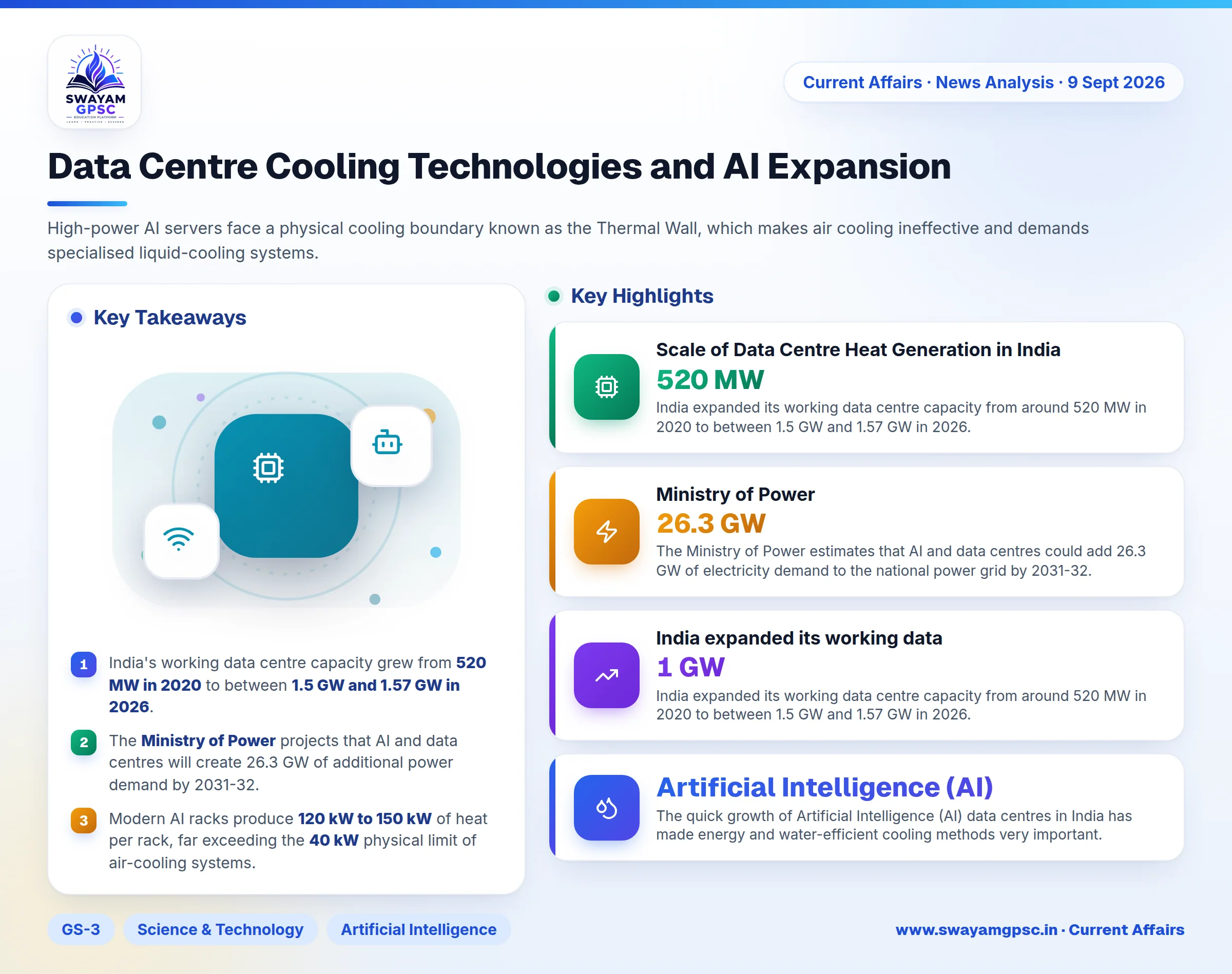
Data Centre Cooling Technologies and AI Expansion
#GS-3 #Science & Technology #Artificial Intelligence #ICT #Energy #Environment #Sustainable Development #Current Events #National
Key takeaways
- India's working data centre capacity grew from 520 MW in 2020 to between 1.5 GW and 1.57 GW in 2026.
- The Ministry of Power projects that AI and data centres will create 26.3 GW of additional power demand by 2031-32.
- Modern AI racks produce 120 kW to 150 kW of heat per rack, far exceeding the 40 kW physical limit of air-cooling systems.
- Data centre equipment converts power into heat at a 1:1 ratio, requiring efficient solutions like Direct-to-Chip (DTC) and immersion cooling.
Why in News
- The quick growth of Artificial Intelligence (AI) data centres in India has made energy and water-efficient cooling methods very important.
- Google plans to build a 1-GW hyperscale data centre in Visakhapatnam using air-cooling technology instead of water-heavy systems to protect local water supplies.
- Tata Consultancy Services plans a 1-GW AI data centre campus named HyperVault in Hyderabad that uses Direct-to-Chip (DTC) liquid cooling for high-power computing.
Scale of Data Centre Heat Generation in India
- India expanded its working data centre capacity from around 520 MW in 2020 to between 1.5 GW and 1.57 GW in 2026.
- The Ministry of Power estimates that AI and data centres could add 26.3 GW of electricity demand to the national power grid by 2031-32.
- IT hardware converts almost all electrical energy into heat at a 1:1 ratio, which means a 1-GW data centre creates nearly 1 GW of heat load that needs continuous removal.
- Standard cloud server racks produce 5 kW to 10 kW of heat, while modern AI racks produce between 120 kW and 150 kW of heat per rack.
- High-power AI servers face a physical cooling boundary known as the Thermal Wall, which makes air cooling ineffective and demands specialised liquid-cooling systems.
- Cooling equipment like fans, chillers, and pumps uses a large share of total electricity, raising operating bills and increasing carbon emissions.
- More than half of India's data centre capacity sits in Mumbai and Navi Mumbai, with other major centres in Chennai, Hyderabad, Bengaluru, Delhi-NCR, and Jamnagar putting heavy pressure on local power and water resources.
- Mechanical systems used to air-cool a 1-GW data centre can generate up to 100 decibels of noise, creating a low-frequency hum that travels several kilometres into nearby neighbourhoods.
- If green power does not grow fast enough, data centres might depend more on coal power plants, making it harder for India to reach its Net Zero 2070 target.
- Large clusters of data centres release massive amounts of waste heat into urban areas, worsening the Urban Heat Island (UHI) effect and raising local temperatures.
Major Data Centre Cooling Technologies
- Air-cooling uses fans, Computer Room Air Conditioning (CRAC) units, and Computer Room Air Handling (CRAH) units to blow cool air across servers.
- Air cooling hits a physical ceiling at around 40 kW of heat per rack, while modern AI chips like the Nvidia Blackwell push heat output to 120 kW to 150 kW per rack.
- Cooling high-power AI racks with air alone would require massive wind tunnels, which causes electricity bills and equipment costs to rise steeply.
- Free cooling brings in cold outdoor air or uses low outside temperatures to cool servers, cutting down the need for powered refrigeration units.
- Direct-to-Chip (DTC) liquid cooling uses metal cold plates to run cooling fluid directly over heat-producing components like central processing units and graphics processing units.
- Liquid coolant absorbs heat straight from the processor chips, making DTC ideal for heavy AI workloads and High-Performance Computing (HPC) systems.
- Rear-Door Heat Exchanger (RDHx) systems replace standard rack doors with liquid-cooled panels that trap hot exhaust air right as it leaves the servers.
- Immersion cooling places whole servers directly inside non-conductive dielectric liquids that absorb heat directly from all electronics.
- Single-phase immersion cooling keeps the liquid in its normal state while pumping it through heat exchangers to release the warmth.
- Two-phase immersion cooling lets the liquid boil into vapour upon absorbing heat, after which it condenses back into liquid against a cold plate.
- Immersion cooling manages extreme heat levels and supports high computing density, though it requires specialised tanks and plumbing infrastructure.
- Evaporative cooling uses water to take away heat through evaporation, which saves electricity but consumes large volumes of fresh water.
- Dry cooling relies on radiator-style air heat exchangers without evaporating water, making it a great choice for dry regions despite requiring larger equipment.
- Other cooling options include geothermal systems that push heat deep underground, as well as setups that use cold water from nearby lakes.
- Waste-Heat Recovery systems collect extra heat from server rooms and channel it into city heating networks or industrial plants to cut overall energy waste.
Frequently Asked Questions
- The Thermal Wall is the physical limit where traditional air cooling can no longer remove heat from very dense server racks, requiring a switch to liquid cooling.
- Direct-to-Chip (DTC) cooling matters for AI because it brings liquid coolants straight to high-power processing chips, handling intense heat much better than air.
- Immersion cooling submerges whole computer boards in non-conductive fluids, removing heat straight from electronic parts to support dense computing setups.
- Cooling poses major environmental concerns because it consumes huge amounts of power and water while creating hot air that worsens urban heat islands.
- Data centres can lower their environmental impact by using clean energy, free cooling, dry cooling, liquid systems, and waste-heat recovery systems.