Vibrant Villages Programme (VVP) for Border Development
#GS-3 #Infrastructure #GS-2 #Governance & Social Justice #Current Events #National #Border Security #Terrorism in Hinterland & Border Areas
Key takeaways
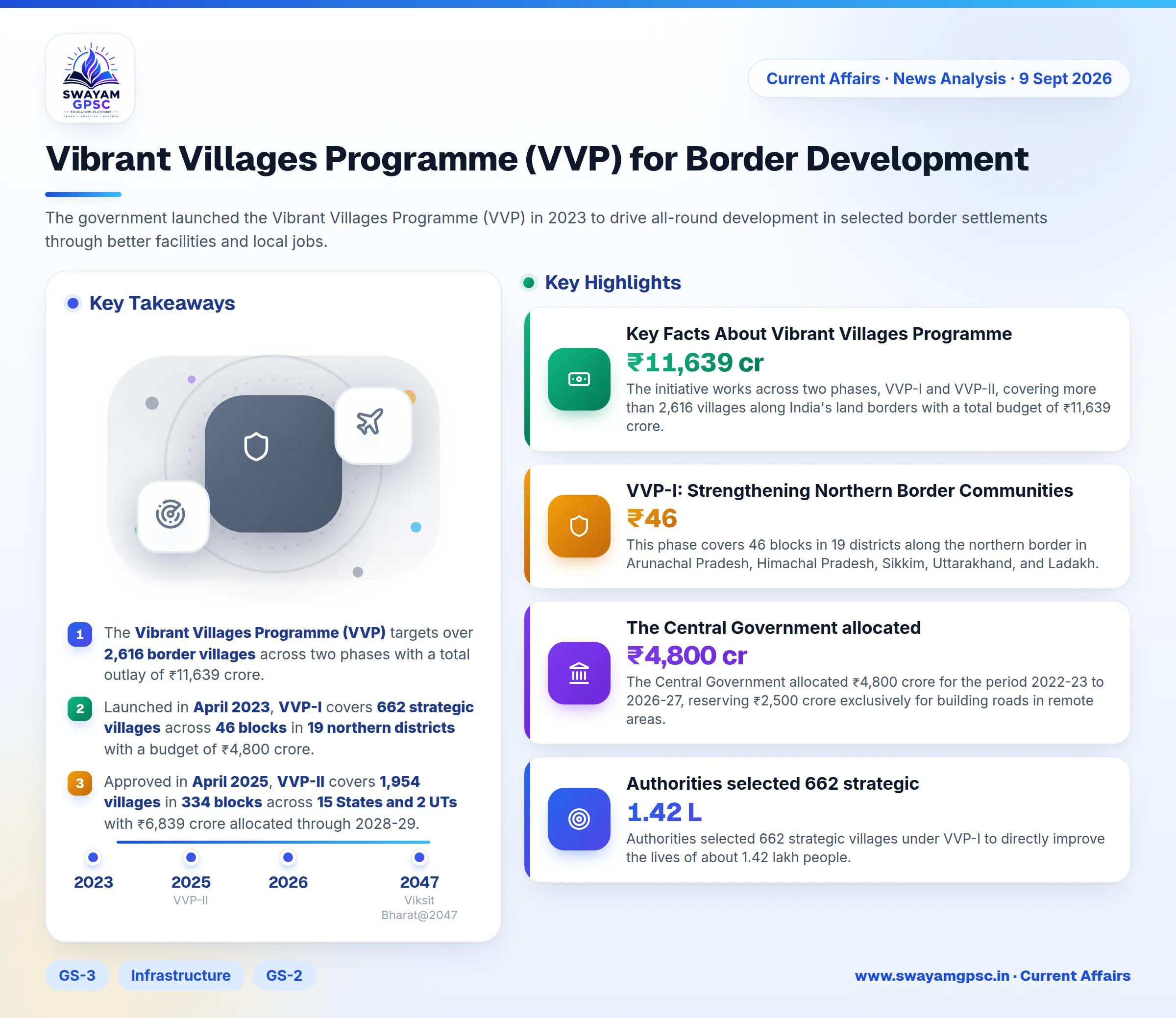
- The Vibrant Villages Programme (VVP) targets over 2,616 border villages across two phases with a total outlay of ₹11,639 crore.
- Launched in April 2023, VVP-I covers 662 strategic villages across 46 blocks in 19 northern districts with a budget of ₹4,800 crore.
- Approved in April 2025, VVP-II covers 1,954 villages in 334 blocks across 15 States and 2 UTs with ₹6,839 crore allocated through 2028-29.
- By July 2026, the Ministry of Home Affairs (MHA) approved 1,248 projects worth ₹3,020.32 crore under VVP-I.
Why in News
- The Vibrant Villages Programme (VVP) is a strategic border development initiative created to turn India's frontier villages into thriving centers of development, security, and resilience.
- By improving roads, basic services, and job opportunities, the program enhances the well-being of border residents while strengthening national security and integration.
Key Facts About Vibrant Villages Programme
- Difficult terrain, poor roads, and a lack of basic facilities forced people in border villages to migrate away, causing a decline in population for decades.
- The government launched the Vibrant Villages Programme (VVP) in 2023 to drive all-round development in selected border settlements through better facilities and local jobs.
- The initiative works across two phases, VVP-I and VVP-II, covering more than 2,616 villages along India's land borders with a total budget of ₹11,639 crore.
VVP-I: Strengthening Northern Border Communities
- First announced in the Union Budget 2022-23, VVP-I was officially launched on 10th April 2023 at Kibithoo village in the Anjaw district of Arunachal Pradesh.
- VVP-I runs as a Centrally Sponsored Scheme where the Central Government and State Governments collaborate on execution.
- This phase covers 46 blocks in 19 districts along the northern border in Arunachal Pradesh, Himachal Pradesh, Sikkim, Uttarakhand, and Ladakh.
- The Central Government allocated ₹4,800 crore for the period 2022-23 to 2026-27, reserving ₹2,500 crore exclusively for building roads in remote areas.
- Authorities selected 662 strategic villages under VVP-I to directly improve the lives of about 1.42 lakh people.
- The main objective is to provide high-quality facilities and living standards in border areas that match the rest of the country.
- To boost earnings, the scheme uses a hub-and-spoke model supporting youth, women entrepreneurs, local tourism, and the One Block One Product (OBOP) framework.
VVP-II: Extending the Model to All Land Borders
- The Union Cabinet approved VVP-II on 2nd April 2025, and it was formally launched on 20th February 2026 at Nathanpur village in Cachar district, Assam.
- By boosting local jobs and living standards, VVP-II encourages residents to stay put, helping security forces stop cross-border crime.
- Unlike the first phase, VVP-II is a Central Sector Scheme fully funded by the Central Government and managed by the Ministry of Home Affairs (MHA).
- With a total budget of ₹6,839 crore through 2028-29, the scheme covers 1,954 villages across 334 blocks in 15 States and 2 Union Territories.
- This phase covers border areas in states like Assam, Gujarat, Punjab, Rajasthan, and Jammu & Kashmir, leaving out villages already included in VVP-I.
Border Area Development Programme (BADP)
- The government originally started the Border Area Development Programme (BADP) in 1986-87 to fix development shortages along India's western border.
- The BADP later expanded to 111 districts across 16 States and 2 Union Territories, approving over 39,000 projects since 2004-05.
- While BADP focused on general infrastructure, VVP creates self-reliant and vibrant border communities with direct strategic value.
Delivering Development Through Scheme Convergence
- Local authorities design customized Village Action Plans tailored to the unique geographic and social needs of each border village.
- The program merges multiple government schemes together, using Pradhan Mantri Gram Sadak Yojana (PMGSY)-IV to build rural roads.
- A High-Powered Committee headed by the Cabinet Secretary can relax standard scheme rules to overcome remote border challenges.
- The Ministry of Home Affairs (MHA) leads the effort, working closely with state governments, district teams, and border guarding forces.
- By July 2026, the Ministry of Home Affairs (MHA) approved 1,248 projects costing ₹3,020.32 crore under VVP-I, while other central ministries sanctioned 1,655 projects.
- Arunachal Pradesh led active participation with 2,990 activities, followed by Ladakh with 2,221, Uttarakhand with 2,038, Himachal Pradesh with 1,037, and Sikkim with 530.
Key Impacts of Vibrant Villages Programme
- Populated border villages serve as vital strategic assets that assist security forces and secure national frontiers.
- Better roads and jobs are reversing migration, leading families in Arunachal Pradesh districts like Kurung Kumey, Dibang Valley, and Shi-Yomi to return home.
- Local businesses, cooperatives, Self-Help Groups (SHGs), Farmer Producer Organisations (FPOs), and border tourism are boosting local income.
- A full-coverage target ensures that every eligible household receives benefits under state and central schemes through coordinated Village Action Plans.
- The initiative proves that social development and national defense strengthen each other, creating secure border areas.
- The Indo-Tibetan Border Police (ITBP) buys fresh produce, milk, and grains directly from local farmers in Arunachal Pradesh, securing their income.
Way Forward
- Combining national security with local economic growth marks a modern shift in how India manages its border regions.
- Developing key infrastructure and creating jobs transforms isolated border hamlets into self-reliant economic hubs.
- Building a safe border requires empowering local populations alongside constructing defense facilities.
- Strong border communities directly support India's vision of becoming a secure and developed nation under Viksit Bharat@2047.