FATF Report on Underground Banking and Digital Hawala
#GS-2 #Governance & Social Justice #Government Policies & Interventions #GS-3 #Economy #Banking #Money Laundering #Current Events #National #International
Key takeaways
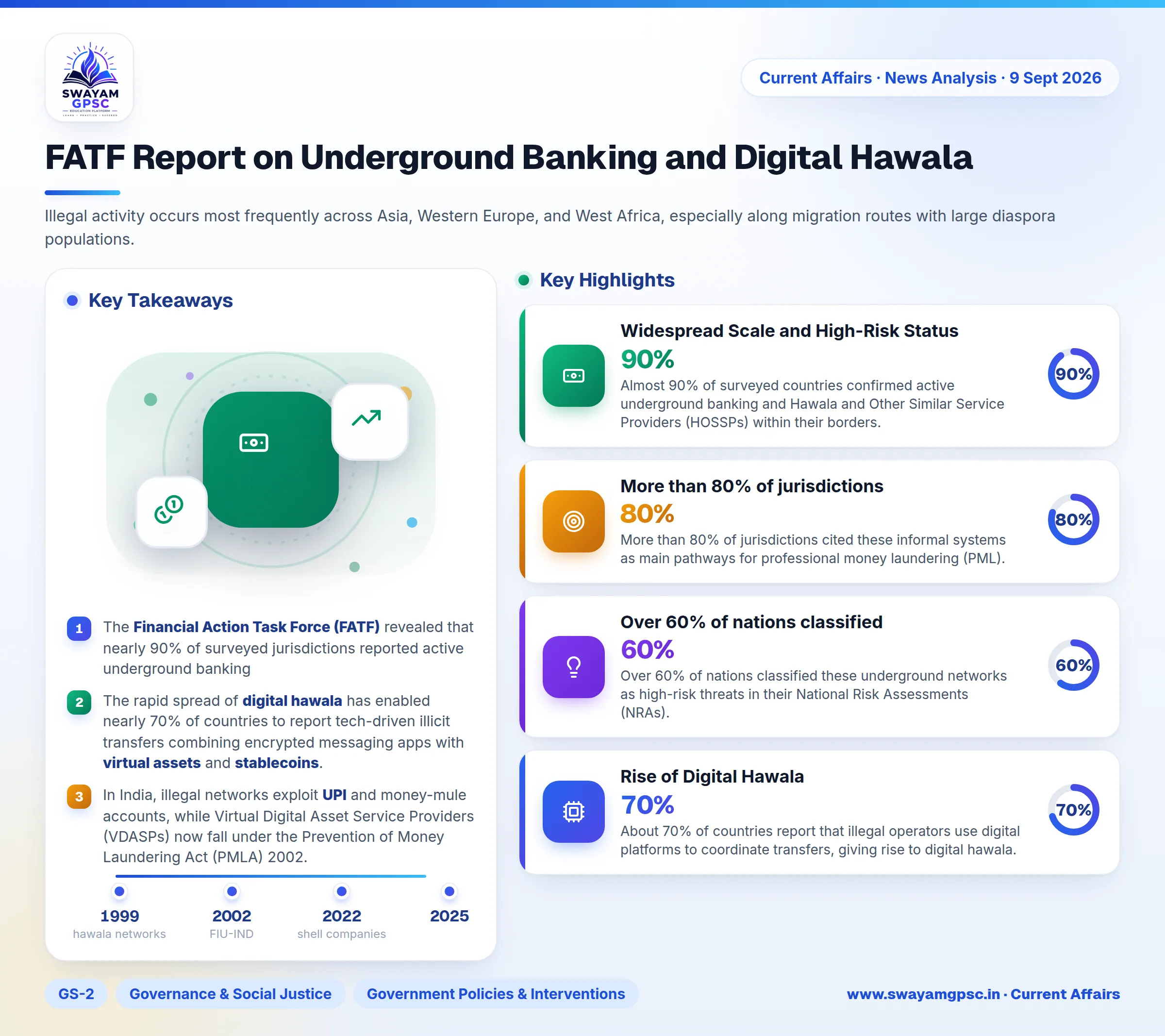
- The Financial Action Task Force (FATF) revealed that nearly 90% of surveyed jurisdictions reported active underground banking, with over 80% citing it as a primary channel for professional money laundering (PML).
- The rapid spread of digital hawala has enabled nearly 70% of countries to report tech-driven illicit transfers combining encrypted messaging apps with virtual assets and stablecoins.
- In India, illegal networks exploit UPI and money-mule accounts, while Virtual Digital Asset Service Providers (VDASPs) now fall under the Prevention of Money Laundering Act (PMLA) 2002.
- To combat trade-based money laundering, the report urges multi-agency coordination among bodies like the Enforcement Directorate (ED) and global networks like INTERPOL.
Why in News
- The Financial Action Task Force (FATF) published a report titled "Investigating Professional Money Laundering, Underground Banking, and the Use of Hawala and Other Similar Service Providers".
- The global watchdog explained that traditional underground banking systems are morphing into modern tech-enabled networks.
- Combining virtual assets with traditional hawala operations has created digital hawala.
- Criminal networks use this system to launder money and finance terrorist organizations.
Widespread Scale and High-Risk Status
- Almost 90% of surveyed countries confirmed active underground banking and Hawala and Other Similar Service Providers (HOSSPs) within their borders.
- More than 80% of jurisdictions cited these informal systems as main pathways for professional money laundering (PML).
- Over 60% of nations classified these underground networks as high-risk threats in their National Risk Assessments (NRAs).
- Illegal activity occurs most frequently across Asia, Western Europe, and West Africa, especially along migration routes with large diaspora populations.
Professionalisation of Money Laundering
- Criminal groups now offer professional money laundering as a paid service to handle illegal transfers.
- These networks function like formal businesses, featuring clear management hierarchies, digital accounting ledgers, and specific roles.
- Professional helpers like lawyers, accountants, notaries, real estate agents, and casino operators now assist these illicit networks.
Rise of Digital Hawala
- About 70% of countries report that illegal operators use digital platforms to coordinate transfers, giving rise to digital hawala.
- Criminals rely on encrypted messaging apps like WhatsApp and Telegram, along with stablecoins, virtual assets, and AI tools, to move money through mule accounts automatically.
- Digital tools make cross-border funds transfers instant and anonymous, making tracking financial flows extremely difficult.
Integration with the Formal Sector
- Landering networks connect informal systems with formal banking using fintech platforms, virtual IBANs, and prepaid cards.
- Informal banking acts as an unseen settlement network hiding beneath clean financial trails.
- Criminals use underground networks to launder proceeds from cybercrime, online fraud, corruption, tax evasion, and human trafficking.
- Informal providers remain a key tool for terrorist financing in war zones, where illicit money mixes directly with family remittances.
Regional Patterns and Transnational Hubs
- In Africa and Asia, customers use regular mobile money wallets while background settlements happen off the official platform.
- In the Middle East, money launderers mix virtual assets with physical gold and precious metals.
- In Latin America, cartels rely heavily on the Black Market Peso Exchange (BMPE) to clean drug money using trade transactions.
- Global illicit networks divide tasks clearly between outgoing cash collection hubs in Europe and incoming settlement hubs in Asia.
India-Specific Case Studies
- In 2022, Indian agencies exposed shell companies formed with fake KYC documents that used under-invoiced trade through third countries to move illegal funds.
- Illegal gambling rings collected money using UPI and money-mule bank accounts, sent cash overseas through hawala, and brought it back as fake foreign investment from the UAE.
Key Terminology
- Underground banking includes informal systems operating outside or alongside regular banks to transfer and store money.
- Hawala and Other Similar Service Providers (HOSSPs) transfer money across borders by settling balances on paper without moving physical cash.
- Licensed operators follow FATF Recommendation 14, while unlicensed ones form part of illegal underground banking.
- Digital hawala is the modern high-tech version of illegal hawala that uses digital software to move value quickly while disguising transaction origins.
Challenges
- Under the Foreign Exchange Management Act (FEMA) 1999, the Indian Rupee offers partial convertibility, which encourages some people to use hawala networks for moving capital.
- Although Virtual Digital Asset Service Providers (VDASPs) fall under the Prevention of Money Laundering Act (PMLA) 2002, criminals use privacy coins and unhosted wallets to dodge FIU-IND monitoring.
- Illegal betting apps collect payments using UPI and money mules before transferring money abroad via hawala.
- The Promotion and Regulation of Online Gaming Act, 2025 strictly bans online money gaming and related banking channels.
- India receives huge sums of money from overseas workers, especially from the Gulf region, making it hard for authorities to spot illegal hawala transactions mixed with family money.
- Innocent citizens often find their bank accounts frozen when linked to suspected hawala trails, causing severe personal hardship.
Way Forward
- Governments must enforce compulsory registration for HOSSPs and penalize illegal underground banking.
- Anti-money laundering rules should apply to high-risk sectors like real estate and precious metals.
- Investigative agencies should attack the full laundering pipeline from initial cash collection to final cash withdrawals.
- Nations need multi-agency task forces combining intelligence units, police, the Enforcement Directorate (ED), and tax authorities.
- Sharing GST, tax, and customs data helps detect trade-based money laundering.
- Governments should build central databases tracking suspicious transaction reports, court prosecutions, and asset confiscations.
- Police and investigators should employ blockchain analytics and AI tools to track crypto flows and detect money-mule networks.
- Countries must align their legal definitions and share real-time threat intelligence through INTERPOL and the Egmont Group.
- Governments should offer cheap formal remittance options with flexible KYC requirements for small transfers to protect financial inclusion.
Global Best Practices
- Sweden requires mandatory licensing and registration to keep all money-transfer services under strict regulatory oversight.
- Belgium uses the Barrier Model to systematically break up every stage of professional money laundering.
- The Netherlands operates a special Taskforce Underground Banking to streamline intelligence and law enforcement action.
- Indonesia uses blockchain analytics through its financial intelligence agency (PPATK) to track illegal crypto transactions.