Coal Gasification Scheme: Promoting Surface Coal and Lignite Projects
#GS-2 #GS-3 #Governance & Social Justice #Current Events #National #Economy #Infrastructure #Environment #Sustainable Development #Coal Gasification Scheme
Key takeaways
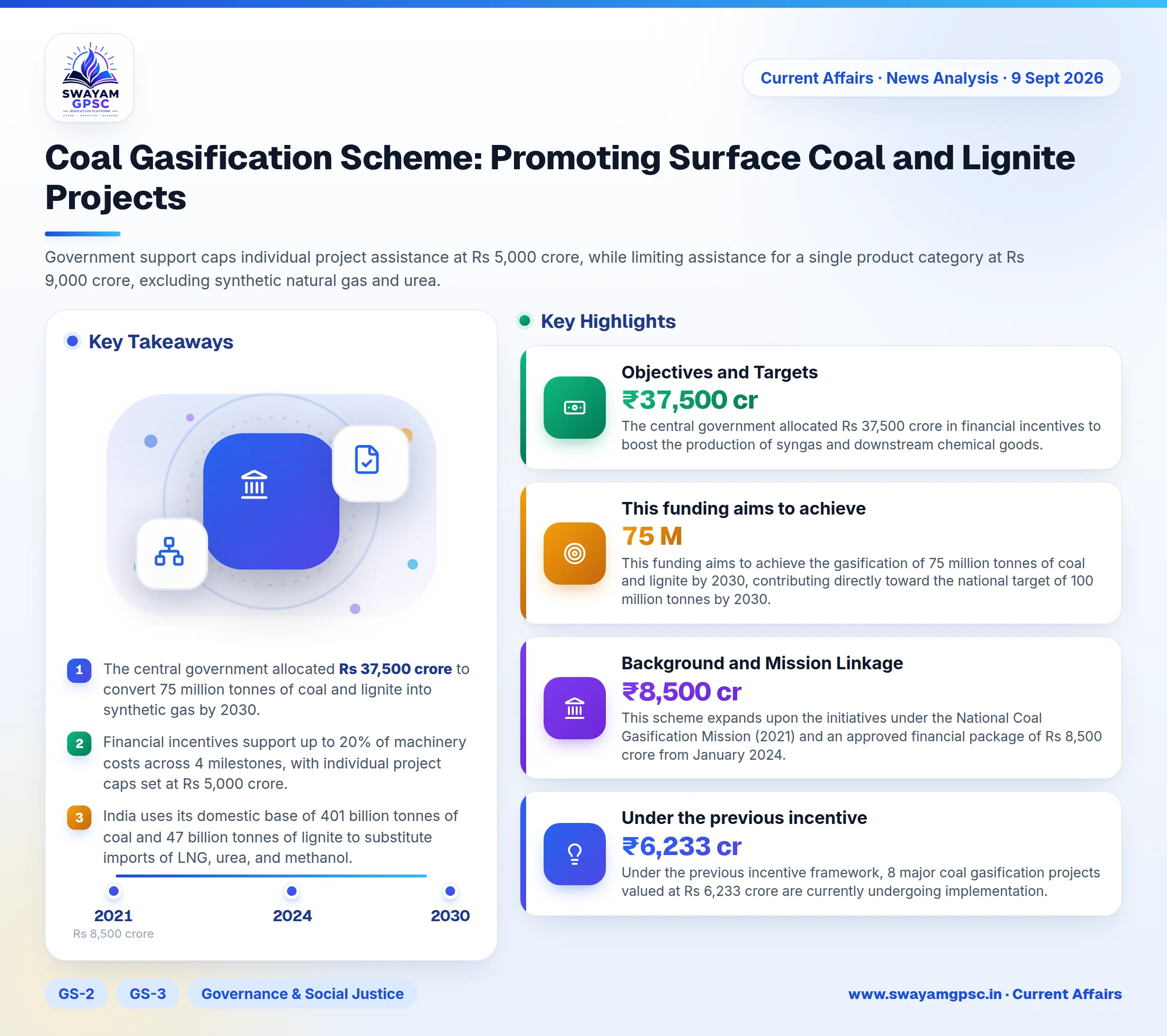
- The central government allocated Rs 37,500 crore to convert 75 million tonnes of coal and lignite into synthetic gas by 2030.
- Financial incentives support up to 20% of machinery costs across 4 milestones, with individual project caps set at Rs 5,000 crore.
- India uses its domestic base of 401 billion tonnes of coal and 47 billion tonnes of lignite to substitute imports of LNG, urea, and methanol.
- Integrating Carbon Capture, Utilisation and Storage (CCUS) technologies remains critical to control carbon emissions during syngas production.
Why in News
- The Coal Gasification Scheme designed to boost surface coal and lignite gasification projects is struggling to attract sufficient interest from private and public sector companies, creating concerns over the economic viability of large projects.
About Coal Gasification
- Coal gasification is a chemical process that transforms solid coal or lignite into synthetic gas (syngas), which mainly consists of carbon monoxide and hydrogen.
- Industries utilize syngas as a key raw material to produce methanol, hydrogen, ammonia, fertilizers, and various other chemical derivatives.
Objectives and Targets
- The central government allocated Rs 37,500 crore in financial incentives to boost the production of syngas and downstream chemical goods.
- This funding aims to achieve the gasification of 75 million tonnes of coal and lignite by 2030, contributing directly toward the national target of 100 million tonnes by 2030.
Background and Mission Linkage
- This scheme expands upon the initiatives under the National Coal Gasification Mission (2021) and an approved financial package of Rs 8,500 crore from January 2024.
- Under the previous incentive framework, 8 major coal gasification projects valued at Rs 6,233 crore are currently undergoing implementation.
Incentive Structure
- The financial assistance covers up to 20% of the capital cost for plant and machinery, distributed in 4 instalments based on project progress.
- Government support caps individual project assistance at Rs 5,000 crore, while limiting assistance for a single product category at Rs 9,000 crore, excluding synthetic natural gas and urea.
- The policy also establishes a maximum cumulative incentive ceiling of Rs 12,000 crore for any single corporate entity group across all its projects.
Technology Neutrality
- The scheme allows flexible technology choices while actively encouraging the adoption of domestic technologies to reduce dependence on foreign engineering and construction firms.
Strategic Importance
- Gasification enables India to make better use of its domestic coal reserves while curbing costly imports of LNG, urea, ammonia, and methanol.
- Developing domestic syngas production capacity significantly enhances national energy security during times of global fuel supply disruptions.
Resource Advantage
- India holds vast domestic reserves of fossil fuels, including approximately 401 billion tonnes of coal and 47 billion tonnes of lignite reserves.
Environmental Concerns
- Even though gasification burns cleaner than traditional coal combustion, the underlying process still generates carbon emissions and consumes significant natural resources.
- Deploying mitigation measures like Carbon Capture, Utilisation and Storage (CCUS) is essential to lower the overall environmental impact.