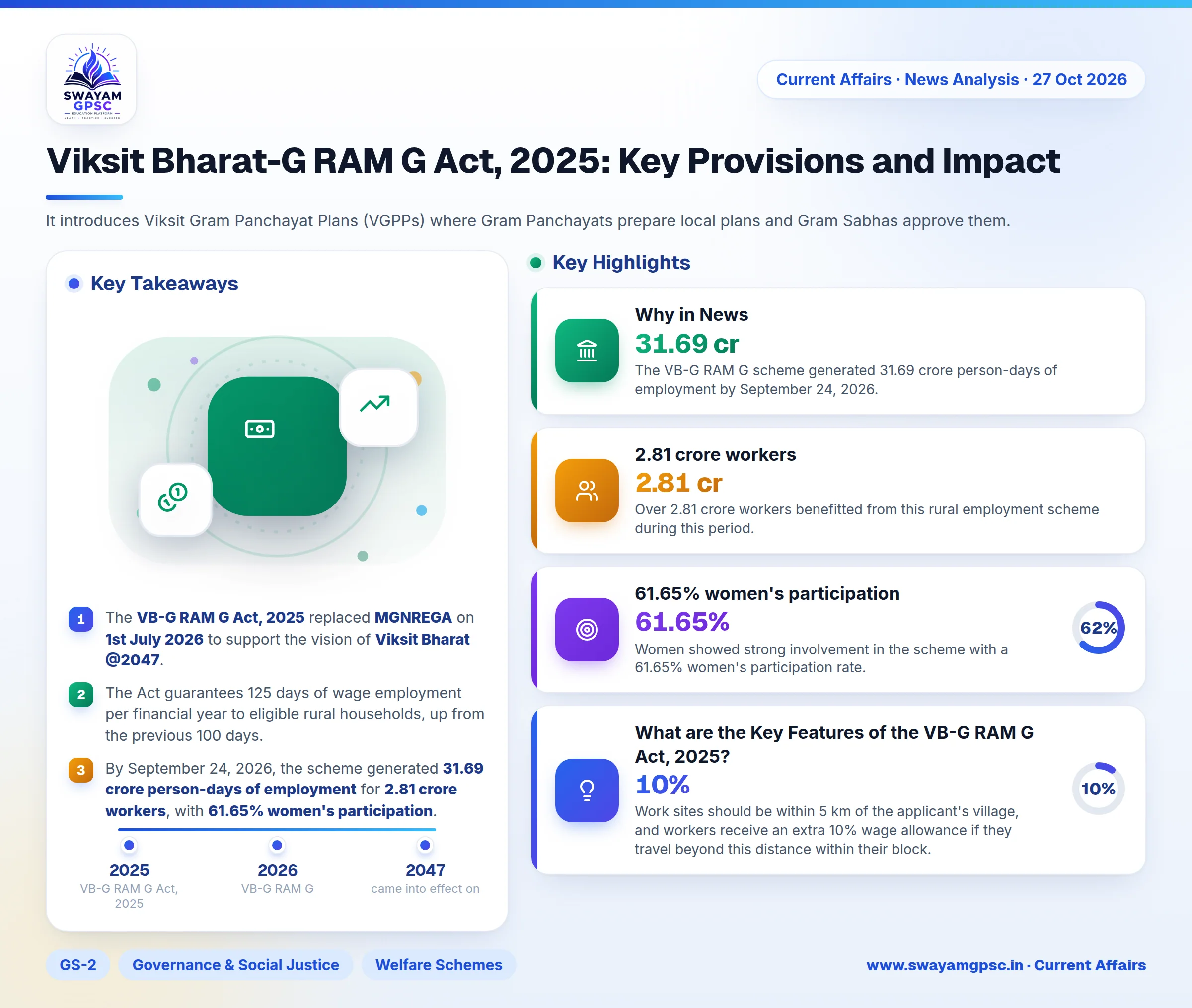
Viksit Bharat-G RAM G Act, 2025: Key Provisions and Impact
#GS-2 #Governance & Social Justice #Welfare Schemes #Poverty #GS-3 #Economy #Employment #Infrastructure #Government Policies & Interventions #Inclusive Growth
Key takeaways
- The VB-G RAM G Act, 2025 replaced MGNREGA on 1st July 2026 to support the vision of Viksit Bharat @2047.
- The Act guarantees 125 days of wage employment per financial year to eligible rural households, up from the previous 100 days.
- By September 24, 2026, the scheme generated 31.69 crore person-days of employment for 2.81 crore workers, with 61.65% women's participation.
- Gram Panchayats now lead local development through Viksit Gram Panchayat Plans (VGPPs) covering 318 types of permissible works.
- Wage payments are made via Direct Benefit Transfer (DBT) within a fortnight, backed by digital tech like face authentication and geo-tagging.
Why in News
- The VB-G RAM G scheme generated 31.69 crore person-days of employment by September 24, 2026.
- Over 2.81 crore workers benefitted from this rural employment scheme during this period.
- Women showed strong involvement in the scheme with a 61.65% women's participation rate.
- This progress highlights the implementation of the VB-G RAM G Act, 2025, which replaced MGNREGA on 1st July 2026.
What are the Key Features of the VB-G RAM G Act, 2025?
- The Viksit Bharat-Guarantee for Rozgar and Ajeevika Mission (Gramin) Act, 2025 came into effect on 1st July 2026 to replace MGNREGA and support Viksit Bharat @2047.
- The new law increases guaranteed wage employment from 100 days to 125 days of wage employment per financial year for every eligible rural household doing unskilled manual work.
- The scheme focuses on four priority areas: Water Security, Core Rural Infrastructure, Livelihood-related Infrastructure, and Extreme Weather Mitigation.
- It introduces Viksit Gram Panchayat Plans (VGPPs) where Gram Panchayats prepare local plans and Gram Sabhas approve them.
- The framework uses a Whole-of-Government approach to combine funding and schemes from Central, State, and local levels into one plan.
- If the administration fails to offer work within 15 days of application, workers receive an official unemployment allowance.
- Authorities transfer wages directly using Direct Benefit Transfer (DBT) within a fortnight of closing the muster roll, paying compensation for any delays.
- Work sites should be within 5 km of the applicant's village, and workers receive an extra 10% wage allowance if they travel beyond this distance within their block.
- The central and state governments split funding at 90:10 for North-Eastern and Himalayan States, 60:40 for other States/UTs with legislatures, and 100% Central funding for UTs without legislatures.
- To ensure transparency, the system uses face authentication-based attendance, clear public records, and mandatory Janata Boards at all work sites.
- States must formally declare non-work periods during peak sowing and harvesting seasons so farm owners have enough agricultural labour.
- The scheme relies on modern technology like e-KYC, face authentication, geo-tagging, electronic Measurement Books (e-MB), real-time dashboards and AI-enabled analytics to track assets and stop corruption.
What are Viksit Gram Panchayat Plans (VGPPs)?
- Viksit Gram Panchayat Plans (VGPPs) are local plans that link guaranteed job creation directly with useful village assets under the VB-G RAM G Act, 2025.
- Gram Panchayats draft these plans and Gram Sabhas approve them, making sure village planning starts directly from local community needs.
- These plans examine current village infrastructure to spot service gaps and avoid building duplicate public assets.
- Planners use digital tools like Yuktdhara, PM Gati Shakti, and Geographic Information System (GIS) for accurate map-based planning.
- The process brings together money and programs from all levels of government to build integrated village infrastructure.
- Villages send their plans up through Block, District, State, and National levels to build the Viksit Bharat National Rural Infrastructure Stack.
- The official rules allow 318 types of permissible works divided across four major development categories.
- These plans give local bodies more authority, ensure wise use of public funds, and create long-lasting assets for rural communities.
Conclusion
- The VB-G RAM G Act, 2025 connects legal work rights with modern digital tools and direct local village planning.
- The actual success of this law depends on quick job placement, on-time wage payments, capable Gram Panchayats, and easy digital tools for all workers.