Cybersecurity of Critical Infrastructure in India
#GS-3 #Science & Technology #Cyber Security #Infrastructure #Critical Infrastructure #CERT-In #NCIIPC
Key takeaways
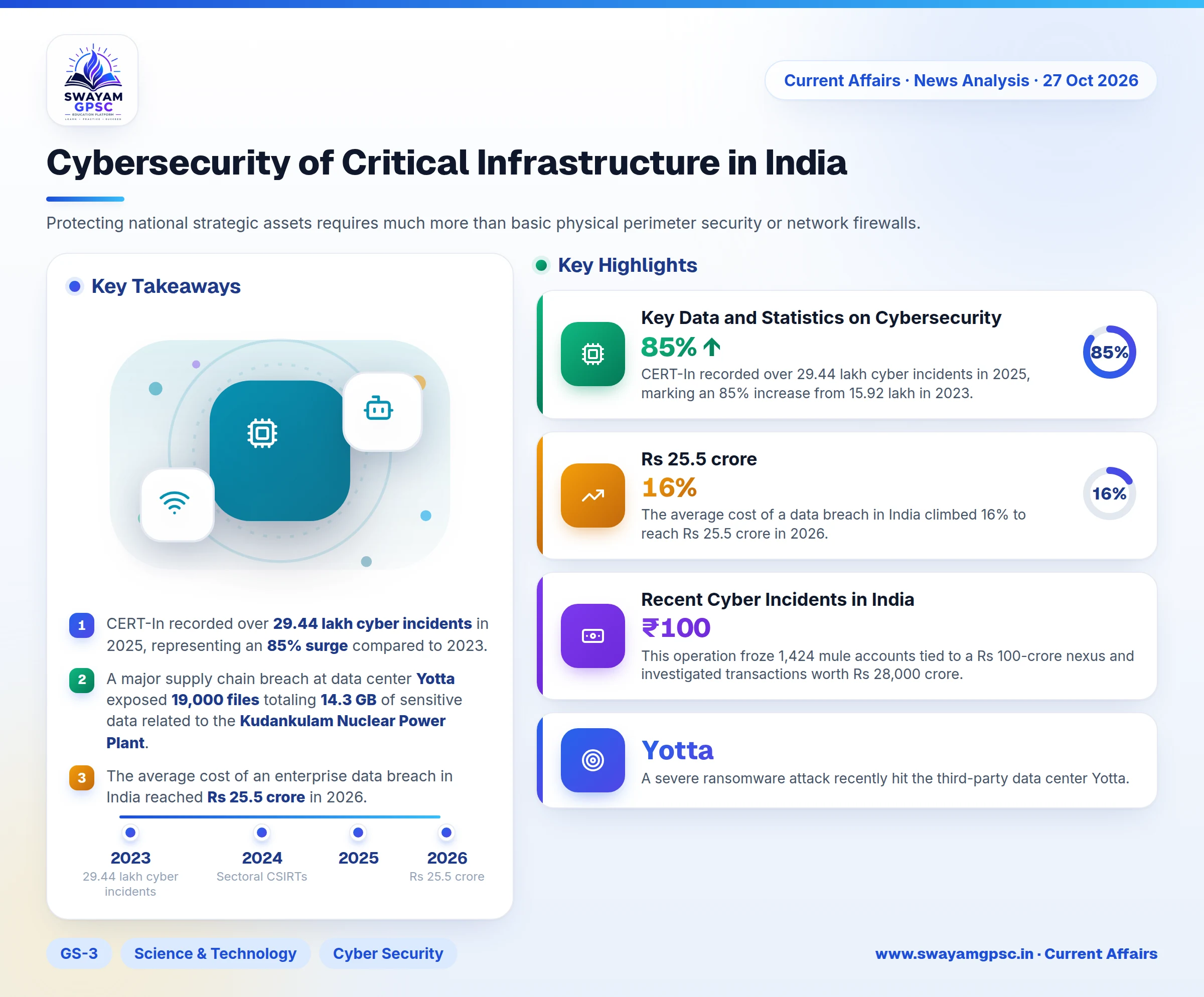
- CERT-In recorded over 29.44 lakh cyber incidents in 2025, representing an 85% surge compared to 2023.
- A major supply chain breach at data center Yotta exposed 19,000 files totaling 14.3 GB of sensitive data related to the Kudankulam Nuclear Power Plant.
- The average cost of an enterprise data breach in India reached Rs 25.5 crore in 2026.
- Key regulatory bodies include NCIIPC under Section 70A and CERT-In under Section 70B of the IT Act 2000.
- The Digital Personal Data Protection (DPDP) Act 2023 creates security gaps because it excludes non-personal technical blueprints and schematics held by vendors.
Why in News
- A severe ransomware attack recently hit the third-party data center Yotta.
- This breach exposed about 19,000 files totaling 14.3 GB of sensitive data.
- The stolen files directly linked to the Kudankulam Nuclear Power Plant.
- This incident highlighted major cybersecurity vulnerabilities in supply chains servicing India's strategic assets.
Understanding Cybersecurity of Critical Infrastructure
- Protecting national strategic assets requires much more than basic physical perimeter security or network firewalls.
- Relying solely on air-gapped systems no longer provides complete isolation from modern cyber threats.
- Government agencies increasingly rely on private contractors and commercial cloud platforms to handle sensitive operations.
- This expanding third-party ecosystem frequently exposes critical technical designs, operational blueprints, and sensitive contracts to cyber risks.
Key Data and Statistics on Cybersecurity
- CERT-In recorded over 29.44 lakh cyber incidents in 2025, marking an 85% increase from 15.92 lakh in 2023.
- Indian public service organizations and government bodies face more than 4,900 cyberattacks every week.
- The average cost of a data breach in India climbed 16% to reach Rs 25.5 crore in 2026.
- Complex IT environments and extended operational recovery times primarily drive up these data breach expenses.
- The Kudankulam vendor breach leaked data spanning from 2016 to 2025, including engineering drawings and inspection reports.
Recent Cyber Incidents in India
- Weak cryptographic keys in eight intermediate CA certificates caused an emergency browser revocation for eMudhra.
- This technical cryptographic failure forced eMudhra to withdraw from the global SSL/TLS certificate registry.
- A leak exposed 3,897 verified customer records of the State Bank of India (SBI) within a 3.75-lakh-record dataset on the dark web.
- Law enforcement launched Operation Trident to dismantle a massive cyberfraud and hawala network across multiple states.
- This operation froze 1,424 mule accounts tied to a Rs 100-crore nexus and investigated transactions worth Rs 28,000 crore.
- The Yotta data breach compromised 14.3 GB of vendor files, proving that contractor networks remain a primary vulnerability.
Existing Framework for Cybersecurity in India
- The National Critical Information Infrastructure Protection Centre (NCIIPC) acts as the main agency under Section 70A of the IT Act 2000.
- It protects critical information infrastructure whose impairment would harm national security, public health, or economic stability.
- NCIIPC sets national security guidelines and performs regular vulnerability assessments across vital sectors like nuclear energy, power, and defense.
- The Indian Computer Emergency Response Team (CERT-In) functions as the primary incident response agency under Section 70B of the IT Act 2000.
- CERT-In issued the 2022 Cyber Security Directions, making six-hour breach reporting and system log retention legally mandatory.
- Specialized Sectoral CSIRTs manage specific industry risks, with CSIRT-Power launched in 2024 and CSIRT-Fin operating since 2022.
- The government established the Cyber Crisis Management Plan (CCMP) to keep public utilities functioning during cyber warfare or cyber-terrorism attacks.
Challenges and Emerging Threats
- Attackers avoid well-defended core networks and instead target vulnerable third-party contractors, suppliers, and commercial cloud hosts.
- Hackers exploited hosting provider Yotta to obtain Kudankulam engineering plans stored by Reliance Infrastructure.
- Advanced Persistent Threat groups deploy silent malware inside administrative networks to conduct long-term espionage without detection.
- The Dtrack malware, linked to North Korea's Lazarus Group, was discovered inside Kudankulam's administrative network in 2019.
- Ransomware syndicates extract proprietary files before encrypting local backups, threatening public releases unless victims pay cryptocurrency ransoms.
- The Digital Personal Data Protection (DPDP) Act 2023 covers personal data but fails to protect shared non-personal engineering blueprints.
- Commercial contracts currently serve as the only protection for shared technical files, leaving major legal gaps in non-personal data security.
Way Forward
- India must establish a Security Follows the Data legal rule that applies mandatory security standards across the entire lifespan of sensitive data.
- All private vendors, subcontractors, and cloud hosts processing sensitive files must meet mandatory NCIIPC security standards.
- Organizations should adopt a strict Zero-Trust Architecture that verifies every user, device, and network connection continuously.
- Agencies must enforce data minimization policies so contractors receive only essential technical files and delete them immediately after contract completion.
- Authorities should replace basic self-compliance paperwork with aggressive, independent Red-Team penetration tests across vendor networks.
- India needs a unified national security framework connecting CERT-In, NCIIPC, and sectoral regulators to handle supply chain threats together.
Conclusion
- The Kudankulam incident proves that critical national infrastructure includes all connected external suppliers and cloud hosts, not just physical facilities.
- Relying only on internal firewalls leaves strategic systems exposed if third-party contractors maintain weak cybersecurity practices.
- Building long-term cyber resilience requires moving toward data-centric protection and enforcing strict zero-trust practices across all contractor networks.