IUCN Global Coral Reef Assessment 2026
#GS-3 #Environment #Biodiversity #Climate Change #Sustainable Development
Key takeaways
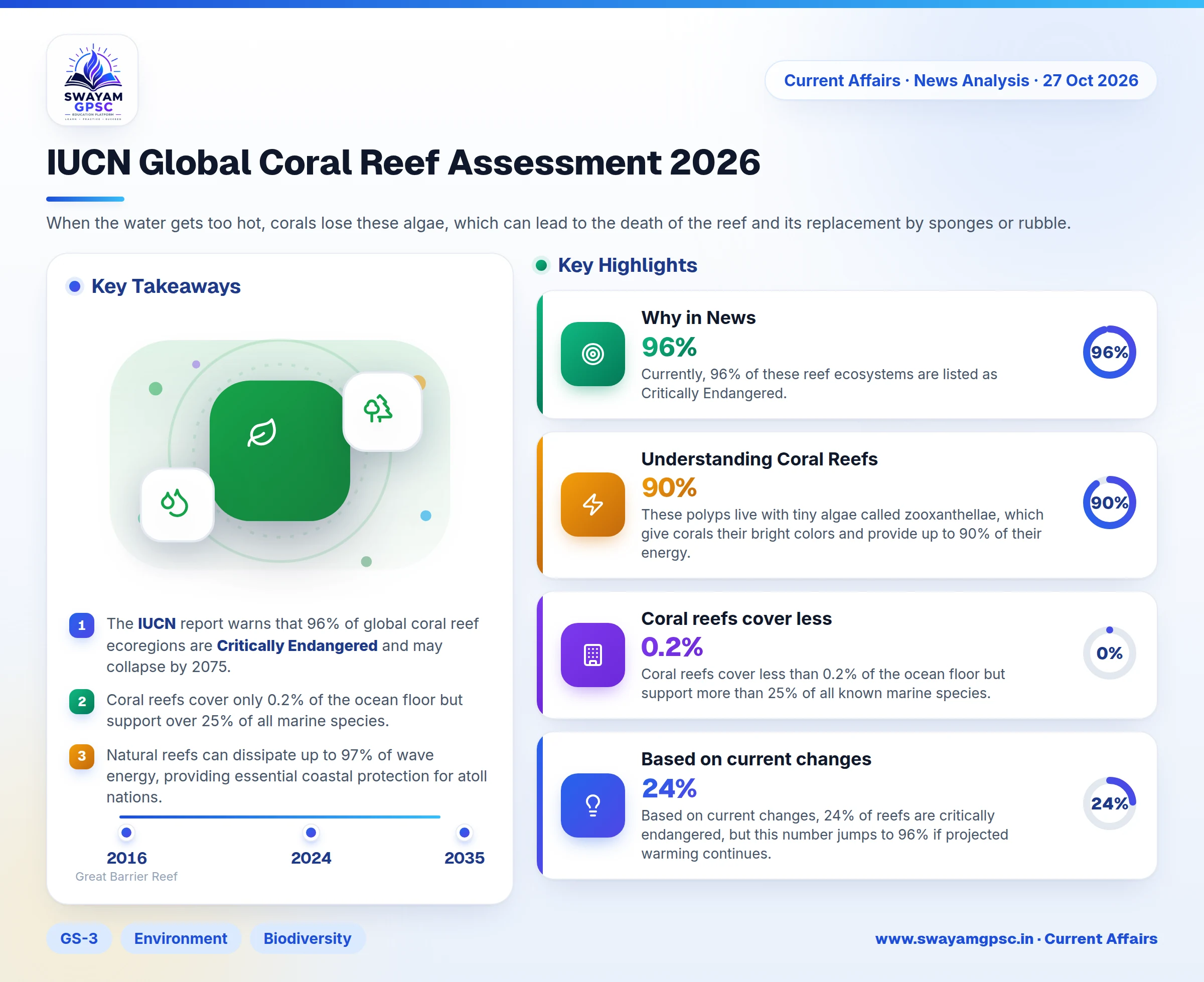
- The IUCN report warns that 96% of global coral reef ecoregions are Critically Endangered and may collapse by 2075.
- Coral reefs cover only 0.2% of the ocean floor but support over 25% of all marine species.
- Natural reefs can dissipate up to 97% of wave energy, providing essential coastal protection for atoll nations.
- India protects its corals through the Wild Life (Protection) Act, 1972, and MPAs in the Gulf of Kutch and Gulf of Mannar.
Why in News
- The IUCN presented its first global study on coral reefs during the UN Biodiversity Conference in Yerevan, Armenia.
- The report warns that almost all shallow-water coral reefs could collapse by 2075.
- Currently, 96% of these reef ecosystems are listed as Critically Endangered.
Understanding Coral Reefs
- Coral reefs are underwater structures built by tiny animals called coral polyps that produce calcium carbonate (CaCO₃).
- These polyps live with tiny algae called zooxanthellae, which give corals their bright colors and provide up to 90% of their energy.
- When the water gets too hot, corals lose these algae, which can lead to the death of the reef and its replacement by sponges or rubble.
Key Data and Statistics
- Out of 127 reef ecoregions, 122 are critically endangered, while the Western Galápagos ecosystem has already collapsed.
- Coral reefs cover less than 0.2% of the ocean floor but support more than 25% of all known marine species.
- Based on current changes, 24% of reefs are critically endangered, but this number jumps to 96% if projected warming continues.
- About 77% of reef regions are threatened by marine heat stress, and 63% suffer from overfishing.
Importance of Coral Reefs
- They act as vital breeding and nursery grounds for many sea creatures, including those in the Great Barrier Reef and the Coral Triangle.
- Reefs protect coastlines by acting as natural barriers that can block up to 97% of wave energy, which is crucial for low-lying atoll nations.
- They support the blue economy by providing food and jobs through fishing and tourism, especially in Southeast Asia.
- Scientists use coral organisms to develop medicines, including anti-cancer and anti-viral drugs like Ara-A, making them the ocean's medicine chest.
Conservation Initiatives
- The Kunming-Montreal Global Biodiversity Framework aims for 30x30 conservation targets and uses the IUCN Red List of Ecosystems for monitoring.
- The Global Coral Reef Monitoring Network (GCRMN) and ICRI work together to reach a $12 billion investment goal for reef resilience.
- In India, corals are protected under the Wild Life (Protection) Act, 1972, with protected areas in the Gulf of Mannar, Gulf of Kutch, and various islands.
- New technologies like Biorock, micro-fragmentation, and larval seeding are being used to regrow damaged reefs.
Challenges
- Marine heatwaves cause thermal bleaching, where corals expel their algae and starve, as seen in the Great Barrier Reef between 2016 and 2024.
- Overfishing of herbivorous fish, like parrotfish, allows algae to grow too fast and smother young corals.
- Pollution from farms and cities, along with dredging in places like Palk Bay and the Andaman Islands, blocks the sunlight corals need.
- Stressed reefs are more likely to suffer from diseases or attacks by predators like the Crown-of-Thorns Starfish.
Way Forward
- Countries must quickly reduce greenhouse gas emissions through updated 2035 Nationally Determined Contributions to stop ocean warming.
- We need to strictly protect thermal refugia, such as the Northern Red Sea and Bermuda, which naturally resist heat.
- Governments should ban the commercial fishing of key herbivore fish to help reefs recover naturally after bleaching.
- Investment should increase in selective breeding for heat-resistant corals and the use of larval cryobanking.
Conclusion
- Coral reefs serve as a primary warning sign for the health of our oceans.
- While local efforts to stop pollution and overfishing help, they are not enough without a global reduction in greenhouse gases.
- Immediate global action is the only way to ensure coral reefs survive beyond 2075.