Vikram-1 Rocket Launch: India's Private Space Revolution
#GS-3 #Science & Technology #Space #Economy #Infrastructure #Governance & Social Justice #Regulatory Bodies #Current Events #National
Why in News
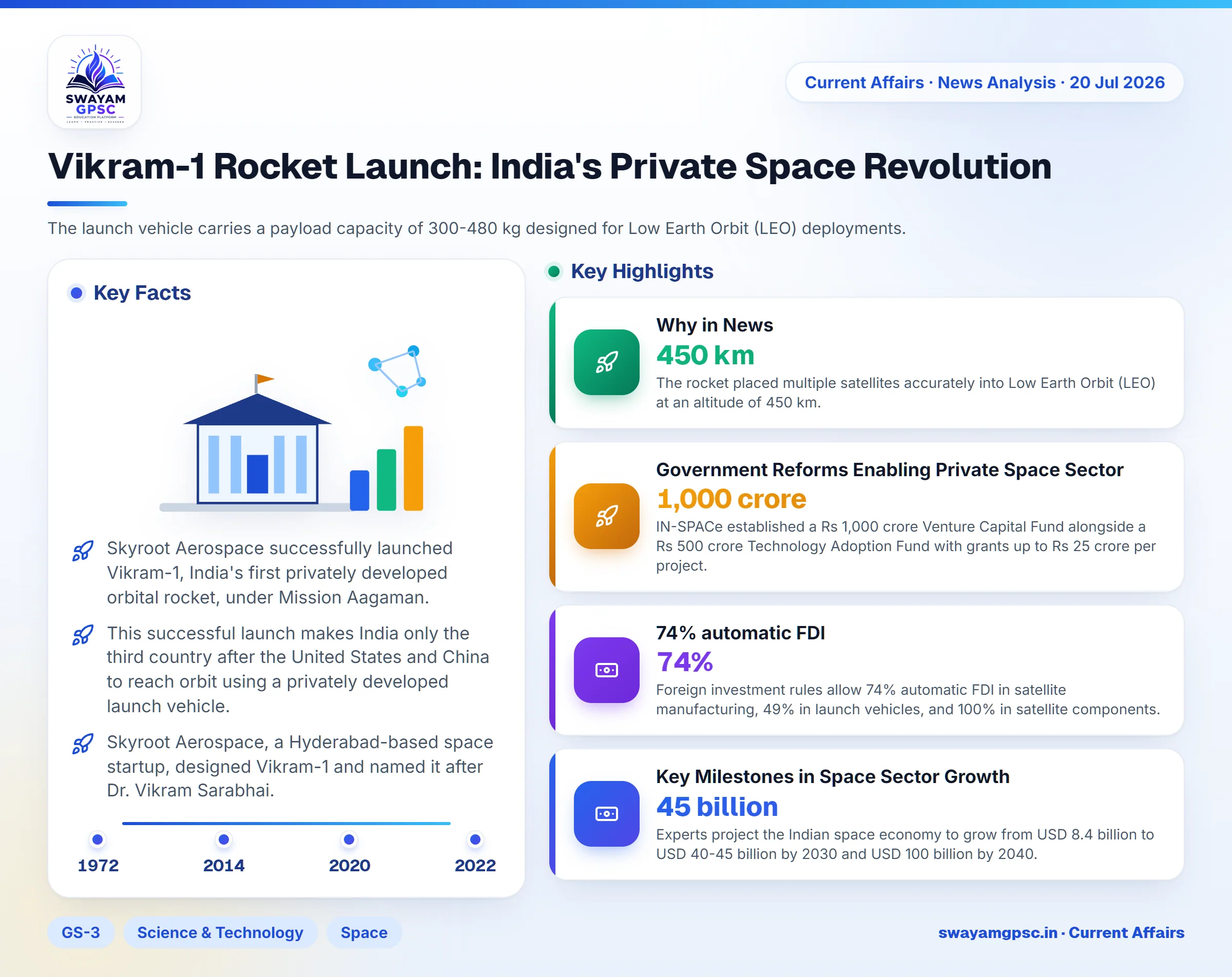
- Skyroot Aerospace successfully launched Vikram-1, India's first privately developed orbital rocket, under Mission Aagaman.
- The rocket placed multiple satellites accurately into Low Earth Orbit (LEO) at an altitude of 450 km.
- This successful launch makes India only the third country after the United States and China to reach orbit using a privately developed launch vehicle.
Key Features of Vikram-1 and Mission Aagaman
- Skyroot Aerospace, a Hyderabad-based space startup, designed Vikram-1 and named it after Dr. Vikram Sarabhai.
- The launch vehicle carries a payload capacity of 300-480 kg designed for Low Earth Orbit (LEO) deployments.
- Vikram-1 features an all-carbon composite structure, which substantially lowers total rocket weight and boosts payload capability.
- The rocket uses a 3D-printed liquid-fuelled Raman engine for upper-stage precision maneuvering alongside Kalam series solid propulsion boosters for lower stages.
- Mission Aagaman delivered customer satellites including SCOPE, SOLARAS S3, DCUBED, and the Embrace robotic debris-capture payload.
- The payload included symbolic items such as Cosmic Bloom artwork and an 18-karat gold micro-rocket carrying microscopic sculptures of C.V. Raman, Vikram Sarabhai, and A.P.J. Abdul Kalam.
Significance of the Vikram-1 Launch
- The flight confirms the success of space reforms started by the government in 2020 to invite private investments.
- It proves the operational capability of IN-SPACe and validates the strategic guidelines of the Indian Space Policy 2023.
- The launch transforms India from an ISRO-dominated model into a competitive public-private space market.
- Private capabilities allow ISRO to focus on major projects like Gaganyaan and deep-space research while startups handle small satellite launches.
Government Reforms Enabling Private Space Sector
- The Indian Space Policy 2023 permitted non-government entities to build satellites, launch rockets, and operate commercial services.
- The government designated NewSpace India Limited (NSIL) as the commercial branch of ISRO, which launched 141 satellites by July 2026.
- IN-SPACe functions as an autonomous single-window regulator providing startups access to ISRO launch pads and testing facilities.
- The IN-SPACe Seed Fund Scheme delivers financial support up to Rs 1 crore to space startups and small businesses.
- IN-SPACe established a Rs 1,000 crore Venture Capital Fund alongside a Rs 500 crore Technology Adoption Fund with grants up to Rs 25 crore per project.
- Foreign investment rules allow 74% automatic FDI in satellite manufacturing, 49% in launch vehicles, and 100% in satellite components.
Key Milestones in Space Sector Growth
- Active Indian space startups expanded rapidly from just 1 startup in 2014 to over 400 in 2026.
- Experts project the Indian space economy to grow from USD 8.4 billion to USD 40-45 billion by 2030 and USD 100 billion by 2040.
- NSIL successfully executed its first commercial LVM3 mission in 2022 by launching 36 OneWeb satellites.
- Skyroot Aerospace conducted the suborbital flight of Vikram-S in 2022, laying the foundation for orbital missions.
- Agnikul Cosmos launched its rocket in 2024 from its private launchpad Dhanush using a single-piece 3D-printed engine.
- IN-SPACe approved a private Earth Observation constellation led by Pixxel for climate and agricultural tracking.
- In 2026, ISRO transferred SSLV technology to HAL, while Bellatrix Aerospace developed an indigenous green propulsion system under DRDO support.
Challenges
- Launches face bottleneck issues because private companies depend almost entirely on the Sriharikota Spaceport.
- Indian startups use expendable rockets, making them less competitive against companies like SpaceX that use reusable rockets.
- The delay in passing a comprehensive Space Activities Act creates uncertainty regarding liability, insurance, and intellectual property.
- Startups face financial stress due to the absence of guaranteed long-term government procurement contracts.
- Indian companies encounter heavy global competition for radio spectrum and orbital slots managed by the International Telecommunication Union (ITU).
- Domestic manufacturing still relies on imported space-grade semiconductors, radiation-hardened components, and specialized sensors.
- Increasing satellite launches require better Space Situational Awareness (SSA) to prevent space debris hazards and cybersecurity threats.
Way Forward
- Parliament should pass a comprehensive Space Activities Act to offer clear laws on technology transfer and international liability under the 1972 Liability Convention.
- India should establish a specialized tribunal similar to TDSAT to resolve commercial space disputes and spectrum issues rapidly.
- The government should adopt an anchor customer model like NASA's COTS to grant long-term procurement contracts to private firms.
- Schemes like ADITI under iDEX should provide direct funding to startups for dual-use space technologies.
- The government needs to launch Production-Linked Incentive (PLI) schemes for manufacturing space-grade electronics and carbon composite materials locally.
- Authorities must speed up construction of the Kulasekarapattinam Spaceport and build regional Space Manufacturing Parks.
- Space agencies and startups must collaborate to build Reusable Launch Vehicles (RLV) and Next Generation Launch Vehicles (NGLV).
- India should leverage international platforms like the US-India iCET and the Artemis Accords to secure global supply chain opportunities.