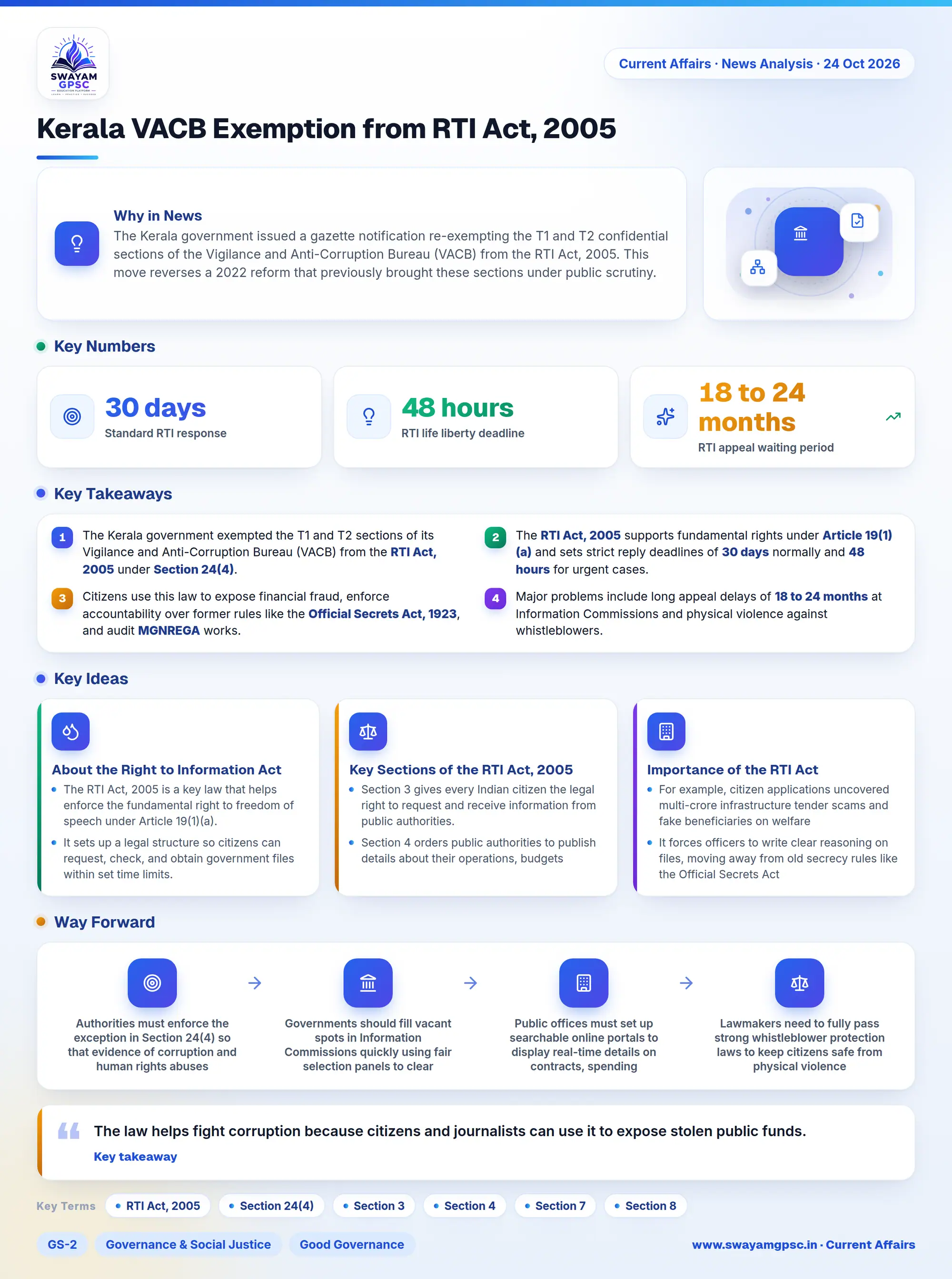
Kerala VACB Exemption from RTI Act, 2005
#GS-2 #Governance & Social Justice #Good Governance #E-Governance #RTI #Current Events #National #Transparency and Accountability #Vigilance
Key takeaways
- The Kerala government exempted the T1 and T2 sections of its Vigilance and Anti-Corruption Bureau (VACB) from the RTI Act, 2005 under Section 24(4).
- The RTI Act, 2005 supports fundamental rights under Article 19(1)(a) and sets strict reply deadlines of 30 days normally and 48 hours for urgent cases.
- Citizens use this law to expose financial fraud, enforce accountability over former rules like the Official Secrets Act, 1923, and audit MGNREGA works.
- Major problems include long appeal delays of 18 to 24 months at Information Commissions and physical violence against whistleblowers.
- The way forward requires filling commission seats quickly and applying the anti-corruption proviso under Section 24(4) to keep investigative files open.
Why in News
- The Kerala government issued a gazette notification re-exempting the T1 and T2 confidential sections of the Vigilance and Anti-Corruption Bureau (VACB) from the RTI Act, 2005.
- This move reverses a 2022 reform that previously brought these sections under public scrutiny.
- The state government invoked Section 24(4) of the Act to justify the decision.
- Officials stated that the exemption is necessary because these units handle sensitive files and top-security personnel documents.
About the Right to Information Act, 2005
- The RTI Act, 2005 is a key law that helps enforce the fundamental right to freedom of speech under Article 19(1)(a).
- It sets up a legal structure so citizens can request, check, and obtain government files within set time limits.
- This law aims to create open governance, public institutional accountability, and total transparency.
Key Sections of the RTI Act, 2005
- Section 3 gives every Indian citizen the legal right to request and receive information from public authorities.
- Section 4 orders public authorities to publish details about their operations, budgets, and functions automatically to cut down on formal applications.
- Section 7 requires Public Information Officers to reply within 30 days, or within 48 hours if the request involves life or personal liberty.
- Section 8 lists reasons to refuse information, such as protecting national security, intellectual property, or trade secrets.
- Section 24 allows central and state governments to keep security and intelligence agencies out of the law's reach.
Importance of the RTI Act
- The law helps fight corruption because citizens and journalists can use it to expose stolen public funds.
- For example, citizen applications uncovered multi-crore infrastructure tender scams and fake beneficiaries on welfare lists.
- It forces officers to write clear reasoning on files, moving away from old secrecy rules like the Official Secrets Act, 1923.
- For example, citizens track delayed pension files, land records, and licenses directly without paying bribes to middlemen.
- It helps poor citizens check if they are receiving their full statutory benefits from social security programs.
- For example, rural women checked local ration shop records to prove that grain was stolen under the National Food Security Act.
- It gives local communities the proof they need to check government work and hold public audits.
- For example, Gram Sabha members used attendance rolls to verify actual physical work done against money paid under MGNREGA.
Challenges in Enforcing the RTI Act
- Governments are using Section 24 more often to hide specialized investigative units behind complete secrecy.
- For example, Kerala exempted the T1 and T2 units of the VACB, making high-level political corruption records private.
- Long delays in filling empty seats in Information Commissions have built up huge backlogs of pending appeals.
- For example, state commissions have thousands of pending second appeals, making citizens wait 18 to 24 months for a hearing.
- Activists face physical threats and attacks because there is no strong, official system to protect whistleblowers.
- For example, local activists suffered violence after using public records to expose illegal sand mining and land theft.
- Public authorities ignore Section 4 rules, leading officers to reject simple requests using weak excuses.
- For example, officers often reject applications by simply claiming exemptions under Section 8(1)(j) without any real proof.
Way Forward
- Authorities must enforce the exception in Section 24(4) so that evidence of corruption and human rights abuses remains public.
- Governments should fill vacant spots in Information Commissions quickly using fair selection panels to clear old appeals.
- Public offices must set up searchable online portals to display real-time details on contracts, spending, and job transfers.
- Lawmakers need to fully pass strong whistleblower protection laws to keep citizens safe from physical violence and state harm.
Conclusion
- Exempting anti-corruption units highlights the ongoing balance between keeping secret files safe and letting citizens monitor government actions.
- While police sources need protection, giving complete secrecy risks hiding wrongdoings and weakening public trust.
- Balancing secrecy exceptions with proactive public disclosures is necessary to keep this law effective for honest governance.